
Milwaukee commission designates 140 W. Garfield Ave. a local historic landmark over owner objections
Get AI-powered insights, summaries, and transcripts
Subscribe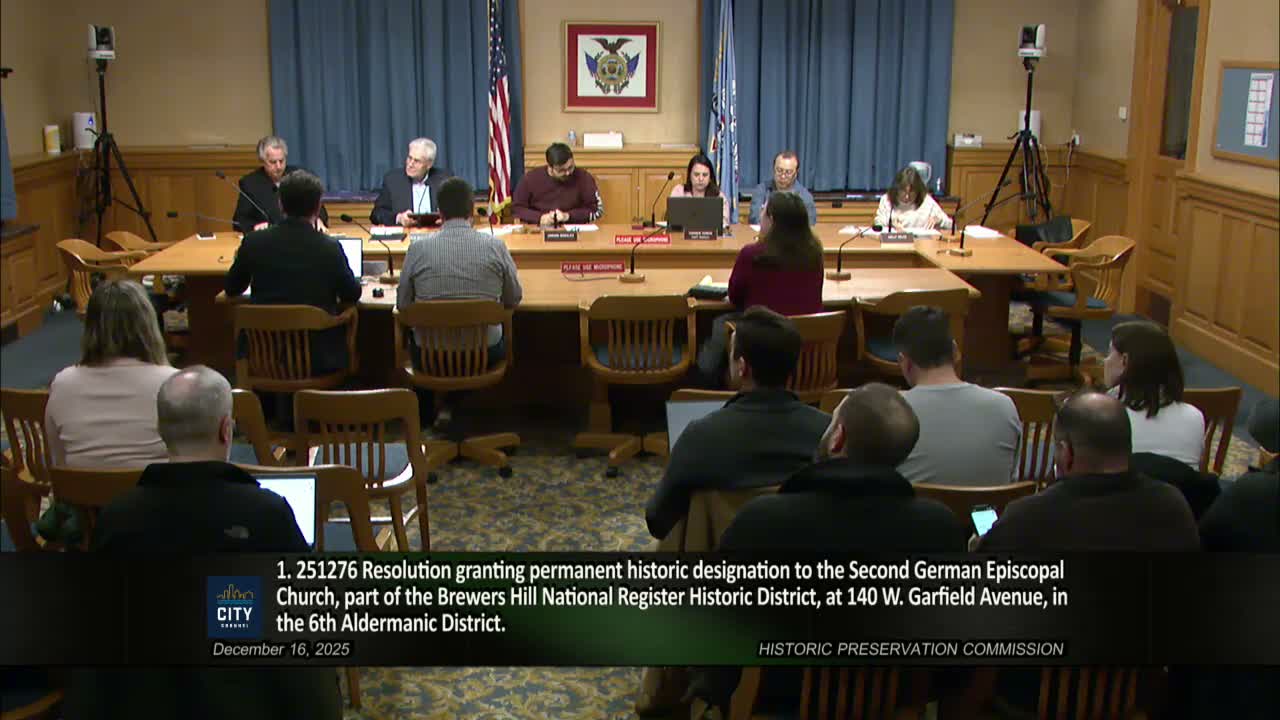
Summary
The Milwaukee Historic Preservation Commission voted to designate the Second German Episcopal Church (also called Epworth Methodist) at 140 West Garfield Avenue as a local historic landmark after hearing owner concerns about repair costs and neighborhood advocates’ warnings about demolition risk.
The Milwaukee Historic Preservation Commission voted to grant local historic designation to the Second German Episcopal Church at 140 West Garfield Avenue, finding the building meets the ordinance criteria cited in the staff report.
Staff presented the church’s history and architectural significance, telling the commission the congregation moved to the Brewers Hill site in the late 19th century, hired local architect Hermann Paul Schnetzky, and later engaged Hugo Heuser for renovations. The staff recommended designation under criteria f1, f5, f6 and f9 because of the building’s cultural role, Gothic Revival character and association with neighborhood development and civil-rights activity.
At the public hearing, owner Ryan Patty said the process had increased repair and maintenance uncertainty and that returning to former window configurations could cost “300 plus thousand dollars” while less exact alternatives might still run “probably a $100,000” — a core reason he asked the commission to postpone a decision so stakeholders could continue negotiations. Emma Rudd of the Milwaukee Preservation Alliance said her organization supports designation but asked for more stakeholder discussion; she apologized after neighbors said an attorney’s email from an MPA volunteer’s firm had given the wrong impression.
Historic Brewers Hill Association president Kristen Lobs and other neighbors urged immediate designation. Rachel Markin said a previously filed raise (demolition) permit had been withdrawn but that protections short of designation had already failed to prevent the loss of original stained glass and other historic fabric. "The sole issue today is whether this building satisfies any of the criteria set forth in the ordinance," Lobs told the commission, urging the body to focus on the ordinance criteria rather than cost trade-offs.
Commissioners debated whether an additional month would change the historic facts; several members noted tax-credit incentives exist but would not remove the commission’s responsibility to evaluate eligibility. Alderman Robert Baumann moved to adopt the staff recommendation; the motion passed on a voice vote and the commission declared the property locally designated.
The designation affects exterior review through certificate-of-appropriateness procedures; the commission noted it could add clarifying language about stained-glass requirements in the designation paperwork but said it lacked power to require interior features. The commission also encouraged the owner and neighborhood groups to continue discussions about feasible preservation options and possible financial incentives for sensitive rehabilitation.
The ordinance-based designation is now in place; next steps for the owner may include working with staff on potential deed-restriction options, pursuing incentives or adjusting future COA applications to reflect the designation.