Committee weighs requiring laser scans before demolition for historic properties
Loading...
Summary
University of Wisconsin–Milwaukee preservation experts and city staff discussed a pilot program to require laser scanning of historically designated properties before demolition. Presenters estimated modest per-project costs for homes and higher costs for large complexes and proposed limiting any requirement to local historic-designation cases.
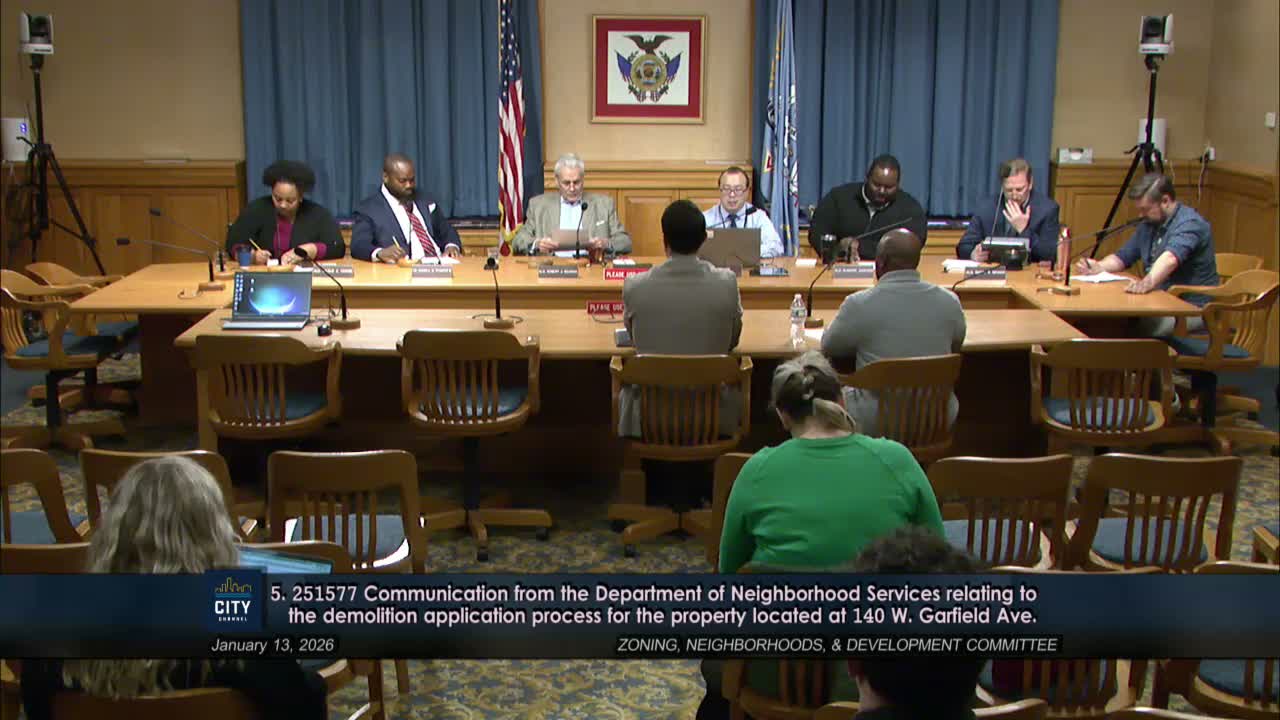
University of Wisconsin–Milwaukee preservation faculty and Department of Neighborhood Services staff brought a proposal to preserve digital records of buildings before demolition to the Jan. 13 committee.
Matt Sherris, director of the UWM Historic Preservation Institute, described laser scanning and “point cloud” documentation as a way to preserve a three-dimensional record of architecturally significant buildings. He cited national cases in which prior scans aided restoration after fire and argued the city should use local academic capacity to retain permanent records when demolition is unavoidable.
Sherris and colleagues said exterior scans of a typical house often take a half-day; small, simple projects can cost roughly $1,000–$5,000, more complicated buildings can require multiple days, and very large industrial complexes can cost tens of thousands. Presenters suggested a pilot limited to locally designated historic properties or demolition within local historic districts to narrow costs and administration.
Department of Neighborhood Services staff outlined the current demolition-permit process: anyone can file an application, but an application moves through multiple checks before issuance — environmental review, utility disconnect notifications, required holds (generally about 26 days for voluntary demolitions, with an extra 30-day hold when historic designation applies), bonding and insurance requirements, and other submittal criteria. Staff said owners registered on the department’s eNotify system receive notices tied to permit processing.
Committee discussion focused on who would pay for scans and who would retain the data. Sherris proposed cloud storage (UWM or other platforms such as Sketchfab) and suggested the city could retain submitted scans as part of the public record; staff agreed a submission requirement could be written into the permit package but noted storage and platform costs would need budgeting.
Members asked staff to draft an approach that limits requirements to historically designated properties or historic districts, explores a city–UWM partnership for reduced rates or in-kind scanning, and models program costs. Several members flagged safety and access concerns for badly deteriorated buildings and said exterior-only scanning could reduce risk.
What’s next: Staff and the preservation institute will draft a file for a pilot proposal, focusing on historically designated properties and discussions with city IT about storage and access.