County-funded feasibility study for 30th Street rail corridor advances; ownership, transit role remain contested
Loading...
Summary
Milwaukee and county officials outlined a county-managed feasibility study, funded by a WisDOT TAP grant, to explore a 7-mile 30th Street rail-and-trail corridor. Committee members pressed for clarity on ownership, access and whether commuter-rail options should be studied alongside a bike-and-pedestrian trail.
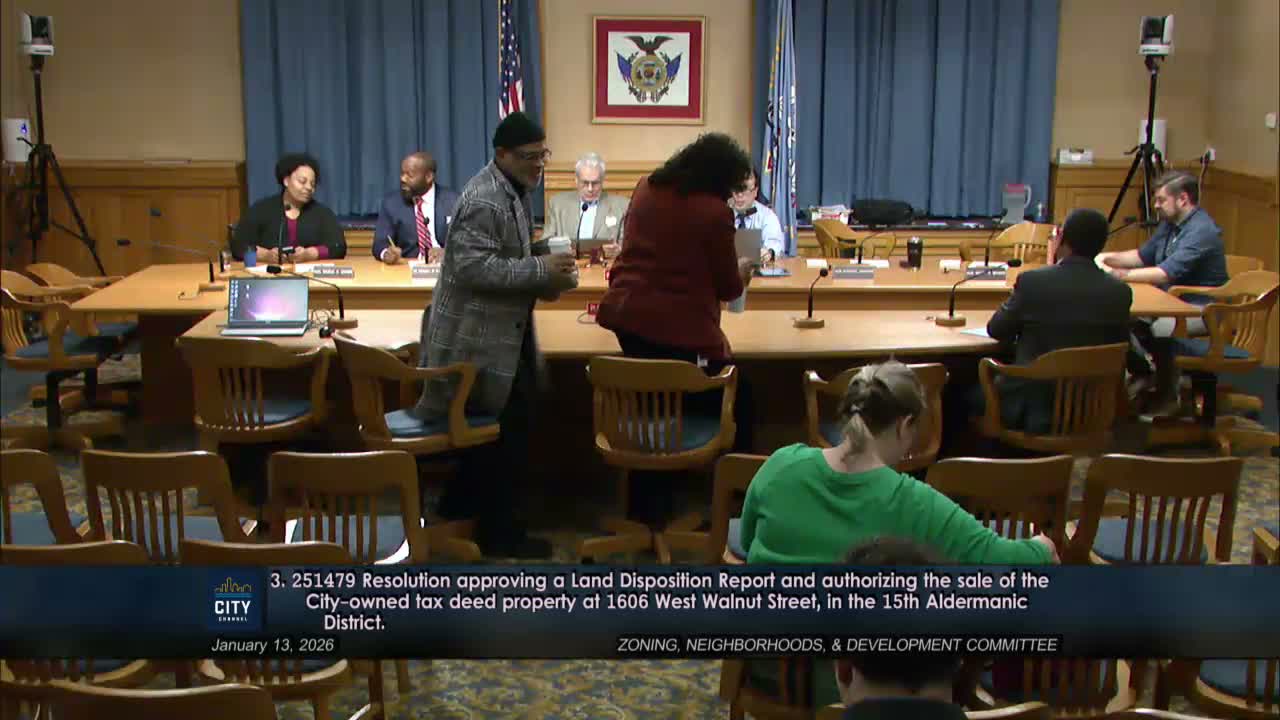
Milwaukee aldermen and county planners debated the scope and potential of a county-led feasibility study of the 30th Street rail corridor at the Jan. 13 meeting of the Zoning, Neighborhoods and Development Committee.
Daniel Park, a transportation planner with the Milwaukee County Department of Transportation, told the committee the county is leading the study and that the work is funded by a WisDOT TAP grant (the presenters cited a $700,000 award). Park said the county’s role is to assess bicycle-and-pedestrian options that touch city streets, and to coordinate public engagement in a corridor that crosses city property and privately owned rail right-of-way.
“This is a county project, funded by the county, not a city project,” Park said, urging city council members to participate in public-engagement events planned for February and spring 2026.
Alderman Bauman and several colleagues pressed presenters on a recurring concern: ownership and access to the privately held rail right-of-way. Bauman said the rail company has declined to sell the corridor and that ownership is the predicate for many follow-up steps, including engineering and funding for construction. “Without ownership, everything is tough,” Bauman said.
City legal and planning staff framed the county study as an early-stage feasibility analysis with a narrow statutory scope. The city attorney and DPW staff said the grant terms limit the present work to the feasibility of a bicycle-and-pedestrian trail within the rail right-of-way and whether on-street alternatives would be needed in ‘pinch’ locations. They also cautioned that acquiring property or pursuing condemnation is not in the present study scope.
Several aldermen pushed a broader approach. Some said the corridor’s long-term public value could include commuter-rail, expanded freight access or mixed uses adjacent to stations, and urged planners to preserve space for future rail options even while preparing trail designs. Committee members and staff discussed parallel funding strategies, including seeking additional federal or state funds to study transit options and station planning concurrent with trail design.
Presenters said the feasibility study will map ownership, inventory structural constraints (bridges, underpasses and at-grade crossings), analyze alternatives and produce a mid-2027 target for study completion. The county and consultant teams will run a public-engagement program, form technical and public advisory committees, and hold a first public meeting on Feb. 24, 2026. Staff emphasized that the corridor touches multiple owners — WATCO, Wisconsin Southern and Canadian Pacific/CP — and that rights and operating needs differ across segments.
The committee did not take a vote on the work plan itself, but members asked to be included in upcoming community outreach and urged county and state partners to preserve options for rail, transit and development while the trail work proceeds.
What’s next: Round 1 public engagement is planned for Feb. 24; further technical analysis and alternative development are scheduled for spring and summer 2026, with study completion anticipated in mid-2027.