
Committee hears report recommending formal sister‑state program; draft bill to be placed on agenda
Get AI-powered insights, summaries, and transcripts
Sign Up Free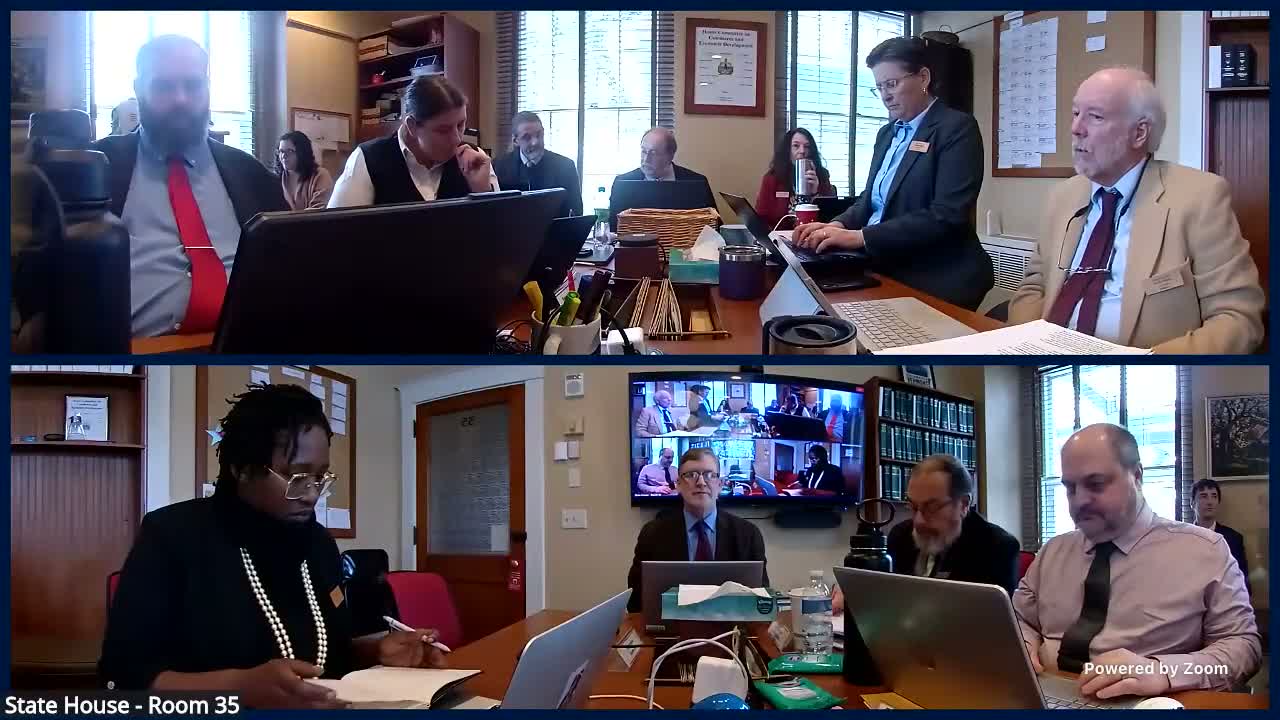
Summary
A legislative working group recommended creating a formal sister‑state program with an application process and periodic review; the committee agreed to place a draft bill on a future agenda for testimony and consideration. Funding and local sponsor capacity were identified as key implementation issues.
The Belmont House Committee on Commerce & Economic Development on Jan. 8 heard a report from a legislative working group that recommends creating a formal sister‑state program and drafting a bill to establish application, selection and review processes.
Tim Tiani, a state employee who led the working group’s presentation, told the committee the group met monthly after being formed during the 2024 legislative session and produced a report with concrete recommendations. “This working group…was one of those enjoyable things I’ve done as a state employee,” Tiani said, describing the group as “thoughtful” and “thorough.” He said the group recommends forming a selection committee, establishing scoring criteria for applications, and instituting periodic reviews to ensure relationships remain active.
The report drew on other states’ models, Tiani said, citing Hawaii as an application model and noting that several programs rely on diaspora communities and local partners to sustain exchanges. Committee discussion emphasized that local nonprofit or community sponsors should carry long‑term responsibility for hosting and maintaining relationships while state staff would vet applications and provide administrative support. “There has to be someone in the state, a group, that wants to sponsor it and that wants to take on that role,” a committee member said.
Tiani also flagged practical considerations: the National Guard’s state partnership program with countries such as North Macedonia, Senegal and Austria was described as an adjacent model the state has used for training and economic ties. He noted examples of economic connections — “almost all of our biomass wood heat furnaces and boilers are made in Austria” — and said that targeting partners with clear cultural or economic ties could yield mutual benefit. The working group recommended a periodic evaluation cycle (participants suggested roughly every five years) to assess whether relationships remain valuable.
On finance, Tiani told the committee that funding questions came up repeatedly during the group’s work. “Funding came up all the time… it really did come from mostly private groups,” he said, adding that hosting delegations and events has real costs that local organizers and sponsors will likely need to cover. Committee members linked that point to earlier conversations about venue capacity and the ability to host visiting delegations.
Committee members said a draft bill based on the working‑group report exists and invited cosponsors. The committee agreed to place the draft bill on a future agenda and schedule testimony; no formal vote on the bill occurred at the meeting. An attendee’s anecdote about the Army National Guard band’s travel to Austria underscored the cultural exchanges the working group cited.
The committee concluded by thanking working‑group members and staff and agreed to return the draft bill for formal testimony and consideration at a subsequent meeting.