
State officials say CHIP guidance ready to launch; portal and trainings coming this month
Get AI-powered insights, summaries, and transcripts
Subscribe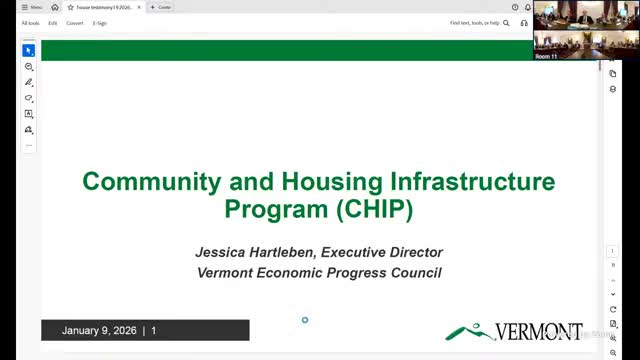
Summary
At a Jan. 9 joint legislative hearing, council staff said guidance for the CHIP tax-increment financing program is set to launch later this month, with an intake portal and trainings to help municipalities apply. Lawmakers pressed officials on definitions, compliance, and verification for primary-residence requirements.
At a Jan. 9 joint hearing of three House committees, state and municipal officials described the rollout plan for the new CHIP program and the council guidance that will govern it. Jess Hartleben, presenting for the council, said CHIP is "on track to launch later this month," the online pre-application interest form is live and staff have been testing the portal and software that will collect municipal applications.
The hearing focused on how the guidance implements Act 69’s statutory requirements. Hartleben told lawmakers the council formed a CHIP subcommittee that drafted the guidance and that the full council adopted the guidelines at its Oct. 22 retreat. She said the council hired a full-time CHIP staff member on Nov. 3 and submitted a report on the definition of a housing development site to the committees on 12/15/2025; the council voted not to change that statutory definition at this time to reduce administrative burden.
Under the guidance explained to legislators, municipalities are the applicants for CHIP projects and must submit a housing development plan, a housing development site and a housing infrastructure agreement. Hartleben described the infrastructure agreement as the “meat” of a CHIP project, a legally binding contract between the municipality, sponsor and developer that will set finance terms, affordability commitments, unit counts and timelines.
The guidance preserves two routes for project eligibility. A project may meet a 60% floor-area threshold of housing reserved for primary residences, or it may "meaningfully address the purpose of the program" even if it does not meet that 60% threshold. Hartleben emphasized that "all housing units must be for primary occupancy" for the duration of the infrastructure indebtedness and that verification will rely on tools the statute requires, such as homestead declarations or landlord certifications.
Officials also described the expected finance mechanics. New development raises grand-list values, generating tax increment that municipalities may retain and share with the state to repay infrastructure debt; those revenues then repay the infrastructure financing and later revert to the education fund. Hartleben summarized retention rates discussed in the guidance: projects must retain at least 85% of municipal tax increment, municipalities may retain up to 100% of municipal tax increment, and education tax increment caps differ by housing type (the guidance cites caps of 75% for market-rate housing and 85% for affordable and moderate-income housing).
Lawmakers asked how the council will define terms such as "luxury housing," how the council will prioritize applications if demand is heavy, and how the tax-increment calculations will be verified. Hartleben said the council had not adopted a formal definition for "luxury housing" and that prioritization is not in place at launch but could be considered later. She said tax-increment calculations will be modeled in portal spreadsheets and verified by Department of Taxes staff before applications come to the council.
Hartleben and others said the council must provide a written denial and remediation path when an application is rejected and that the statute requires the council to provide an answer within 90 days of a site visit. The council will monitor operations and return to the legislature if guidance changes are necessary. The hearing closed with lawmakers thanking council staff and partners for rapid work to implement the new program.
The next procedural step identified in the hearing was broader reporting back to the legislature: staff said they expect initial reporting deadlines in the 2026–2027 cycle and suggested a check-in hearing in March to update committees on early portal intake and pre-application activity.