
House approves technical corrections to judicial precinct maps; bill passed 112-0
Get AI-powered insights, summaries, and transcripts
Subscribe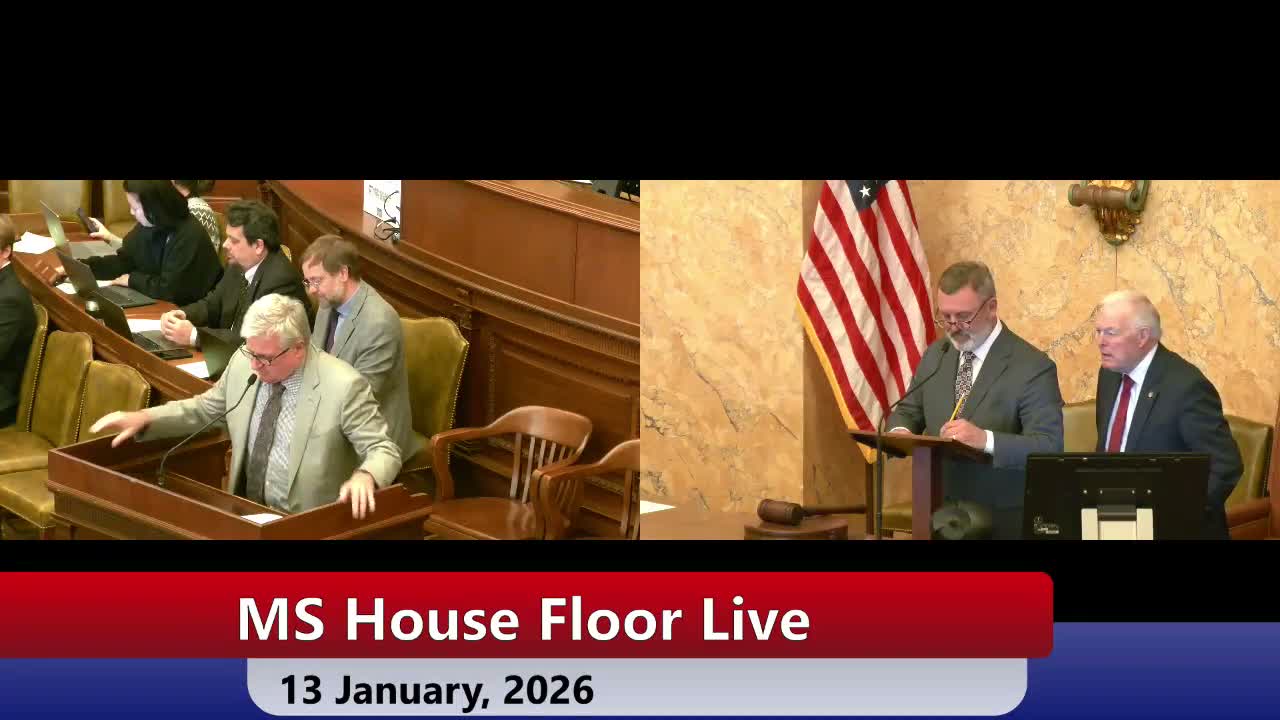
Summary
The Mississippi House passed a bill to correct circuit and chancery court precinct placements — restoring certain precincts to their original subdistricts and addressing overlaps caused by a CCID — after members sought clarification about the number of judges on affected ballots and qualifying deadlines; the measure passed 112-0 and was immediately released to the Senate.
The Mississippi House of Representatives voted unanimously to pass a technical redistricting bill affecting circuit and chancery court precincts, restoring precincts that were shifted by recent census-block updates and addressing precinct overlaps tied to a local CCID in Hinds County.
A representative explaining the measure said the bill "corrects that, puts those precincts back in the original subdistrict," describing the changes as "technical" fixes to maps altered after census updates. He told the chamber the bill returns certain precincts to their prior subdistrict alignments and resolves issues where creation of a CCID had removed precincts from existing judges' districts.
Why it matters: The adjustments affect which judicial contests appear on some voters' ballots and, for one limited period while the CCID exists, can create overlapping contests where some precincts vote for two judges. Lawmakers said the changes do not create new permanent judgeships but restore prior precinct alignments; the CCID judge was described on the floor as "a regular circuit judge" with civil and criminal responsibilities.
Members pressed for practical details. One lawmaker asked whether the Seventh Circuit would have six judges including the CCID judge; the floor explanation confirmed that, during the CCID period, impacted areas would see an overlapping count that results in six judgeships for the circuit while the CCID judgeship is in place. Another member asked how many judicial contests Hinds County voters would face; the representative estimated roughly a dozen contests based on prior calculations but acknowledged he had not recalculated the exact number for the current year.
There was also discussion of qualifying deadlines. A questioner noted judicial qualifying opens in January; the representative said the bill’s language makes it effective upon passage and that, depending on when it reaches the governor, it could affect qualifying deadlines for the affected districts. He added lawmakers had a commitment from the Senate to move the bill quickly; on the floor he also said that, if enacted and processed before the qualifying cutoffs, the qualifying deadline for affected districts would remain unchanged.
After debate and questions, the House moved to final passage. The clerk recorded a vote of 112 yeas and 0 nays. The representative requested immediate release of the bill to the Senate; the Speaker announced no objection and the bill was released to the Clerk’s office for transmittal.
Next steps: The bill was sent to the Senate for consideration. Because the changes described on the floor were characterized as technical map corrections, proponents said the measure’s purpose was to restore prior precinct alignments and to avoid inadvertent changes to judges’ subdistricts caused by prior mapping updates.