Citizen Portal

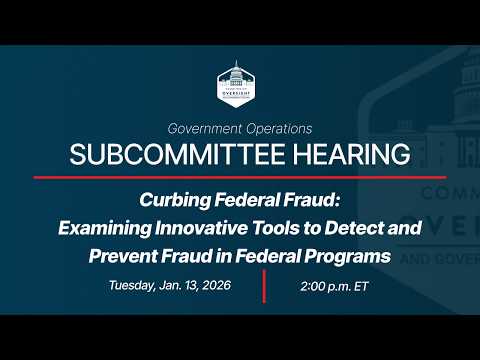
House Oversight subcommittee hears PRAC, Treasury and GAO on AI and data-sharing to prevent fraud

Subcommittee on Government Operations, House Committee on Oversight and Accountability · January 6, 2026

Get AI-powered insights, summaries, and transcripts

Subscribe
AI-Generated Content: All content on this page was generated by AI to highlight key points from the meeting. For complete details and context, we recommend watching the full video. so we can fix them.

Summary

Witnesses told a House Oversight subcommittee that data analytics, interagency data access and responsibly applied AI can flag fraud before payments are made; Treasury urged statutory access to key datasets and GAO stressed data quality and workforce training.

WASHINGTON

Lawmakers and government investigators on the House Oversight subcommittee on government operations on Wednesday pressed officials on the scope and limits of tools meant to detect and stop fraud in federal programs before payments are made.

Chairman Sessions opened the hearing by citing recent large-scale schemes and saying the panel would consider making the Pandemic Response Accountability Committee permanent. ‘‘Finding a solution is a very important thing,’’ he said in his opening remarks, and later signaled he will introduce legislation to address PRAC's long-term status.

Ken Diefenbach, executive director of the Pandemic Response Accountability Committee, described the office's work with large datasets and analytics. Diefenbach said PRAC operates on roughly $18.5 million a year, has helped recover ‘‘over $500,000,000 for the taxpayer,’’ and has issued alerts that identified ‘‘over $79,000,000,000 in potential fraud’’ that could have been prevented by pre-award vetting. He also described an AI-enabled fraud-prevention engine trained on pandemic-era applications that, he said, ‘‘would have flagged at least tens of billions of dollars in fraudulent claims for further scrutiny.’'

A senior Treasury official described Do Not Pay's role as a front-line tool for certifying officers, grant managers and caseworkers. Treasury said Do Not Pay has limits because it cannot always verify tax identification numbers, Social Security numbers, or confirm financial status without statutory access to other federal data sources. The official told the committee Treasury supports legislation to expand certain authorities, noting Congress recently passed an extension of some access and that additional authority "would help Treasury fully achieve its objectives."

Treasury also highlighted Do Not Pay's program-level results: the agency said parity and backend matching prevented and recovered $1.3 billion in duplicate payments through state matching and that adding death data identified $156 million in one month among 19 states that subscribed.

Sterling Thomas, GAO's chief scientist, urged lawmakers to prioritize data quality and the federal workforce needed to run analytics responsibly. GAO told the committee the federal government reported an estimated $162 billion in payment errors or improper payments during fiscal 2024 and cautioned that AI systems require ‘‘ground truth data and a human in the loop’’ to avoid producing poor outcomes.

Committee members pressed witnesses on where statutory or technical barriers block pre-payment checks. Ranking Member Mfume and others repeatedly raised the Privacy Act and legacy IT systems as impediments and asked whether Congress should create narrow exceptions for fraud investigations or provide incentives to modernize agency systems.

Witnesses offered practical steps for members: piloting state partnerships with PRAC and Treasury tools, expanding Do Not Pay's high-value datasets, building program-level fraud risk assessments that feed analytics, and creating training pipelines for analysts. Diefenbach urged using PRAC's accumulated pandemic data to create repeatable indicators of risk; GAO recommended a permanent analytics center and a public sector training pathway for data specialists.

The committee did not vote on legislation at the hearing. Members were given five legislative days to submit materials for the record; Chairman Sessions said he plans to introduce bills to make PRAC's analytic capacities permanent.

The subcommittee adjourned after the witnesses answered members' questions and agreed to provide additional reports and examples to the committee for follow-up.