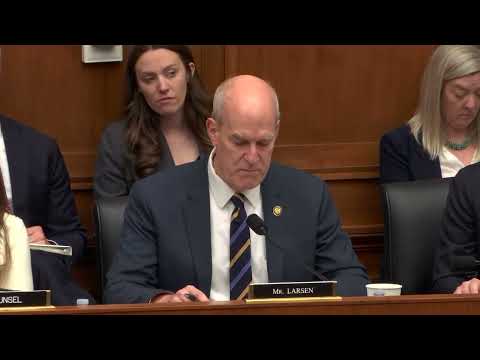
Lawmaker touts Coast Guard seizures, cites IUU fishing numbers and urges balance with search-and-rescue
Loading...
Summary
A committee member praised recent Coast Guard operations that intercepted shadow-fleet oil tankers and cited enforcement figures for fiscal years 2023–24, while asking witnesses how the service will keep core missions such as search and rescue from being neglected.
Mr. Larson (role not specified in transcript) opened remarks at the committee hearing by praising the Coast Guard’s law-enforcement role, saying, “Every day, the women and men of the Coast Guard coordinate and execute law enforcement operations to halt illicit activities, to protect lives, and to safeguard the interests of The US.”
He noted a range of missions — from drug and migrant interdiction to enforcement against illegal, unreported and unregulated (IUU) fishing — and highlighted recent operations targeting shadow-fleet oil tankers. “By violating international law, these vessels and their operators become subject to search and seizure by the Coast Guard,” he said, framing the seizures as an exercise of longstanding authority conducted in coordination with other agencies and international partners.
Mr. Larson described what he called a broader dark-fleet problem, saying hundreds of commercial vessels operate in violation of fishing and labor laws and, in some cases, participate in trafficking. He said IUU fishing strains fish stocks and undercuts lawful fishers in his district, and identified regions where many cases are found, including Oceania, Alaska and the Aleutians.
Citing figures he attributed to the Coast Guard for fiscal years 2023–24, Mr. Larson said roughly 40% of detected fishing vessels were conducting IUU fishing within the U.S. Exclusive Economic Zone (EEZ), that the service interdicted about 21% of detected vessels, and that the Coast Guard boarded 274 fishing vessels on the high seas or within foreign EEZs, resulting in 75 violations. He said additional resources could improve those results.
He closed his opening remarks by stressing the human costs of these operations and asking witnesses to identify how the service will preserve core missions and improve conditions for personnel. “I look forward to hearing, from our witnesses today on ways to improve the lives of [Coast Guard personnel] serving at sea who are conducting these law enforcement missions, and how we can continue to support and improve the service,” he said. With that, he yielded back.
No motions or formal votes were recorded in the provided transcript segments.