Get Full Government Meeting Transcripts, Videos, & Alerts Forever!
Get email alerts on the Employer Childcare topic
No spam. Unsubscribe anytime.
Employers describe on-site and employer-partnered child care as retention tool; lawmakers debate role of Section 45(f) tax credit
Summary
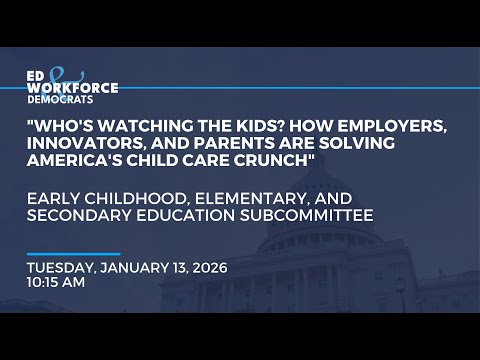
Witnesses told the House Education and Workforce Committee that employer-run or employer‑supported childcare can improve retention, reduce absenteeism, and expand access in some communities, while witnesses and members warned that tax credits alone cannot replace large-scale public investment.
Employers and provider representatives told the House Education and Workforce Committee that employer‑sponsored child care programs can stabilize workforces and expand access for employees, but both witnesses and Democratic members said such programs are not a substitute for broader federal investment.
Hayden Paulcino Hensley, co‑founder of Red Rooster Coffee, described creating Yellow Hen Childcare in Floyd, Virginia after long local wait lists and costs made care unaffordable for employees. Hensley said Yellow Hen began with about 10 children, served as many as 24, and initially charged $1 an hour while the coffee business subsidized the program “at nearly $90,000 a year.” He said the program produced strong retention — many workers stayed five years or more — and cited one example: “India DiPietro… at 21 became a single mother… Yellow Hen made it possible for her to return to her job,” and she later became a managing partner.
Alex Grover, chief executive of I2M, said her manufacturing company launched an employer‑facilitated program in 2022 that contracts with a local provider, offsets costs, and expands hours to fit non‑9‑to‑5 shifts. Grover framed the choice as strategic: “childcare is a business decision,” she said, and added that an expanded Section 45(f) employer childcare tax credit that allows pooling and intermediaries makes participation realistic for small and mid‑sized firms.
Marylou Burke Afonso, chief operating officer of Bright Horizons, described several employer models — on‑site centers, near‑site partnerships, sliding‑scale tuition subsidies and backup care — and said her organization partners with roughly 1,400 employers across industries. She emphasized workforce supports and professional development and argued employer partnerships can complement public programs while noting they do not replace them.
Witnesses and several Democratic members raised limits of tax credits as a stand‑alone solution. Amy K. Matsui of the National Women’s Law Center argued employer tax credits historically reached “fewer than 1% of corporate tax returns” and do not by themselves raise wages for early educators or scale supply across communities. Lawmakers pressed for implementation details: several members urged IRS guidance so small businesses could navigate upfront costs and credit execution.
The committee heard practical barriers employers confront: finding suitable space, recruiting licensed staff, and shouldering large upfront buildout and operating costs. Hensley and others said those realities mean tax credits alone may not be enough for many small employers; Hensley told members Yellow Hen did not use Section 45(f) when it started and cautioned that “the upfront cost is pretty prohibitive.”
The hearing concluded with members from both parties acknowledging employer programs’ potential role while reiterating that durable progress will require clearer federal guidance on credits, targeted public investment to expand supply and specific supports to raise early educator pay.
The committee did not take formal action on legislation during the hearing; members said they will work with the IRS and administration officials on implementation details of tax incentives and continue debating how employer programs and public funding should interact.