UN briefing: $2.3 billion appeal for Ukraine, major 2026 humanitarian plans and rising field needs
Loading...
Summary
At a UN press briefing, officials outlined large 2026 humanitarian appeals — including $2.3 billion for Ukraine and $1.5 billion for South Sudan — and reported escalating civilian harm in multiple crises; journalists pressed the Secretariat on unverifiable casualty reports from Iran and on incidents involving UN peacekeepers in Lebanon.
The United Nations on Monday detailed a string of 2026 humanitarian appeals and on-the-ground crises, asking member states to step up funding as needs rise across Ukraine, South Sudan, Sudan, Myanmar, Syria and Gaza.
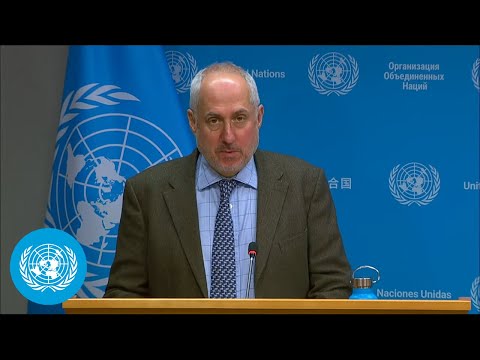
Spokesperson Steph opened the briefing by announcing a 2 p.m. meeting by the president of the General Assembly, Elena Berbock, and the Secretary-General’s scheduled priority speech later this week.
The briefing said the 2026 Ukraine humanitarian needs and response plan calls for $2,300,000,000 to support more than 4,000,000 people, and that nearly 11,000,000 people in Ukraine are estimated to require humanitarian assistance this year. Officials described winter-related disruptions — including rolling power outages and heating failures with temperatures dropping to minus 15°C in parts of Kyiv — and reported damage to civilian infrastructure and premises of several UN organizations in Odesa following overnight attacks.
Under-Secretary-General Rosemary DeCarlo briefed the Security Council, according to the Secretariat, and reiterated the Secretary-General’s call for “an immediate, full and unconditional ceasefire” and observance of international humanitarian law.
Ramesh Rajasingham of the Office for the Coordination of Humanitarian Affairs (OCHA) told the Council that recent assaults are especially devastating during winter because they “cripple systems that keep civilians alive,” and urged concrete actions to reduce civilian harm and sustain humanitarian access.
Separately, the UN launched a 2026 humanitarian needs and response plan for South Sudan seeking $1,500,000,000 to reach 4,300,000 people; a $1,000,000,000 priority tranche is aimed at reaching 4,000,000 people. The Secretariat said an estimated 10,000,000 people in South Sudan — roughly two-thirds of the population, including more than 600,000 refugees — will need aid this year.
The briefing also flagged acute malnutrition in North Darfur, where a UNICEF-led survey found levels far above World Health Organization emergency thresholds and a locality with a reported 53% rate of acute malnutrition.
On Yemen, the Special Envoy Hans Grundberg (reported by the spokesperson) met Omani officials and Ansar Allah negotiators and raised the case of 73 aid and UN personnel the spokesperson said remain detained; the UN called for their “immediate and unconditional release.”
In Gaza, humanitarian coordinator Ramiz Alakbarov began a three-day visit to Khan Yunis and displacement sites supported by UNICEF, the World Food Programme and UN Development Programme. The coordinator said teams provided water and sanitation, temporary learning spaces and school feeding and urged lifting restrictions on supplies to address weather-related risks; the Secretariat said nearly 20,000 households received emergency support from the UN and partners over the past month.
The briefing also relayed security incidents involving UNIFIL peacekeepers in southern Lebanon: peacekeepers reported two possible flare mortars near a position, sighted Israeli tanks moving further into Lebanon and said one tank fired three shells that landed about 150 meters from UN personnel. The Secretariat said such attacks violate the obligations set out in Security Council resolution 1701 and called on parties to ensure peacekeeper safety.
During question-and-answer exchanges, journalists pressed the spokesperson about reported death tolls from recent unrest in Iran. Some media reports cited figures ranging from hundreds to, in one question, a claimed figure of 12,000. The spokesperson said those higher figures were not verifiable by the UN and that UN teams in Iran are mainly focused on development and humanitarian work, with no confirmed human-rights presence to independently verify casualty counts. The spokesperson reiterated that people in Tehran exercising the right to peaceful protest should be protected and that member states must respect those rights.
Reporters also asked about a recent Secretariat letter to Israel’s prime minister concerning the status of UN premises in Jerusalem; the spokesperson said the letter reaffirmed the UN’s rights under the Convention on the Privileges and Immunities of the United Nations and noted that any referral to the International Court of Justice (ICJ) would follow separate procedures and mandates.
The briefing closed with the spokesperson offering to share follow-up statistics and materials where available.
Ending: The Secretariat emphasized aid shortfalls across multiple crises and urged donor governments to scale up funding for the 2026 response plans; no formal decisions or votes were announced at the briefing.