
WFP official urges local procurement to shield aid as hunger surges in Haiti and worldwide
Get AI-powered insights, summaries, and transcripts
Subscribe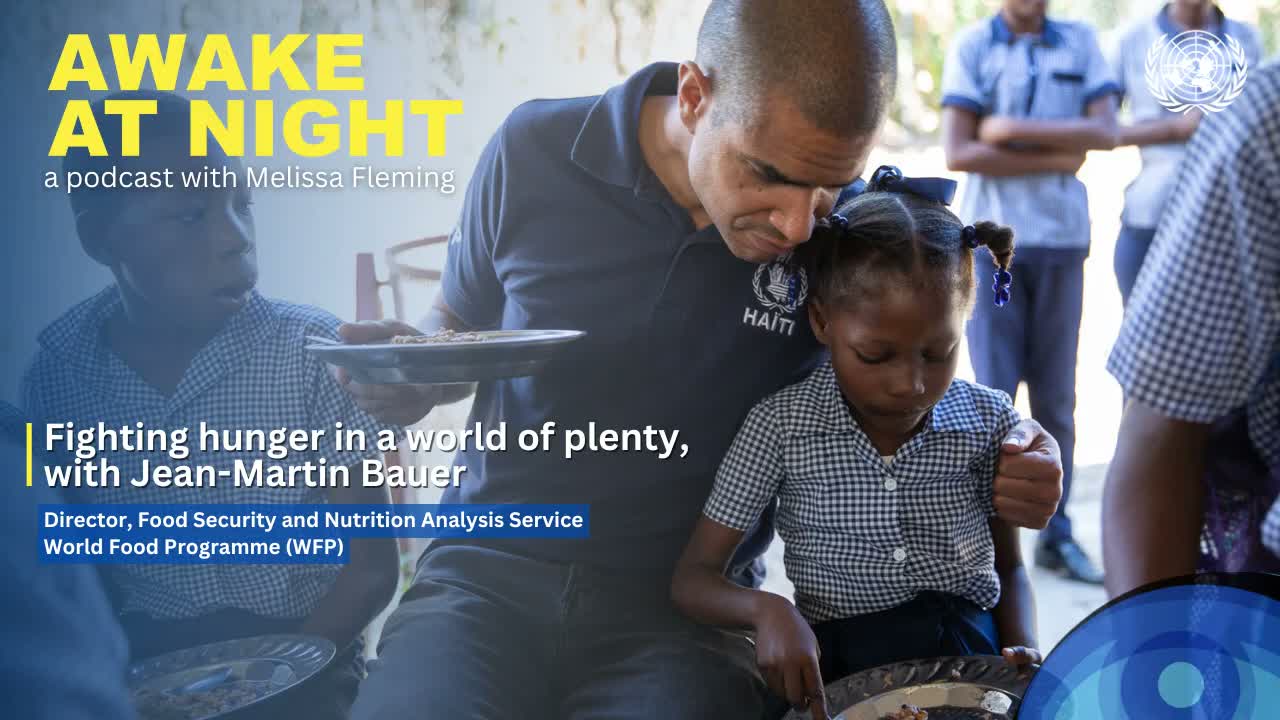
Summary
Jean Martin Bauer, director of food security and nutrition analysis at the World Food Programme, said on the United Nations podcast Awake at Night that localization — buying from local farmers — helped WFP keep food flowing in Haiti after looting and that global acute food insecurity has risen sharply, requiring urgent action.
Jean Martin Bauer, director of food security and nutrition analysis at the World Food Programme, told the United Nations podcast Awake at Night that violent disruption and funding cuts have pushed the agency to shift toward buying food locally to protect aid operations and support farmers.
"When you purchase food from local farmers, from a local cooperative, you're providing employment to dozens of people," Bauer said, describing how local procurement changed the equation for WFP during recent crises in Haiti. He said that by shortening supply chains and using Haitian-grown food, WFP was able to keep programs running when ports and roads were closed.
Bauer outlined two episodes of large-scale looting in Haiti in 2022 and 2024 that destroyed WFP stores and briefly halted deliveries. "The warehouse was ransacked, looted, and burned to the ground," he said, adding that, "thankfully, no one got hurt." The experience prompted a programmatic shift to buy and process food inside Haiti and to work directly with farmer cooperatives to supply school meals and other assistance.
The WFP official said that localization both insulates aid operations from supply-chain breakdowns and helps gain community acceptance. He described feeding "a quarter million school children every single day with a hot meal" made from food planted, harvested and processed in Haiti during a displacement response.
Bauer placed Haiti’s crisis in a global context, saying famine-risk indicators have risen in recent years. He explained the Integrated Food Security Phase Classification, or IPC, a five-step scale used to rate severity. "The number of people living in phase 5 worldwide has increased from about 1.1 million in 2018 to nearly 2 million in 2024," he said, adding that the total number of acutely food-insecure people has grown to roughly 300 million.
On the human consequences, Bauer said phase 4 already shows excess mortality and that phase 5 involves far higher death rates and long recovery times for children with severe malnutrition. "It's life-threatening food insecurity," he said.
The guest also explained that long international supply chains can take months to deliver food in some crises and are vulnerable when ports and roads are cut off. He offered an example from earlier work in the Congo, where U.S.-grown food was barged and shipped across oceans and rivers and could take five to six months to reach beneficiaries.
Bauer described his personal ties to Haiti — his mother was born in Port-au-Prince and he served as WFP country director there in 2022 — and recounted how a family rice farm and repeated market shocks shaped his view that small farmers can be central to durable food solutions.
Funding pressures have reinforced the push toward localization, he said. "All major donors have reduced their funding to the agency this past year," Bauer said. He added that in some contexts host governments themselves have become large contributors to local WFP operations.
Bauer said he wrote a book, New Breadline, during the COVID-19 lockdown to explain how food insecurity was misunderstood and to highlight opportunities for preventing famines rather than merely responding to them.
The episode closes with Bauer urging collective action to limit the long-term social damage of protracted hunger and to protect children vulnerable to malnutrition. The podcast provides additional resources and credits at un.org/awake-at-night.