
Adams County Board approves ordinance to add humane officer positions, sends change to county board
Get AI-powered insights, summaries, and transcripts
Subscribe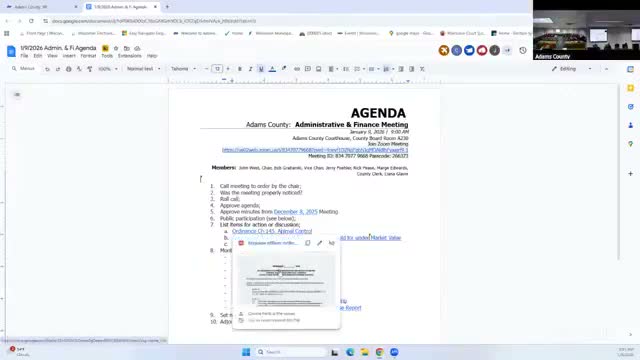
Summary
The county board approved an ordinance amending Chapter 145 to formalize humane officer appointments and designate an appeal/hearing role in line with statute Chapter 173; humane officers (Planning & Zoning employees) will handle dogs at large while the sheriff retains responsibility for dangerous or criminal animal matters. The ordinance was approved by voice vote and will be forwarded to the county board.
The Adams County Board of Supervisors voted to approve an ordinance amending Chapter 145 to formally add the position of a humane officer and to designate an authority to hear appeals of abatement orders.
Corporation counsel explained that while the county has historically relied on a deputy from the Sheriff’s Department to serve as humane officer, the ordinance would also allow the county to appoint two humane officers who are employees of the Planning and Zoning department. "This ordinance amends chapter 145 to add the position of a humane officer," corporation counsel said, describing the statutory requirement under Chapter 173 that the county board appoint humane officers and that an authority be named to hear appeals of abatement orders.
Counsel and supervisors clarified the division of responsibilities: humane officers in Planning and Zoning will handle dogs at large and efforts to return animals to owners, whereas the Sheriff’s Department will continue to handle dangerous animals, dog bites and criminal matters. Corporation counsel noted that Chapter 173 requires an appointed hearing officer to hold an informal hearing and rule on any abatement order appeals.
Supervisor Edwards moved to approve the ordinance and send it on to the county board; Supervisor Paylor seconded the motion. After brief discussion and clarifications about which department the humane officers would be employed by, the board approved the ordinance by voice vote. The ordinance change will now be transmitted to the county board for further action.
The board record does not include a roll‑call tally; the transcript records a voice vote in favor of the motion.