Committee approves 2026 large-project funding bill for wildlife and invasive-species projects
Loading...
Summary
The Select Natural Resource Funding Committee approved bill draft 26LSO-157, a 2026 large-project funding bill covering six landscape and fish-passage projects (including fish screens and cheatgrass treatments). The bill passed by committee vote 5–0 with one member excused.
The Select Natural Resource Funding Committee voted to approve bill draft 26LSO-157, a 2026 large-project funding bill that packages six landscape-scale and fish-passage projects, advancing the proposal out of committee by a 5–0 roll-call vote (Co‑chairman Williams excused).
The bill funds a mix of projects the Wyoming Wildlife Natural Resource Trust (WWNRT) and its partners prioritize, including completion work on the Upper Grama fish-passage project, a fifth phase of the Baggs Valley Headwaters restoration, cheatgrass-control phases in the Absaroka Front, North Platte corridor and western Wyoming, and a large drum fish screen proposed for the Cody Canal.
Bob Budd, director of the Wyoming Wildlife Natural Resource Trust, told the committee the Upper Grama completion included fish ladders, irrigation-diversion work and culvert replacements and that an extra $300,000 request this spring pushed the project over the large-project threshold. He described the Baggs Valley Headwaters Phase 5 as a $700,000 phase in an ongoing restoration that has received roughly $2,148,000 in total grants to date.
On the Cody Canal project, Budd said the proposed drum screen would handle high flow (about 275 cubic feet per second) and that tagging studies indicate “as many as 42,000 native fish per year” are entrained into the canal, a loss he called ecologically significant. The committee and Budd discussed that the Trust recommended funding roughly half of the original $1,600,000 ask (about $800,000) to help the applicant leverage other partners and complete the drum screen purchase.
Budd emphasized that several cheatgrass phases are contingent on supplemental cheatgrass funding; he said contracts would not be written until that funding is confirmed. On the North Platte corridor work he noted the project targets gallery cottonwood forest and the increased wildfire risk where people have built homes in the interface. On the Absaroka Front and other cheatgrass projects he described retreatment timelines and the collaborative, multi-county model the Trust uses.
Committee members pressed on funding capacity. Senator Landon asked about the Trust’s financial footing; Budd said the Trust corpus is a little over $200 million under the endowment model and currently generates about $8 million a year. Multiple members discussed whether the Select Committee should pursue a separate policy or budget action—such as a budget amendment or resolution—to grow the fund or create a targeted line item for invasive-species mitigation; Budd said he and staff had requested supplemental increases in prior processes and that the governor had proposed additional fire-impacted funding this cycle.
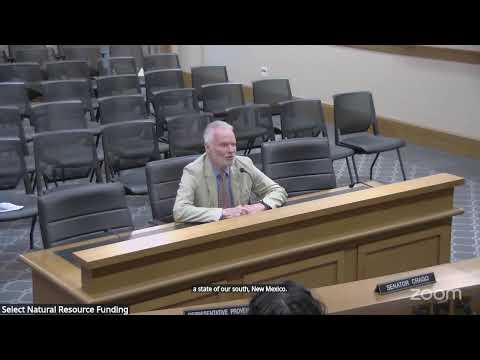
Public comment included Richard Garrett, a Cheyenne resident, who urged increasing the Trust endowment and offered support to carry that message to appropriators. Brett Moline of the Wyoming Farm Bureau Federation urged an ecosystem-wide approach that can include grazing, chemicals and landscape-scale coordination.
Representative Provenza moved the bill; it was seconded. The committee called the roll on item 26157: Senator Cooper (Aye), Senator Landon (Aye), Representative Otman (Aye), Representative Provenza (Aye), and Chairman Crago (Aye); Co‑chairman Williams was excused. The chair announced 5 Aye and the bill was approved by the committee.
The bill now advances from the Select Natural Resource Funding Committee as approved by the committee.