
Students, educators and farmers ask Legislature to level-fund Farm to School and Local Food Incentive programs
Get AI-powered insights, summaries, and transcripts
Sign Up Free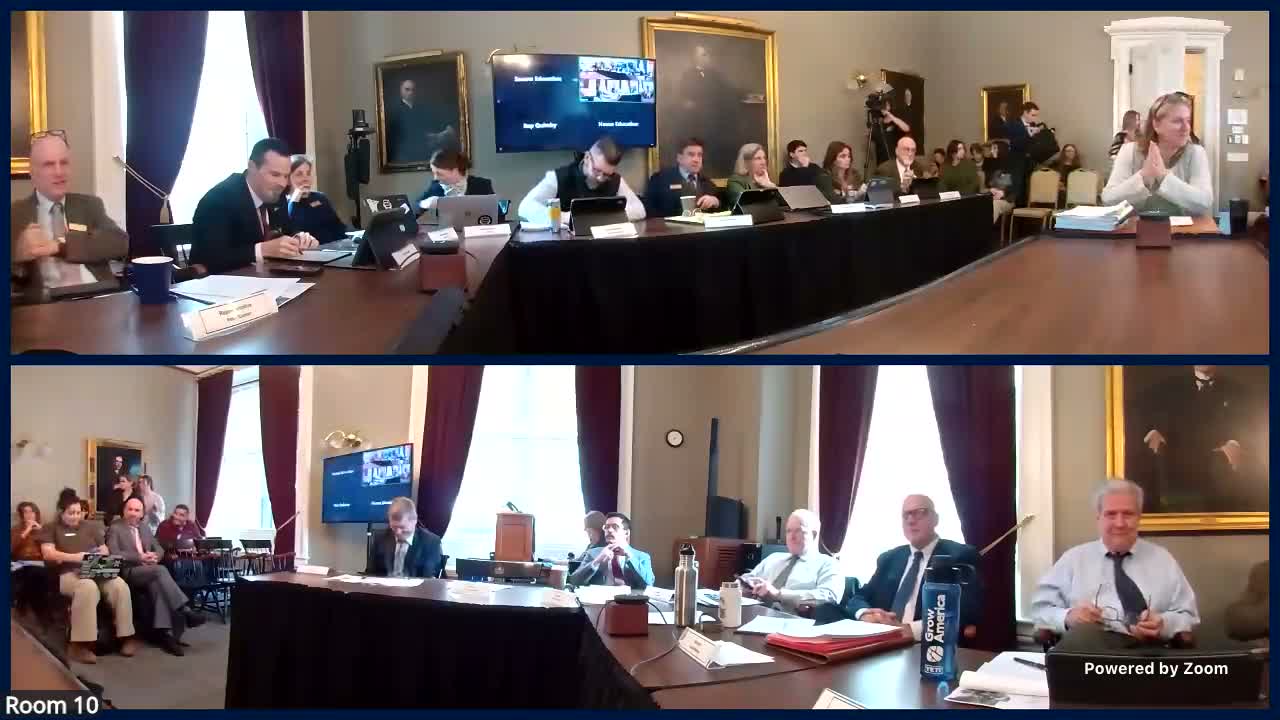
Summary
Students, superintendents and food-service professionals urged the joint education committees to continue $500,000 base appropriations for the Farm to School grant program and the Local Food Incentive program and to maintain universal school meals, citing student health, local economic return, and increased local purchasing.
Witnesses at a joint House and Senate education committee hearing asked lawmakers to level-fund two Vermont food programs at $500,000 each for fiscal year 2027 and to continue universal school meals through the education fund.
Dana Hudson, coordinator of the Vermont Farm to School and Early Childhood Network (Shelburne Farms), asked the Legislature to fund the Rosa McLaughlin Farm to School and Early Childhood grant program and the Local Food Incentive program at $500,000 each. She described three cornerstone initiatives—grant-making to build school capacity, incentives to boost local purchasing, and universal school meals—and said the programs help schools, farmers and students.
Student testimony: Julia Wolf, a Harwood Union High School student, told lawmakers she benefited from farm-to-school activities from preschool onward—classroom cooking, beehives and greenhouse work—and urged support for $500,000 in base funding for each program. "These programs are essential to teaching young students to understand and care for the food they eat," she said.
Local and operational impacts: Mike Licklider, superintendent of Harwood Unified Union School District, said his district sources about 25% of cafeteria ingredients locally—roughly $37,000 annually—and urged continued appropriation to keep those markets viable for Vermont producers. Ian Rose, food-service director for Windsor Southeast Supervisory Union, said his program feeds about 1,100 students daily and echoed the $500,000 request while urging continuation of universal school meals in the education fund.
Early childhood perspective: Lisonbee Grisb., director at the Bennington Early Childhood Center, joined by Zoom and described gardens, Story Walks and local-CSAs funded by prior grants in 2022–24; she asked that farm-to-early-childhood grants remain at $500,000 so small programs can sustain hands-on learning and community connections.
Data and ROI: Witnesses told the committee that statewide schools spend about $25,000,000 annually on food, with local purchasing rising from roughly 5% to 14% over the past decade (the witnesses said about 150 farms now sell to schools). Dana Hudson cited a study referenced in her materials showing roughly a $1.60 local economic return for every dollar spent on these initiatives, and noted a statewide goal of 30% local purchasing by 2030.
Policy levers and procurement: Witnesses suggested state policy can lower barriers to local buying—examples include procurement rules and limiting access of highly processed, low-cost products (other states have used statutory or regulatory levers). Witnesses said incentives and procurement changes can expand competition and help lower prices for local, minimally processed food over time.
Committee response and next steps: Committee members asked questions about sustainability, ROI and procurement options. Witnesses said the programs are currently in a transition phase—moving procurement patterns so that ongoing state support might not be required eventually—but "we're not there yet." The committee thanked the panel and recessed for a break.
Funding request summary: Level funding for FY2027—$500,000 base appropriation for the Farm to School and Early Childhood grant program and $500,000 base for the Local Food Incentive program; continued funding of universal school meals through the education fund.