
Superintendents tell joint education committees to prioritize funding, not just redistricting maps
Get AI-powered insights, summaries, and transcripts
Sign Up Free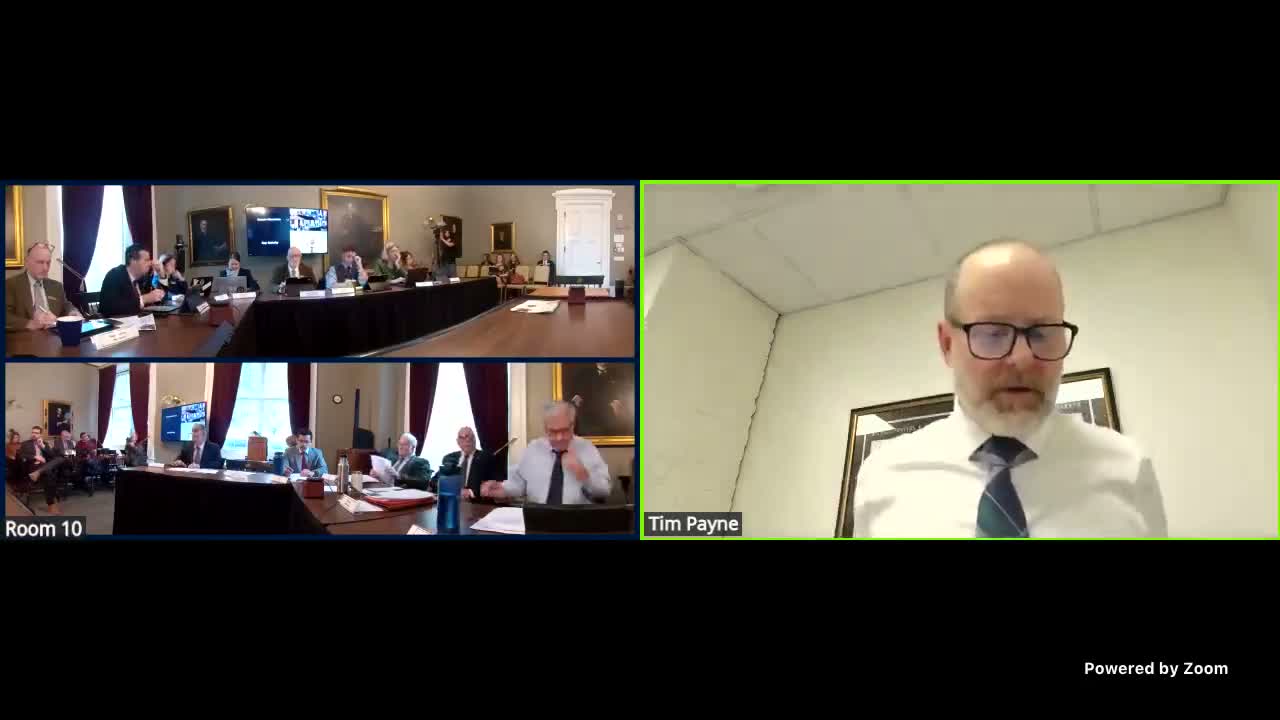
Summary
Superintendents from across Vermont urged the joint House and Senate Education Committees to emphasize predictable, equitable school funding and careful implementation of Act 73 rather than rushing to redraw district maps. Witnesses called for district‑level fiscal modeling, transition resources, and phased changes to protect students and communities.
Tim Paine, superintendent of the Southwest Vermont Supervisory Union, told the joint House and Senate Education Committees that lawmakers should "set aside the map discussion and focus on how we pay for school." Paine described his district's challenges—about 3,100 students, high free and reduced‑price meal rates and rising mental‑health needs—and said the current funding system is confusing to residents. He warned that unspecified accounting changes leave taxpayers mystified and recommended a budget process that tells districts how much money is available up front so local leaders can prioritize spending.
Sherry Souza, superintendent of Mountain View Supervisory Union, echoed that emphasis and urged phased, evidence‑based implementation of Act 73 provisions. Souza said cooperative education service agencies (BOCES) have produced "more timely and cost efficient" special‑education evaluations and helped districts compete for grants they could not access alone. She cautioned that equal dollars per student is not the same as equity and urged the legislature to "analyze the impacts across district sizes, demographics, and regions" before applying a foundation formula statewide.
Pam Reed, superintendent of Rutland City Public Schools, asked the Agency of Education and the Joint Fiscal Office to release modeling showing district‑level and tax impacts before any funding formula change takes effect. Reed said prior modeling tied to earlier reforms produced district‑level projections and tax estimates that were useful to communities, and she warned that changing the formula without comparable analysis risks reversing recent gains in some districts.
Witnesses repeatedly emphasized that implementation choices—timing, transition funding, and technical assistance—will determine whether reforms improve equity or simply shift costs. Several superintendents said voluntary consolidation or cooperative service agreements can work where communities buy in, but they cautioned that forced, top‑down mergers without local visioning risk long transition periods and erosion of trust.
The hearing produced no formal votes. Committee members pressed for specifics on incentives and timelines; witnesses answered that the most constructive next step is detailed, transparent modeling and a clear expectation (with deadlines and support) for districts to pursue cooperative options. The committees said they will continue to solicit testimony and modeling results as legislative work proceeds.