Get Full Government Meeting Transcripts, Videos, & Alerts Forever!
Get email alerts on the Equity Pbis Integration topic
No spam. Unsubscribe anytime.
Wallingford-Swarthmore committee hears update on cultural proficiency, PBIS and Jan. 16 in-service
Summary
District presenters described a scaled, more integrated Cultural Proficiency and Equity Teacher Leaders (CPEDL) structure that ties equity work to teaching, learning and social-emotional pathways; the district will use a culturally responsive Tiered Fidelity Inventory and a Jan. 16 in-service to distribute restorative-practice lessons.
The Wallingford-Swarthmore School District Educational Affairs Committee on Jan. 13 received an update on the district—s cultural-proficiency work and its integration with PBIS (positive behavioral interventions and supports).
Dr. Megan McCullough, who led the presentation, traced the work to a 2022 equity audit conducted by Hanover Research and said the district is moving from initiation to integration. "This year—s work focuses on connecting diversity, equity and belonging to our teaching, learning and social-emotional pathways," she said, describing a smaller, more focused team of teacher leaders and principals charged with intensive professional learning.
Why it matters: presenters said the aim is to shift from mindset and initiation activities toward measurable student impact, using existing behavioral and PBIS datasets to identify disproportionality and close opportunity gaps.
What—s new: Anthony (first name only in the record) described —Educate— modules developed from restorative-practice work intended to give teachers practical lessons for classroom incidents. He said the modules will be distributed more broadly beyond central admin and counseling teams so classroom teachers can use them. "For the year the past few years, [these lessons] lived mostly within the admin team and maybe some counselors. This was about getting these lessons into everyone—s hands," Anthony said.
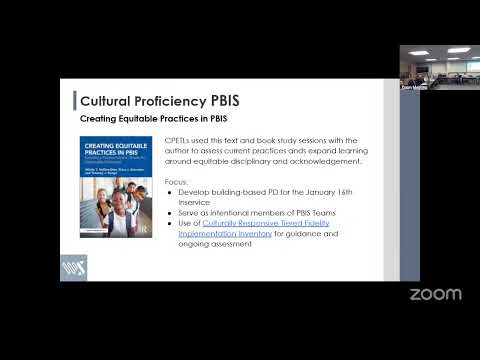
Assessment and oversight: the presenters described adding a cultural-lens overlay to the district—s Tiered Fidelity Inventory (TFI), an instrument the district—s DCIU coach has administered since 2018. Dr. McCullough said the coach leads the assessments, interviews staff and students, and performs walkthroughs; she added that the state PBIS network recommends the coach continue in that role and that, at times, additional outside reviewers join for a "fresh set of eyes."
Staff training and timing: presenters highlighted a full-morning professional learning day scheduled for Jan. 16 focused on using modules, responding to bias and applying culturally responsive pedagogy and PBIS strategies in classrooms.
Committee questions and responses: committee members asked how the district will know whether the restructuring is working. Presenters pointed to year-over-year PBIS and behavioral-health metrics, subgroup discipline referrals and intervention data as measures: when gaps shrink and achievement increases, the district will judge progress. A committee member also asked whether the TFI produces a written report and how findings feed into superintendent goals; presenters confirmed written outputs and said the TFI contributes to the district—s annual goal-setting process.
Next steps: presenters said they will continue PBIS data reviews, expand student involvement on PBIS teams and compile culturally responsive TFI findings into program guidance. The committee did not take separate formal action on the presentation.