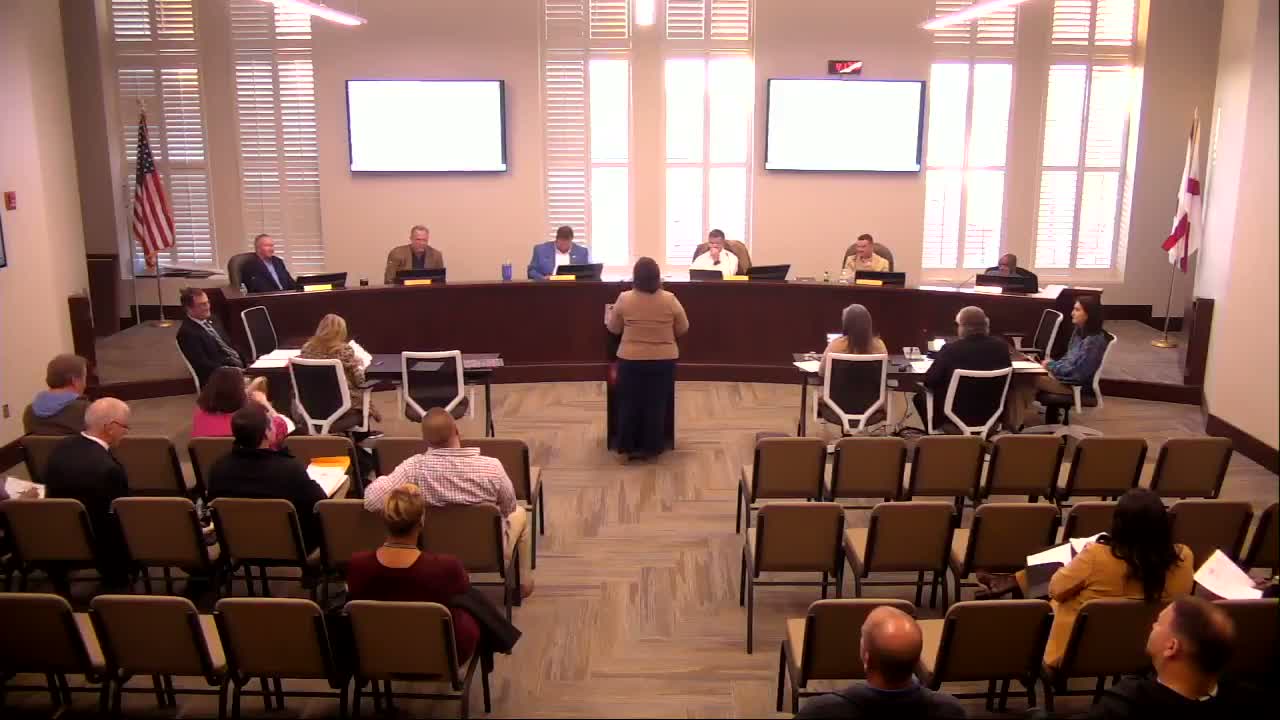
Lee County presenter urges dissolving alternative sentencing board, proposes county-run court services
Loading...
Summary
A county presenter (identified in the meeting as Jesse) recommended dissolving Lee County's alternative sentencing board, citing overlap with a state "accountability courts" law effective Oct. 1 and staffing/funding problems, and proposed transitioning court referral staff to a county court services division.
A presenter identified in the meeting as Jesse told the Lee County Commission on Nov. 10 that the local alternative sentencing board has become ‘‘more of a hindrance than it is a help’’ and recommended dissolving the board in favor of a county-run court services division that would make court referral staff county employees.
Jesse described the existing system of court referral and accountability courts — including drug court and veterans court — and said a state accountability-courts law that took effect Oct. 1 has absorbed much of the local board’s statutory scope. ‘‘When I started looking at it, I realized that we really have a very ineffective model here,’’ Jesse said, adding the current board structure has impeded staff advocacy and supervision.
Why it matters: Jesse said better supervision and an organized county structure could expand capacity for alternatives to jail — including a potential mental health court — and relieve pressure on the county jail by placing more defendants into monitored programs instead of custody.
Funding and staff: Jesse said the county currently provides about $100,000 to the program, and the operation runs on a roughly $400,000 budget supplemented by Alabama Office of Courts funds and client fees such as drug-testing payments. He told commissioners only two staff remain in the court referral office and that some long-serving employees want to be county employees; Jesse specifically cited Amy Frazier as having worked in the office for more than 20 years.
Comparative model and implementation questions: Jesse pointed to Madison County’s model, where court referral staff are county employees and a county director works with county HR on hiring and procurement. Commissioners pressed on likely county costs and supervision arrangements; Jesse and staff said their aim would be to keep initial county costs roughly the same and to develop a supervision structure acceptable to judges and county managers.
Intergovernmental contributions: Jesse confirmed municipalities participate (Opelika paid $60,000 this year), and said the county would need to coordinate with municipalities if it changed program structure so those partners’ contributions and expectations were preserved.
Next steps: Jesse said he will work with Judge Cawley and Mr. Beck and asked staff (including Jessica) to research other counties and draft a presentable proposal addressing supervision, funding and legal issues for the commission’s consideration.
The commission did not take a formal vote at the work session; commissioners asked follow-up questions and directed staff to develop implementation options.