
Muskogee police brief council on recent shootings; NAACP launches 'Safe Storage Saves Lives' campaign
Get AI-powered insights, summaries, and transcripts
Sign Up Free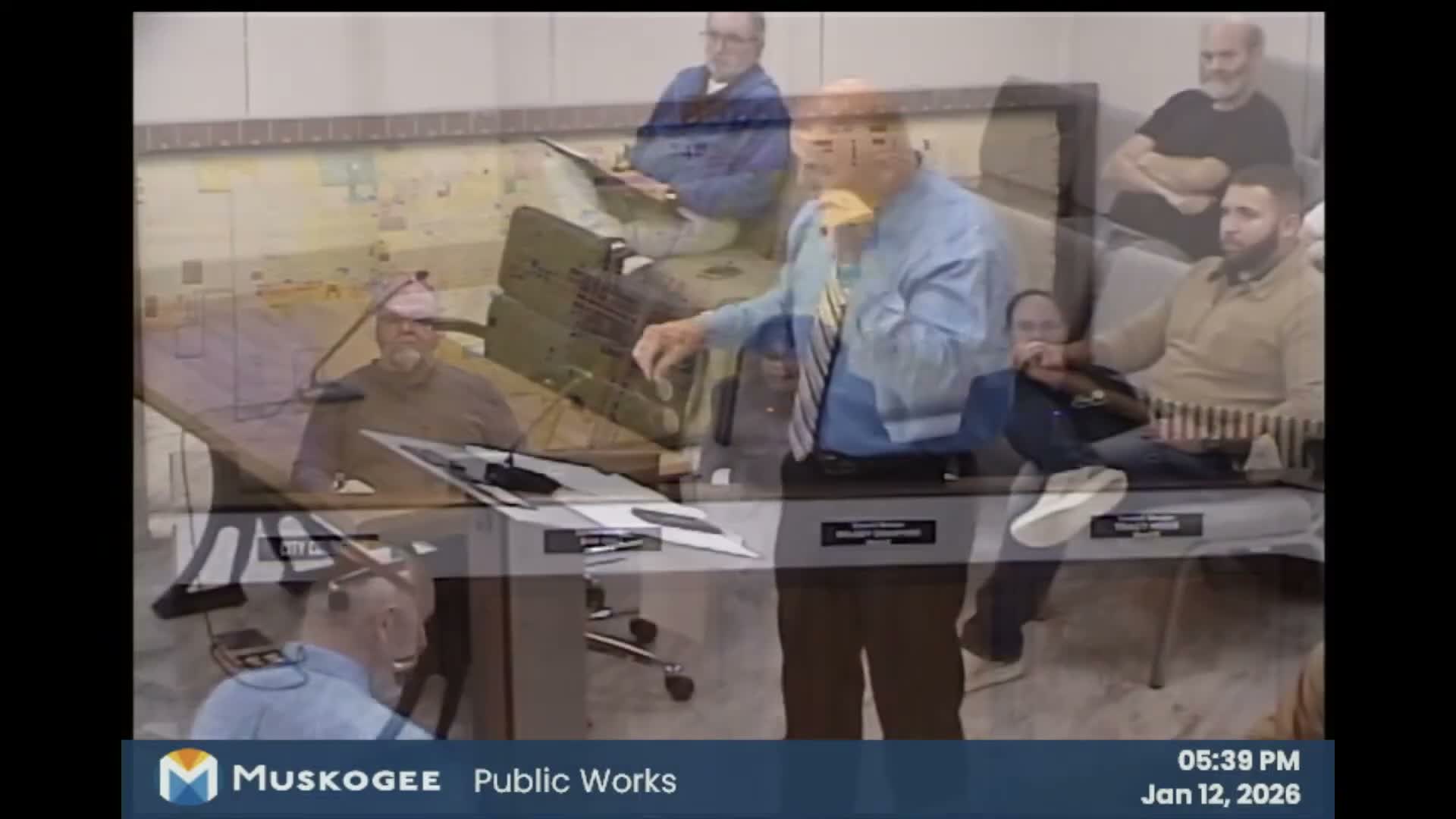
Summary
Police Chief Teehee told the council the city’s shootings are at roughly the same monthly rate reported over the past year and outlined enforcement steps that included license‑plate readers and recent saturation patrols; NAACP Muskogee announced a firearm‑safety campaign and asked council support.
Chief Teehee told the Muskogee City Council on Jan. 12 that social‑media claims of escalating violent crime in the city were “completely untrue” and described how the police distinguish routine "shots‑fired" calls from verified shooting incidents. "What we're talking about is when shots are fired, we have shots or fired calls, and we don't know nobody's hit," he said, adding that the department averages about 20–25 shots‑fired calls a month.
Teehee gave a 13‑month tally — from Jan. 1, 2025, through Jan. 10, 2026 — of 265 shots‑fired calls and said there were 17 shooting calls in that window. He described investigative tools the department uses, including 10 Flock license‑plate readers deployed around town. Over the most recent 30‑day window he cited roughly 667 vehicle reads and about 574 officer searches using the system; the system also produced hot‑list and offender alerts that the department uses to follow leads. He credited a resident doorbell camera and license‑plate data with helping narrow a suspect vehicle in a recent arrest.
Council members asked about other technologies, including acoustic gun‑shot sensors, and Chief Teehee said Muskogee does not use those devices and that budget and staffing constraints inform equipment decisions. He said targeted saturation patrols on the city’s west side produced 126 traffic stops, 45 citations, 56 warnings and nine arrests, and that the arrests covered multiple offenses, including warrants and felony firearm cases.
Officer Mace and other staff described juvenile intervention programs offered through the police department and partner agencies. Mace said the department runs a six‑week gang‑prevention course and offers programs described as "mindful resolutions" and "Law in the Community," focused on de‑escalation, youth‑police interaction and wraparound supports. Councilors and staff emphasized that many juvenile services are confidential by design, limiting public detail about individual participants.
During public comment, Reverend Roger Cutler of the NAACP’s Muskogee branch announced a community initiative called "Safe Storage Saves Lives," which he described as a practical, nonpolitical effort to reduce firearm accidents and unauthorized access to firearms. Cutler said the initiative will include a community education meeting, distribution of free gun locks through partners, and a social‑media awareness campaign. "This effort is not about politics and is certainly not about blame. It's about prevention," he said, asking the council to stand with community partners to promote education and participation.
Several residents also addressed the council during public comment, offering both praise for recent street and code enforcement work and criticism of perceived leniency toward juvenile offenders. One resident questioned charging decisions for juveniles in the wake of a recent shooting; councilors and staff reiterated the confidentiality and legal limits surrounding juvenile cases.
The council did not take a policy vote specifically on new gun‑safety requirements. Councilors and staff asked staff to continue outreach and to encourage residents to report lighting or camera outages through the city's Clickfix tool so infrastructure and neighborhood reporting can support public‑safety efforts.
The next procedural step noted at the meeting was continued coordination between law enforcement, community organizations and city staff on public education and enforcement tactics.