NJSBA trainer outlines 'students first' duties and limits for Hunterdon Central board members
Loading...
Summary
Kathy Poirier of the New Jersey School Boards Association led a committee-of-the-whole training emphasizing the board's policymaking and oversight role, the superintendent's executive role, ethics, and communication rules—including limits on individual board contact with staff and caution on social media.
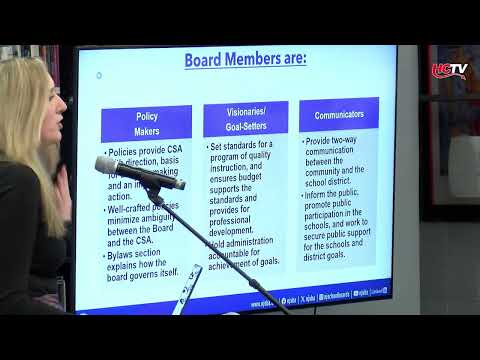
Kathy Poirier, a field service representative with the New Jersey School Boards Association, told the Hunterdon Central Regional High School District Board of Education on Jan. 12 that board members’ primary responsibility is to act “for the good of all students.” Poirier, who said she represents Hunterdon and Somerset counties, framed the board as the body that sets policy and strategic goals while the superintendent implements those policies and runs the district.
The training, delivered at a committee-of-the-whole session, explained New Jersey’s governance hierarchy and cautioned new board members against individual actions that can overstep the board’s role. “Every policy that a board approves, every action a board takes needs to be based on what’s best for all the students in your school district,” Poirier said. She urged members to treat the board as the “what” and the superintendent as the “how.”
Poised as an orientation for newly seated members, the presentation covered finance responsibilities, governor‑driven timelines for the budget, and the board’s role in superintendent evaluation. Poirier ran an interactive quiz using real examples — for instance, she said that setting district goals and adopting policies are board responsibilities, while implementing curriculum or selecting a specific course falls to administration.
She also addressed ethics and communications: board members were advised to avoid directing staff individually, to be cautious about “reply all” email threads that could create a quorum under the Open Public Meetings Act, and to use district email for official correspondence. On social media, Poirier recommended using a disclaimer and warned that even with a disclaimer posts could raise ethical concerns.
The training concluded with a reminder on the board’s obligation to build community trust through respectful debate and by following established processes. The district’s packet includes the Lighthouse study, which Poirier cited as evidence linking effective boards to improved student outcomes. The board will consider policy and committee work in subsequent meetings as part of the regular agenda.