
South Washington County outlines math standards rollout, highlights teacher collaboration and student pathways
Get AI-powered insights, summaries, and transcripts
Subscribe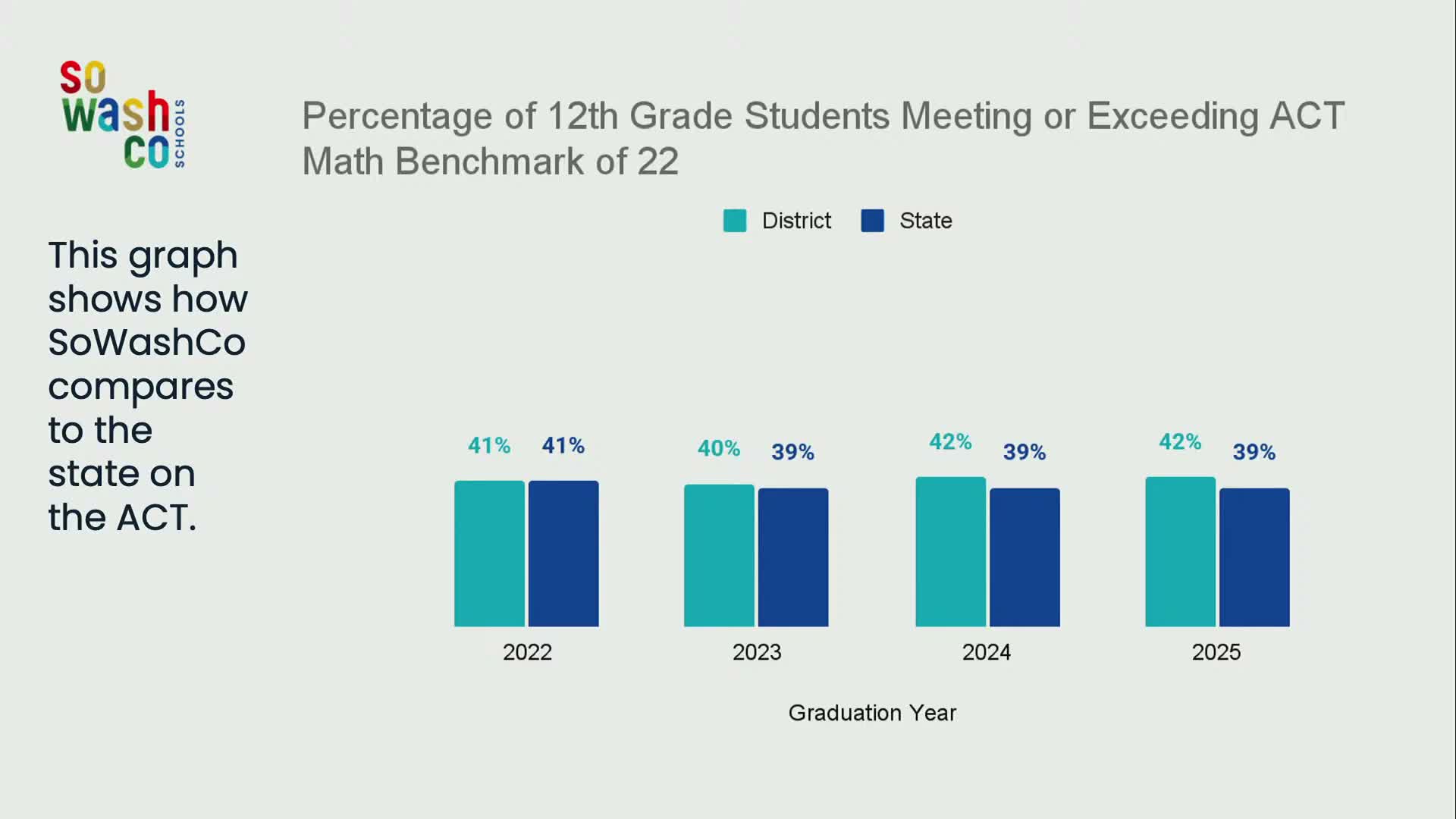
Summary
District presenters described a multi-year rollout to align K'12 math instruction with the Minnesota math standards, introduced new elementary enrichment "concept quests," and said a new secondary curriculum will be phased in ahead of MDE's assessment changes; students and board members raised questions about assessment comparisons and course pathways.
South Washington County Schools officials told the school board the district is moving ahead with a multi-year plan to align classroom instruction to the new Minnesota math standards and an adopted secondary curriculum.
District presenters said the core strategy is to strengthen Tier 1 instruction ' the universal math instruction every student receives ' while adding coordinated unit planning, clear scope and sequence work and district-selected instructional resources. The presenters described the Minnesota standards as asking for three balanced emphases: conceptual understanding, real-world application and procedural skill and fluency.
"We are looking at how we are balancing that out," a district presenter said, explaining that teams of teachers across elementary and secondary schools will build shared scope-and-sequence plans before the full rollout.
Elementary: concept quests and classroom practice
Laura Larson, introduced as the elementary presenter, described a new supplemental program called "concept quests" designed to give all grade-level students deeper problem-solving tasks that stay within grade expectations. The district said the approach is intended as "horizontal enrichment": deeper work at grade level rather than acceleration beyond grade standards.
Larson read a sample third-grade task aloud and invited the board to note how students use reasoning and collaboration rather than a single prescribed method. "It's enrichment for all," Larson said, adding that teachers launch tasks without front-loading so the thinking process is visible.
Secondary curriculum and student pathways
District staff said they have adopted a new secondary curriculum and will pilot it this year with fuller implementation the following year to meet Minnesota Department of Education timelines for standards and assessments. Presenters emphasized that Algebra II remains the baseline expectation in state standards and that the district's typical sequence (math 6, pre-algebra, middle school algebra, intermediate algebra, geometry, algebra 2) prepares students for college assessments like the ACT.
Students on a brief panel described a range of pathways (IB Algebra 2, Pre-Calc, AP Calculus, CIS algebra and PSEO statistics) and said the district provides options that align with individual postsecondary plans. One student said, "It really matters about if you're actually learning stuff from it," and described flexible choices for senior-year coursework.
Assessment and board questions
Board members raised questions about a 2022 dip in some assessment measures and whether new standards, test opt-outs or cohort accounting explain the trend. District staff cautioned that year-by-year grade-level ACT and preACT reports are not necessarily cohort-linked by default and offered to run cohort-level ACT analyses to clarify comparisons. Staff also noted that opt-out behavior (for example, students choosing PSAT) can change the composition of test-takers and affect averages.
Course availability and advanced offerings
Board members asked whether trigonometry or non-AP calculus are offered; staff said trigonometry concepts are addressed within geometry and algebra 2 and that the district provides both AP and non-AP options for precalculus and statistics, while calculus in the high school program is offered as AP calculus.
Why it matters
District leaders said the combined approach of a shared scope-and-sequence, selected digital resources (named by staff as Big Ideas and Envision Math for middle grades) and teacher collaboration aims to give students consistent learning progressions across the district and to prepare them for the transition to updated state assessments.
The board heard the overview as an information item; presenters did not ask the board to take formal action during the meeting. The district said the full implementation timeline and professional learning will continue over the next several years.