West Des Moines council workshop weighs Valley Junction ‘transitional’ zones, developer’s 12‑unit proposal and how strictly to enforce design rules
Get AI-powered insights, summaries, and transcripts
Sign Up FreeSummary
City staff reviewed a master-plan update for Valley Junction that would create transitional zones allowing small multifamily and neighborhood commercial uses. Council debated a developer’s proposed 12‑unit project on 4th Street and whether design guidelines should be codified as mandatory ('shall') or advisory ('should').
City of West Des Moines planning staff asked the council Wednesday to give direction on proposed "transitional" zoning for Valley Junction and on whether to codify the neighborhood’s design guidelines as mandatory or advisory, while a nearby developer described a 12‑unit row‑home proposal that cannot proceed without PUD approval.
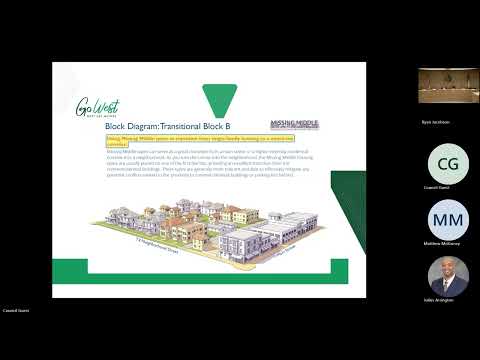
Ryan Moffitt, the city’s community and economic development director, summarized the Valley Junction effort as three linked documents—the master plan (about 90% complete), design guidelines (adopted December 2022), and a PUD/master-plan ordinance (about 60% complete)—and framed the night’s questions as whether the council wants to preserve primarily single‑family character or permit targeted reinvestment through transitional zones. He said the transitional zones are intended as a “relief valve” for 5th Street retail demand and a way to encourage "missing‑middle" housing such as small multifamily, townhomes or cottage clusters.
The workshop focused on one immediate application: a developer (WB Realty / property owner Ryan Wiederstein) has assembled three lots behind the Union 315 development on 4th Street and proposes a 12‑unit cottage‑style residential project. Wiederstein told the council the three houses he owns include one with a failing basement and one in “really bad” condition that needs electrical, plumbing and a new roof, and a third with a hazardous garage; he said renovating foundations in 120‑year‑old houses is often not economically feasible. “It wouldn’t make any sense. I would be better off tearing them down than renovating them,” Wiederstein said, calling the row‑house concept a fit for those assembled lots.
Staff and Lynn (city planning staff) explained the zoning reality: the current single‑family zoning permits one dwelling unit per lot (plus accessory units in limited circumstances), and the developer’s concept exceeds what straight code allows. Moffitt described a subcommittee recommendation that a typical 50‑foot residential lot (about 7,200 square feet) could allow up to four dwelling units, with certain uses (drive‑thrus, auto‑dominant uses and large multifamily that exceed the unit cap) listed as restricted.
A second, contested question was enforcement of the design guidelines the council adopted in 2022. Moffitt framed two options: keep the guidelines advisory—"should"—which allows administrative flexibility and possible deviations, or make them mandatory—"shall"—which would leave little room for waiver short of amending the PUD. "The shall language is…we want those followed to the letter of the law," Moffitt said, describing the tradeoff between certainty and flexibility.
Several council members voiced support for stronger enforcement and greater certainty for residents. "I'd like to see the word 'shall'," said one council member, arguing that mandatory language signals clear expectations for both the development community and residents. Others favored a compromise that would require any deviation to come before the Planning and Zoning Commission and the council rather than being handled administratively.
Council discussion also touched on preservation and demolition. Multiple speakers warned that, under current code, a property owner can pull a demolition permit and remove a building; staff suggested exploring a demolition overlay or requiring a council vote or additional study before certain demolitions proceed. Moffitt suggested an appeal process tied to the PUD so deviations could be considered by the Planning and Zoning Commission and council rather than decided solely by staff.
No formal motions or votes were taken at the workshop. By the adjournment, staff reported they had sufficient direction to continue drafting the PUD and return with more detailed regulations—setbacks, heights, open‑space requirements and the exact enforcement language—for a future workshop and subsequent ordinance process. The council asked staff to consider targeted options (for example, allowing the 4th‑Street project to proceed as a single PUD while refining standards for other transitional zones) and to examine possible demolition‑control measures.
What’s next: staff will continue the PUD drafting process, return with detailed standards and timelines, and schedule a follow‑up workshop when documents are ready for more formal council review.