
Fluvanna planners defer zoning and SUP requests for Tenaska’s proposed plant after packed public comment; contested 'substantial accord' motion recorded
Get AI-powered insights, summaries, and transcripts
Subscribe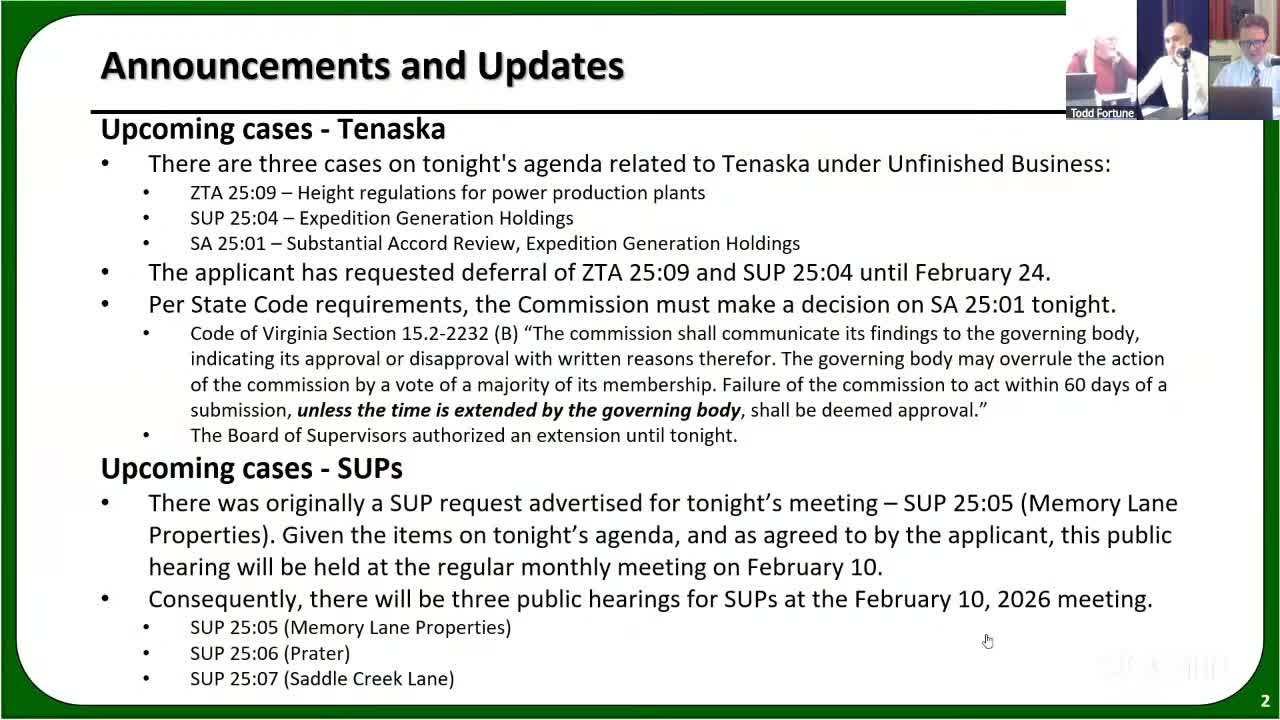
Summary
The planning commission heard hours of public testimony on Tenaska’s proposed Expedition Generation gas plant and voted to defer a zoning text amendment and the special‑use permit to Feb. 24. Commissioners debated whether the project is "substantially in accord" with the county comprehensive plan and recorded a contested motion to find it not in accord; written reasons were requested.
The Fluvanna County Planning Commission on Jan. 13 deferred two pending actions tied to Tenaska’s proposed Expedition Generation gas‑fired plant and recorded a contested written motion on whether the project is “substantially in accord” with the county comprehensive plan.
Todd Fortune, the county’s director of planning, told commissioners the applicant had asked to defer ZTA‑25‑09 (an amendment to allow the board to modify maximum chimney and stack heights) and SUP‑25‑04 (the special‑use permit for the proposed 414‑acre facility). The commission approved both deferrals, scheduling further consideration for Feb. 24. Fortune reminded the panel that state code required the commission to act on SA‑25‑01 — the statutory “substantial accord” review — unless the governing body granted an extension.
A large public turnout filled the meeting for two public‑comment sessions. Dozens of residents urged the commission to find the proposal inconsistent with the comprehensive plan and cited peer‑reviewed health analyses and local noise, traffic, water‑use, and environmental‑justice concerns. “This project is not in substantial accord with our comprehensive plan,” Tracy Smith said, adding that previous process errors around the first plant had harmed neighbors and that residents had to press for an independent health study. Multiple speakers referenced a health impact analysis commissioned by community groups and called for rejection.
Proponents spoke in favor of the project’s regional grid‑reliability role and potential county revenue. “This facility meets stringent environmental and safety requirements,” said a resident who identified himself as supporting the proposal and cited permitting frameworks and potential tax revenue projections presented by the applicant.
Applicant representatives described updated technical materials and offered mitigation commitments during a presentation to the commission. They highlighted a third‑party noise study, pledged pre‑ and post‑construction sound modeling, and said they would work with staff on traffic and environmental conditions. The applicant also described plans to place two additional parcels into permanent conservation easement if acquisition proceeds.
David Taylor, the former director of the Virginia Department of Environmental Quality (DEQ) who reviewed some technical materials for the county, told commissioners that DEQ permitting for a project of this type typically involves separate applications for air permits, water withdrawals, and water discharges and that other agencies may submit comments through the state permitting process.
After the presentations and hours of public testimony, Commissioner Kilpatrick moved that the commission find the application not substantially in accord with the comprehensive plan; Commissioner Morgan seconded. The motion and subsequent roll call were recorded in the minutes and transcript. The transcript reads, in full, that the commission voted with a recorded tally and that written reasons should be provided for the record; the verbatim motion, second, and the commission’s recorded vote appear in the meeting minutes. Staff and commissioners discussed the legal ambiguity of the statutory phrase “substantially in accord, or part thereof” and the scarcity of direct case law; several commissioners said the determination is qualitative and must be supported by written findings.
Next steps: the ZTA and SUP were deferred to Feb. 24 for further review and revised draft conditions; the substantial‑accord record and any written reasons from the commission will be part of the official record and may be appealed to the Board of Supervisors under state code procedures.
What to watch: Feb. 24 meeting materials (staff said they will post a project landing page and supplemental documents on the county website) and any written reasons the commission files about the SA‑25‑01 determination. The transcript shows commissioners asked staff to compile any legal precedent and to make project materials, including the traffic study, more accessible online.