Get Full Government Meeting Transcripts, Videos, & Alerts Forever!
Get email alerts on the Education Funding topic
No spam. Unsubscribe anytime.
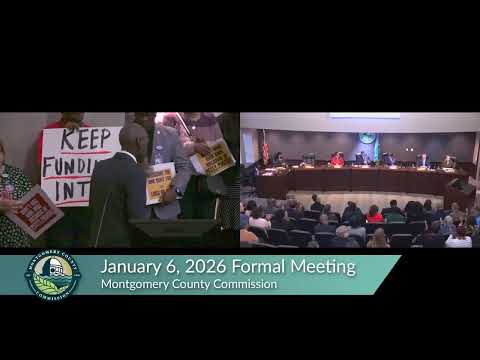
Montgomery County delays vote on capping 1¢ school sales tax after school leaders and residents push back
Summary
Superintendent Dr. Byrd, Board President Pamela Portis and multiple residents urged commissioners not to reduce or cap the county—s 1¢ sales tax for Montgomery Public Schools, citing potential multimillion-dollar losses to classroom services; the commission voted to table the proposal for later review.
Montgomery County commissioners voted on Jan. 6 to table consideration of a proposal that would cap or reduce the 1¢ sales tax dedicated to Montgomery Public Schools after a string of public comments by school leaders and residents.
Dr. Byrd, superintendent of Montgomery Public Schools, told the commission the tax "generates nearly $40,000,000 each year for our schools" and warned that a 10% reduction would remove "more than $4,000,000 annually" from classrooms, leading to "fewer teachers, fewer counselors, fewer career programs, and reduced student services." He framed stable school funding as essential to the county's workforce and local economy.
Pamela Portis, president of the Montgomery Public Schools Board of Education, urged the commission to preserve the tax, saying it has been a reliable source of funding for nearly 20 years and "generates nearly $33,000,000 annually" (as stated in her remarks). Both Portis and Dr. Byrd described the tax as foundational to ongoing improvements in student services and staff capacity.
Several residents and community leaders echoed that view in public comment. Phaedra Carson Foster, a parent, educator and Montgomery County Council PTA volunteer, said a cap "would reverse that progress" and shift costs onto families and teachers. Jean Charbonneau, a longtime resident, said her family stayed in Montgomery "because of the schools" and urged funding that keeps pace with inflation. Brenda Irvey, a school advocate, called for greater stewardship and said the commission should exercise oversight when district contracts or spending affect public funds.
Commissioners discussed timing and fiscal risk. One commissioner warned that delaying a resolution until July could jeopardize the county—s bond rating because of roughly $37,000,000 in near-term cash obligations described during the meeting. Another commissioner offered a compromise proposal to guarantee the school system the same funding level received in 2025 (cited in the meeting as approximately $41,000,000) and allow the county to retain subsequent growth; school leaders said they wanted further conversations rather than an immediate acceptance.
After discussion, the commission moved and seconded a motion to table item 11 (the sales-tax proposal). Commissioners called the vote and recorded ayes; the proposal will return for further consideration and additional financial review.
The meeting record shows inconsistent figures cited during public comment and discussion: speakers referenced the tax as generating "nearly $40,000,000," "nearly $33,000,000," and a 2025 funding level cited at about $41,000,000. The commission and school leaders signaled they will meet again to reconcile revenue projections and program needs before taking final action.