
Vermont council unveils CHIP guidelines to deploy $2 billion for housing infrastructure
Get AI-powered insights, summaries, and transcripts
Subscribe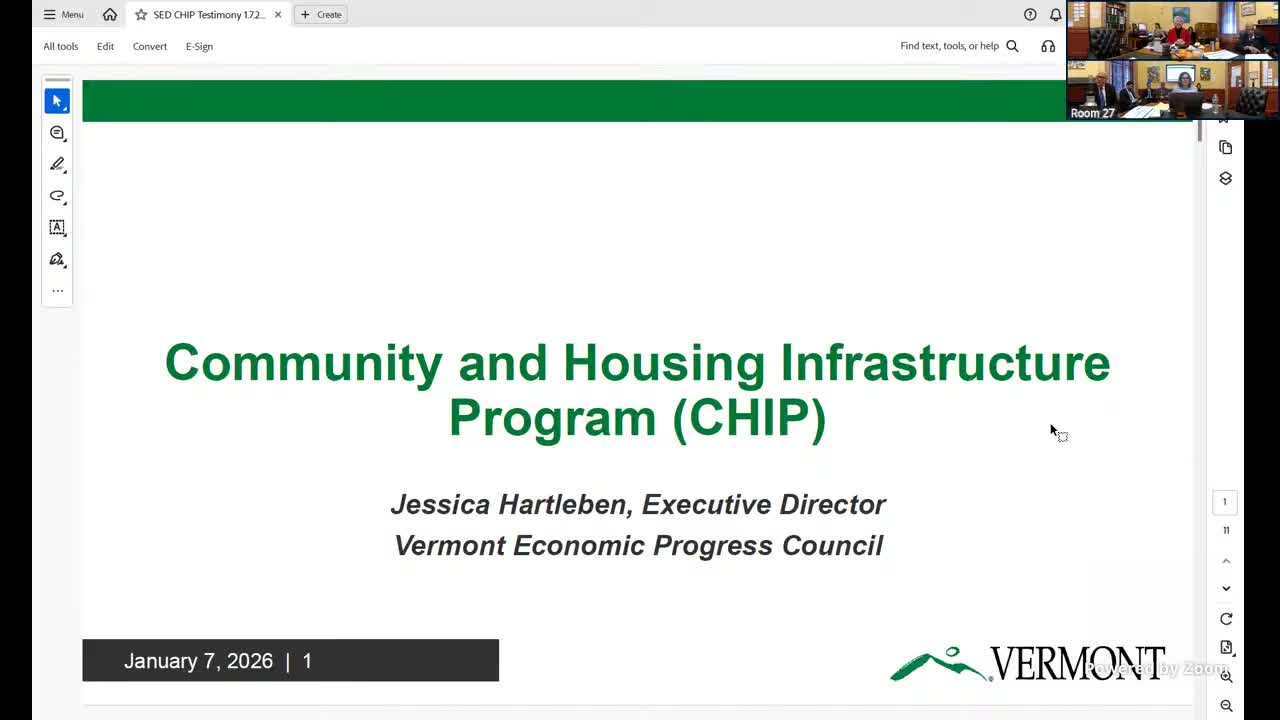
Summary
The Vermont Economic Progress Council presented finalized guidelines for the Community and Housing Infrastructure Program (CHIP), a tax-increment financing tool designed to fund infrastructure that enables new housing; VEPC launched a pre-interest form, plans webinars, and said applications will roll in through 2035.
Jessica Hartleben, executive director of the Vermont Economic Progress Council, told the Senate Economic Development, Housing & General Affairs Committee on Jan. 7 that the council has finalized guidelines and is preparing to launch the Community and Housing Infrastructure Program (CHIP), a statewide tax-increment financing tool aimed at unlocking housing by investing in infrastructure. "$2,000,000,000 is going to be invested between now and December 2035," Hartleben said, and she said the program’s targeted launch date is January 2026.
The guidelines set out who can apply, the program’s finance rules and municipal responsibilities, and a schedule for applications and oversight. CHIP will pay for infrastructure — roads, septic, site preparation, transportation improvements and certain soft costs — that ‘‘serve a public good’’ and ‘‘directly support the development of an eligible housing development,’’ Hartleben said. She noted a pre-interest application form is already live and that the full application portal and an applicant PDF are being finalized; a VEPC webinar series for municipal officials, developers and stakeholders begins tomorrow at 2 p.m., with recordings to be posted.
Why it matters: CHIP is intended to lower the infrastructure barrier that prevents some projects from moving forward, particularly in smaller and rural communities that lack financing tools. Hartleben said municipalities and developers must submit a housing development plan, a housing development site definition, and a housing development agreement to VEPC; municipalities also must hold the required municipal legislative vote before submitting an application. If approved, projects may use municipal bonding or pay developers directly according to negotiated infrastructure agreements.
Key program details laid out to the committee include: applications accepted on a rolling basis through Dec. 31, 2035; a requirement that at least 60% of projected floor area be primary residences for most projects (alternatively, projects that do not meet that threshold must otherwise demonstrate they meaningfully meet CHIP’s purpose); affordable housing unit targets of 15% for the ‘‘affordable’’ category and 25% for ‘‘moderate-income’’ projects; and municipal retention of at least 85% of municipal tax increment (municipalities may retain up to 100%). Hartleben also explained differing education tax increment caps: market-rate projects are capped at a 75% education tax share, while affordable and moderate-income projects are capped at 85%.
Hartleben highlighted an early local example: a 24-acre racetrack site in Fairhaven was donated to the town and the town intends to use it as a CHIP project site. She also announced VEPC hired Farida Ibrahim in November to serve as the CHIP program lead.
Committee members and VEPC staff discussed risks the program will face, chiefly affordability pressure and rising construction costs. Hartleben cited a recent example where construction costs increased roughly 41% for a project that then required a ‘‘substantial change request.’’ She and committee members flagged permitting delays and material-cost escalation as potential barriers that could require adjustments through the program’s substantial change request process.
Hartleben said the legislature added three nonvoting expert reviewers to assist VEPC with CHIP applications: Maura Collins (DHFA), a BHCD representative, and Alex Farrell (DHCD). On compliance, municipalities are responsible for annual verification that infrastructure has been installed as agreed, confirmation of total project costs and retained tax amounts (in coordination with the Department of Taxes), and annual audits and reporting.
Next steps: VEPC will finalize the application portal, continue outreach (webinars and recorded sessions), and accept applications as the portal goes live. Hartleben told the committee VEPC plans to return with data and updates as applications come in and recommended the committee consider a follow-up briefing in February to review early implementation and evidence on what is working.