
Senate leader tells Wentworth council DOT study funded, short session expected in spring
Get AI-powered insights, summaries, and transcripts
Subscribe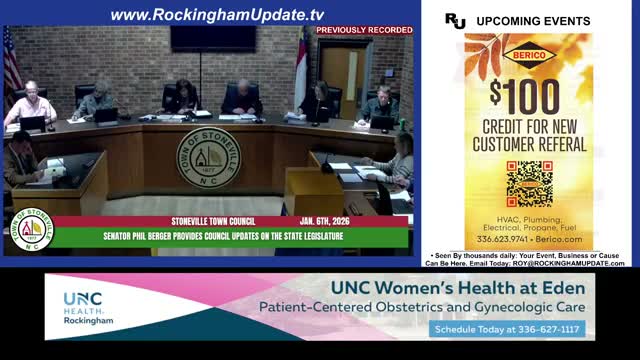
Summary
Senate President Pro Tem Phil Berger told the Wentworth Town Council Jan. 6 that he helped secure $2 million for DOT engineering studies to break long highway upgrades into fundable segments, outlined DMV fixes tied to Real ID backlogs and said the legislative short session will likely begin in April or May.
Senator Phil Berger, president pro tem of the North Carolina Senate, told the Wentworth Town Council on Jan. 6 that state leaders are working to turn long-planned highway upgrades into smaller projects that can be funded and planned more quickly.
Berger said he "was able to find $2,000,000, to get to DOT to fund the study that is in the process of being done as we speak," describing the money as intended to pay for engineering work that would allow projects such as upgrades on US 220 and US 29 to be split into smaller segments and placed into the State Transportation Improvement Program (STIP).
Why it matters: Council members have raised congestion and safety concerns on local corridors. Berger said breaking a multi-county corridor into phases makes state and federal funding more attainable and allows work to begin on the most congested segments sooner.
Berger also addressed questions about the Division of Motor Vehicles, which has faced long lines and appointment backlogs since implementation of the federal Real ID requirements. He said the state auditor’s recent DMV audit had recommendations, the governor appointed a new DMV commissioner and the legislature has funded some additional positions and made procedural changes, such as allowing online extensions for certain renewals. "It ain't fixed yet, but I think we are making some progress," Berger said.
On the state budget, Berger said North Carolina operates under a rollover mechanism when a new full budget is not adopted: the prior year’s numbers continue while lawmakers negotiate. He described the remaining disagreement between House and Senate leadership as centered on a previously enacted income tax reduction trigger; the House has sought to change the trigger and the Senate has resisted cancelling the promised tax cut. Berger said the legislature will convene for a short session in the spring and urged local governments to submit proposed local bills early so staff can help draft them.
What’s next: Berger encouraged residents and officials to contact his office with local issues and offered a weekly legislative email distribution list and staff contacts for constituent assistance. He also said results of the DOT engineering study should be available in coming months and that DOT meetings could follow to discuss specific local safety projects.