
Lawmakers told Vermont weatherization programs face funding cliff without federal approvals
Get AI-powered insights, summaries, and transcripts
Subscribe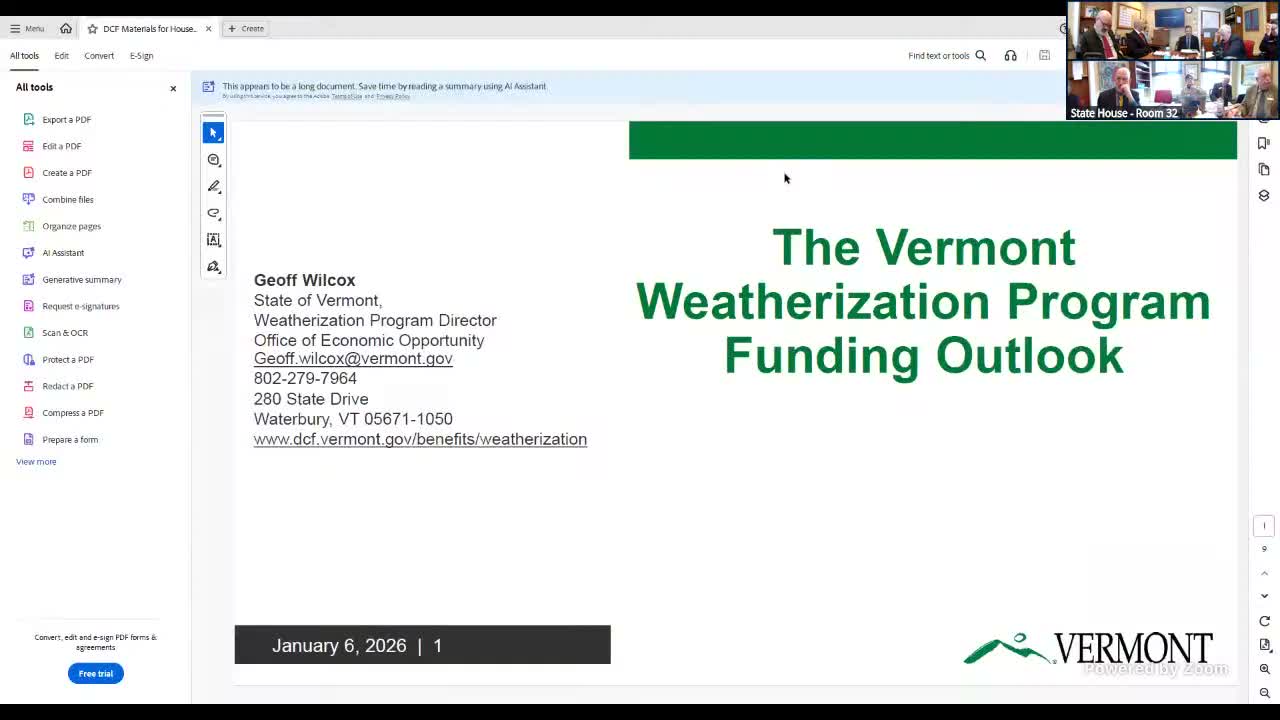
Summary
Witnesses told the House Energy and Digital Infrastructure Committee that Vermont can sustain roughly $22–23 million and about 1,300 weatherized homes per year through 2029 only if federal IRA/HOMES funds flow; ARPA funds and DOE training grants are ending soon and pre-weatherization repair funds are insufficient.
Rep. Kathleen James convened the House Energy and Digital Infrastructure Committee and heard from state officials who warned that Vermont’s weatherization programs will face a funding cliff if federal approvals and IRA dollars falter.
Jeff Wilcox, weatherization director at the Office of Economic Opportunity (part of the Department for Children and Families), told the committee the program currently relies on four funding streams: the state home weatherization assistance fund (the 2¢/gallon tax), the Department of Energy (DOE) core grant, a multiyear IIJA/Infrastructure award, and one-time ARPA awards that expire this spring. "That grant performance has been extended through 06/30/2029 by the Department of Energy, but the funds won't last that long. We'll expend those in the next year and a half," Wilcox said.
Wilcox said current program performance is about $22 million and roughly 1,300 homes weatherized per year; state fiscal year '25 saw approximately 900–1,000 low-income homes served, the most to date. Sustaining the 1,300-home level through 2027–29 depends on an anticipated $29 million HOMES award from the IRA that state officials said the Department of Public Service (DPS) plans to grant to OEO.
Melissa Bailey, director of the State Energy Office at the Vermont Department of Public Service, explained the federal picture: Vermont received conditional approval for the HOMES award but DOE placed conditional awards on hold while conducting an OMB-driven program review. "We are in a posture of uncertainty and cautiously optimistic that the funds will flow," Bailey said, summarizing the department’s position.
Committee members pressed officials on two related vulnerabilities. First, pre-weatherization home repairs and vermiculite remediation—roof repair, knob-and-tube wiring fixes and mitigation of vermiculite insulation—have been funded largely with ARPA dollars that will expire. Wilcox said the program has been spending about $900,000/year on home repairs and $300,000/year on vermiculite remediation; by contrast, the DOE weatherization-readiness fund available going forward is only about $200,000/year, leaving a significant shortfall for pre-weatherization work.
Second, Vermont is awaiting DOE approval to use the Hancock energy-modeling tool for HOMES program rollout. Officials said Hancock is already in use for the existing weatherization assistance program but DOE must approve its use under HOMES guidance before rebates and wider HOMES activities can begin.
State options to soften a funding cliff include reallocating state efficiency dollars (TEPF), leveraging higher-than-expected RGGI revenues, and the DPS/efficiency Vermont Demand Resources Plan (DRP) process. Bailey said the department’s DRP proposal would allocate slightly more to low-income weatherization than Efficiency Vermont’s proposal, but she and other witnesses warned that state sources will not fully replace declining federal funds.
The committee did not take formal action; members asked for follow-up testimony and flagged potential cross-committee work if additional state revenues or a new charge (thermal benefits charge) are required to sustain weatherization efforts. The committee will continue oversight and may invite additional testimony to evaluate funding options and contingency planning.