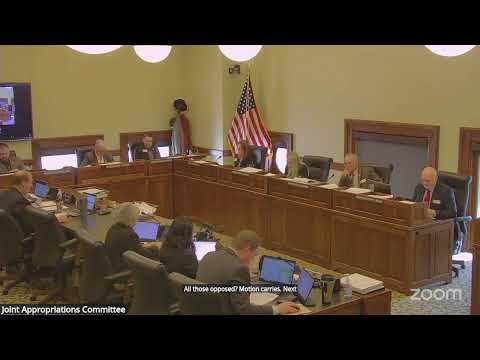
Appropriations committee codifies local direct distributions at 5.6% of sales/use tax after extensive public comment
Loading...
Summary
The committee voted 11–1 to pass LSO 0295, which codifies the Madden distribution formula into statute and sets the direct distribution at 5.6% of state sales and use tax (estimated just over $105 million for the biennium), with payments shifted to October and March and legislative intent language preserved.
The Joint Appropriations Committee on Jan. 12 voted to codify the state’s direct distribution to cities and counties by advancing LSO 0295 (working draft v0.6), which replaces a fixed appropriation with a statutory percentage of state sales and use tax.
LSO legal staff explained the draft replicates the long‑standing Madden formula inputs and moves the distribution schedule from August/January to October/March. "This would be the first time it's in the green books," the attorney said of codifying the formula. Director Don Richards told the committee "the 5.6% for the biennium is just over $105,000,000," adding year‑by‑year timing will slightly vary but the combined amount aligns with the governor's suggestion.
Local officials — county commissioners and municipal representatives — urged higher allocations during a lengthy public comment period. Jeremiah Grama of the Wyoming County Commissioners Association warned the 5.6% could represent "a roughly 30% reduction over current appropriations" for some counties and asked the committee not to alter the Madden formula. Ashley Harpstreet of the Wyoming Association of Municipalities and several mayors described direct distributions as essential for frontline services such as police, fire, water and road maintenance.
Within committee debate Representative Sherwood moved to increase the share to 8%; members expressed concern about changing long‑standing formula inputs and the motion failed on a hand‑raise/voice vote. Representative Alman later proposed targeted tweaks to help very small towns; that amendment also failed after members cautioned that changing the Madden formula would open difficult tradeoffs.
On final roll call the committee approved the bill 11 ayes, 1 no. Members said codification would provide predictability and an inflation adjustment; the chair indicated the committee would make the draft a House bill and that floor leaders would manage timing and further adjustments during the session.