
Vermont working group urges statute with guardrails for noncompete agreements
Get AI-powered insights, summaries, and transcripts
Subscribe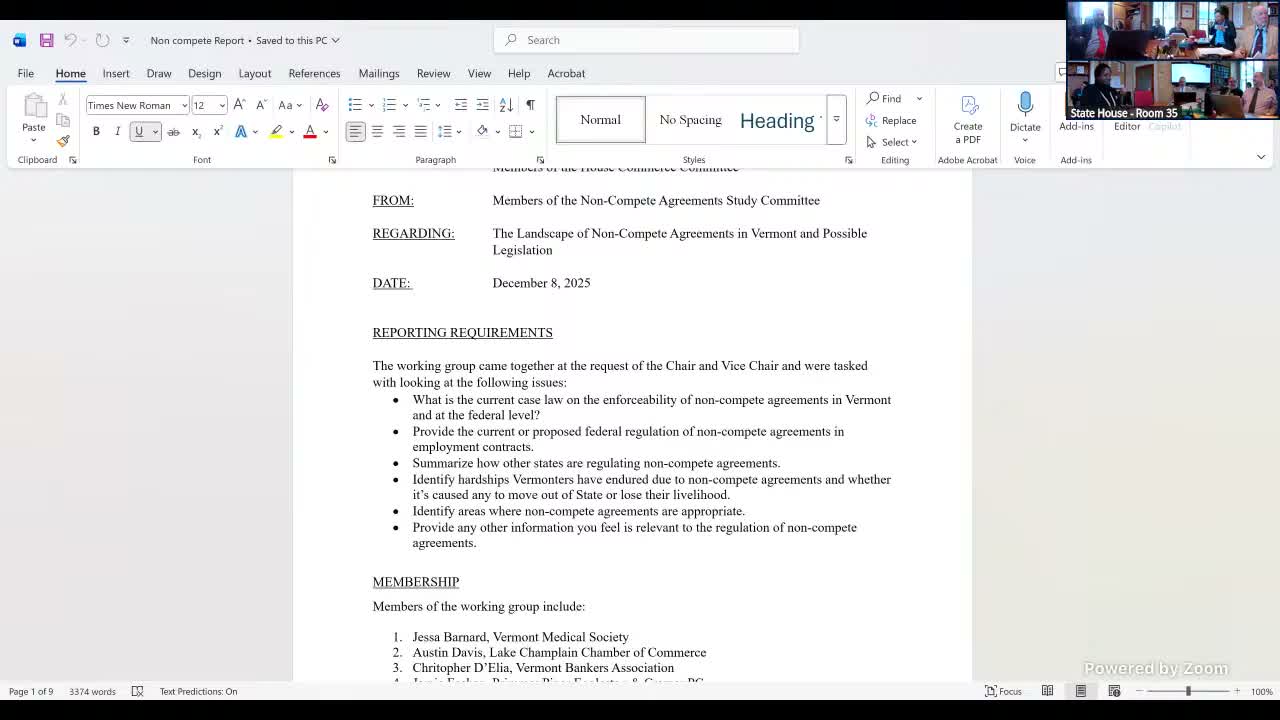
Summary
A Bakers Association-led working group told the House Commerce & Economic Development Committee it could support statutory guardrails on noncompete agreements but flagged major open questions — wage thresholds, trade-secret scope, health-care impacts and a recommendation against retroactive changes.
A working group convened at the House Commerce & Economic Development Committee on Jan. 8, 2026 recommended that lawmakers consider statutory guardrails for noncompete agreements while leaving several consequential decisions — including wage thresholds, trade-secret definitions and health-care exceptions — to further legislative work and case-law review.
The group, organized by Chris Delia of the Bakers Association, reported it met several times last year to examine how Vermont courts have handled noncompete cases and how other states approach the issue. "We felt this might be, an opportunity for you," Delia told the committee, urging lawmakers to use established case law as a foundation for any draft legislation rather than creating an entirely new framework that would invite prolonged litigation.
Why it matters: Noncompete clauses can limit workers’ mobility and earnings but can also protect employers’ proprietary information. The working group and several committee members said a statutory standard would offer clarity for employees, employers and courts — but the group did not reach agreement on key thresholds or definitions that would determine who is covered and when.
Key details: The group highlighted three persistent questions for policymakers. First, whether to adopt an income or salary threshold (some states use fixed-dollar tests) or a two-part test based on both salary and job function; members warned a simple salary cutoff could exclude low-paid workers in startups who nonetheless access proprietary information. Second, how to define trade secrets and the boundary between trade-secret protections, non-solicitation clauses and noncompete restrictions; the group did not undertake a comprehensive review of Vermont’s Uniform Trade Secrets Act to test compatibility with proposed bill language. Third, health-care-specific concerns: presenters and members said noncompetes for clinicians and traveling nurses could reduce access to care and merit careful, possibly separate, treatment.
The working group also recommended several procedural safeguards. Members generally favored prospective-only legislation ("We would strongly suggest you stay away from that," Delia said of retroactive repeal of existing contracts) to avoid litigation risks tied to altering existing agreements. The group supported disclosure and a review period for employees, though Delia flagged practical concerns about a three-day waiting rule if employers must withdraw offers on emergent eligibility information.
What members said: Representative Herb Olsen, who participated in the working group, framed the issue as a public-policy question and noted courts have already developed a body of cautious common law. "They were in general agreement, that, yes, statutory language around this subject, is good idea," Olsen said, urging statute to reduce reliance on costly litigation. Another committee member said simply: "noncompete should be used very rarely," reflecting a broader sentiment among some members that such clauses ought to be exceptional, not routine.
Next steps: Committee members asked staff to compile case law and suggested inviting judiciary staff or legal counsel to clarify how proposed statutory language would interact with existing court decisions and the Uniform Trade Secrets Act. Delia offered to share working-group minutes and source materials with committee counsel. No formal motion or vote occurred during the session.
The committee will consider the working group's materials, request a focused review of relevant case law, and return to draft language and policy choices in future hearings.