
Roseville Grants Advisory Commission details Citizens Benefit Fund rules, $279,940 available for FY2026–27
Get AI-powered insights, summaries, and transcripts
Subscribe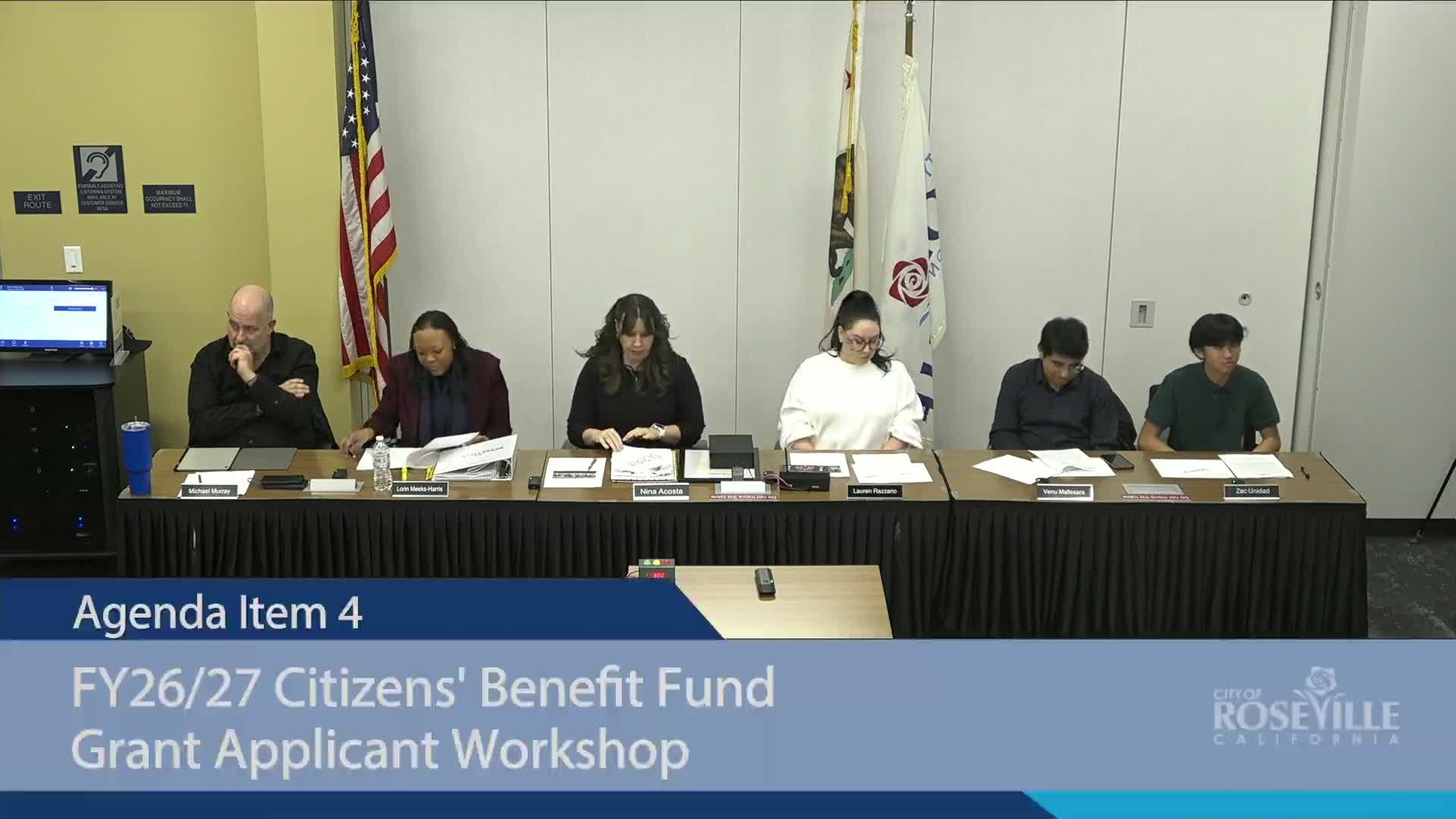
Summary
City staff and commissioners walked applicants through eligibility, required documents, scoring and deadlines for the Citizen Benefit Fund; the commission reported $279,940 available, an application deadline of 5 p.m. Feb. 2, 2026, and emphasized the three‑bid rule for capital expenditures.
City of Roseville staff and the Grants Advisory Commission gave a detailed applicant workshop on Jan. 13, outlining who may apply to the Citizens Benefit Fund, what paperwork is required and how proposals will be scored.
Staff said the commission has $279,940 available for the FY2026–27 grant cycle and urged nonprofits and school‑affiliated applicants to submit applications through ZoomGrants by 5 p.m. Monday, Feb. 2, 2026. Staff also described the award schedule: staff eligibility review in February, commissioner scoring in March, a commission funding discussion on April 14 and city‑council consideration of recommendations in May or June. The commission plans to present award checks at its Aug. 11, 2026 meeting; the fiscal year runs July 1, 2026–June 30, 2027.
The presentation reviewed eligibility limits and documentation. Staff said the Citizens Benefit Fund accepts applications from 501(c)(3) and 501(c)(4) entities and some private‑school–linked nonprofit associations, but public funds must primarily benefit Roseville residents. Applications must include a current Roseville business license, evidence of charitable registration (RRF‑1 or extension), a Secretary of State certificate of status (or filed statement of information), a 501(c) determination letter, board authorization (wet signature or DocuSign), and a budget narrative. Staff advised that if a required document genuinely does not apply, applicants should upload a short “NA” explanation rather than leaving the field blank; otherwise an application may be ruled incomplete and disqualified.
On capital projects, staff emphasized the procurement rule adopted in the policy manual: individual items or projects with costs above $500 require three documented bids (telephone, online or written). Purchases or projects of $4,000 or more require three written bids. Staff said proof of property ownership or a landlord authorization letter must be attached for requests that include property improvements.
Commissioners reviewed funding priorities and community‑needs categories derived from a community needs assessment: strategic one‑time grants for innovation and capital; operational mission support; and small requests up to $10,000. Applicants must choose one funding priority and one needs area (food, health and wellness, community and social context, education, or neighborhood/physical environment).
Scoring guidance emphasized clarity and measurable outcomes. Commissioners told applicants to "spell out your acronyms" and to write applications as if reviewers had never heard of the organization. One commissioner urged applicants to explain the "probability of success" and provide concrete measures of impact; staff reminded applicants that commissioners rely only on materials submitted and cannot seek additional clarification during scoring.
Staff reviewed practical ZoomGrants tips: use a monitored email address for continuity, draft responses offline then paste plain text into the form, and confirm required fields and attachments before final submission. Staff said the city will open a short eligibility‑determination period (roughly Feb. 9–13) to allow applicants to correct inadvertent deficiencies in documentation, but warned that failure to respond to staff inquiries may still lead to disqualification.
During a public Q&A, applicants asked whether practicum students supervised by licensed clinicians were acceptable for therapy programs (staff: yes, include documentation), whether the application required a balance sheet (staff: include a program budget and the organization's operating budget), and whether partial funding was possible (staff: yes, partial awards will be considered though staff will try to fully fund projects when feasible). Dr. Amira Halawa asked whether scoring adjusts for equity to help lower‑resourced nonprofit applicants; staff said equity adjustments are not built into the current scoring approach or the KONE community needs assessment but that the commission had discussed the topic and will revisit it in May.
The workshop materials, scoring questions and a frequently asked questions document will be posted on the city grants web page. Staff encouraged applicants to contact city staff or the listed ZoomGrants technical support address for submission issues. "The grant application is available via the link to Zoom grants," staff said, and repeated the Feb. 2 submission deadline and the $279,940 funding amount.
Next steps: applicants should submit a complete packet by 5 p.m. Feb. 2; staff will perform an eligibility review in February and return qualifying applications for commissioner scoring in March, with the commission meeting to consider funding recommendations on April 14.