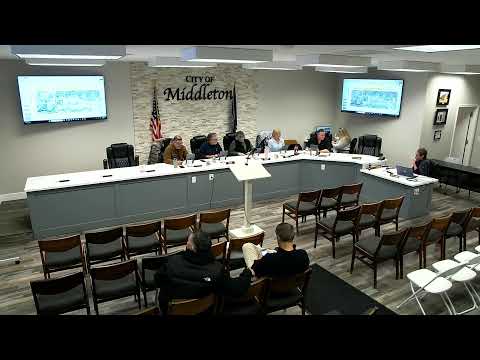
Middleton planning commission removes downtown couplet, approves county AOI and rejects Southern Bypass routes
Loading...
Summary
The Middleton Planning & Zoning Commission voted to remove a proposed downtown couplet from the comprehensive plan, accept the Canyon County-determined Area of Impact (AOI) and Viking Street addition, and deny adding two Southern Bypass alternatives and deleting Crane Creek Plaza; developers warned the changes follow months of uncertainty and millions in local investment.
MIDDLETON, Idaho — The Middleton Planning & Zoning Commission on Jan. 12 voted to amend the city's comprehensive plan maps to remove the downtown one-way 'couplet', accept the Area of Impact (AOI) map approved by Canyon County, and add a Viking Street corridor — while declining to add two Southern Bypass alternatives drawn from an ITD PEL study or to remove the Crane Creek Plaza concept.
The vote concluded a public hearing and several hours of staff presentation and public testimony. The commission's motion, made by Chair Matthew Watkins and seconded as recorded, instructed staff to replace appendix graphics and revise comp plan text to reflect the county AOI and to strike the couplet from both the Transportation & Schools map and the Functional Classification Map.
Why it matters: The contested map changes would redraw assumptions about where the Idaho Transportation Department (ITD) might site a regional bypass and who controls future development. Developers told the commission that placing a bypass line on local maps could halt projects and scare off investors. Two local developers said they had already spent substantial sums: Tyler Hess said his firm was about $10,000,000 into Riverwalk Ranch and that a bypass line could pause construction and investor interest; Spencer Kofet said he and partners were over $12,000,000 into a commercial project and had recently paid a roughly $2.5 million invoice for infrastructure.
City planner presentation: A city planner summarized the PEL (Planning and Environmental Linkages) study prepared for ITD, saying the study evaluated four alternatives, eliminated a simple widening of Highway 44, and recommended two Southern Bypass alternatives (labeled in the PEL as alternatives 2 and 3) to advance to federal-level review. The planner also said the recommended bypass alternatives would require a roughly 150-foot right-of-way and produce a five-lane cross section (two lanes each direction plus center turn lane).
Commissioner concerns and staff response: Multiple commissioners voiced reluctance to draw firm bypass lines into the comp plan without formal written confirmation from ITD. One commissioner asked whether ITD had provided formal letterhead documentation; staff replied that they had e-mail correspondence from the PEL team but not a formal federal submittal. Chair Watkins and others argued that placing conceptual alignments on the comp plan could chill development and force repeated plan updates.
AOI and county role: The planner explained that a 2024 state law required counties to reconfirm cities' AOIs; Canyon County adopted a smaller AOI for Middleton during that process, and the planner said the commission's action will replace comp plan appendix maps with the county-determined boundary. The planner noted the commission may recommend changes to the council but must place any relied-upon facts and law into the record.
Public testimony: Speakers from the public urged caution. Tyler Hess (Hess Properties) said, ''Number 1, we're $10,000,000 into this project,'' and warned that a bypass line would 'scare people away.' Spencer Kofet said his team had followed development agreements and invested heavily in roads, sewer and a roundabout, and pleaded with the commission not to put a bypass line back through an approved plat.
Vote: On roll call the commission recorded Chair Watkins — Aye; Commissioner Gregory — No; Commissioner Gibson — Yes; Commissioner Klinger — Aye; Commissioner Thi — Aye. The commission declared the motion approved.
What happens next: The commission's action is a recommendation to modify the comp plan maps and text; staff will prepare the map and appendix changes for the formal record and next steps with city council and other agencies. The commission also left the AOI as the county adopted it; commissioners indicated that the AOI decision resulted from a county process and was not practically reversible at the local level.
The planning commission closed the meeting at 6:43 p.m.