
Vermont economic development authority seeks role in financing multifamily housing; VHFA urges caution
Get AI-powered insights, summaries, and transcripts
Subscribe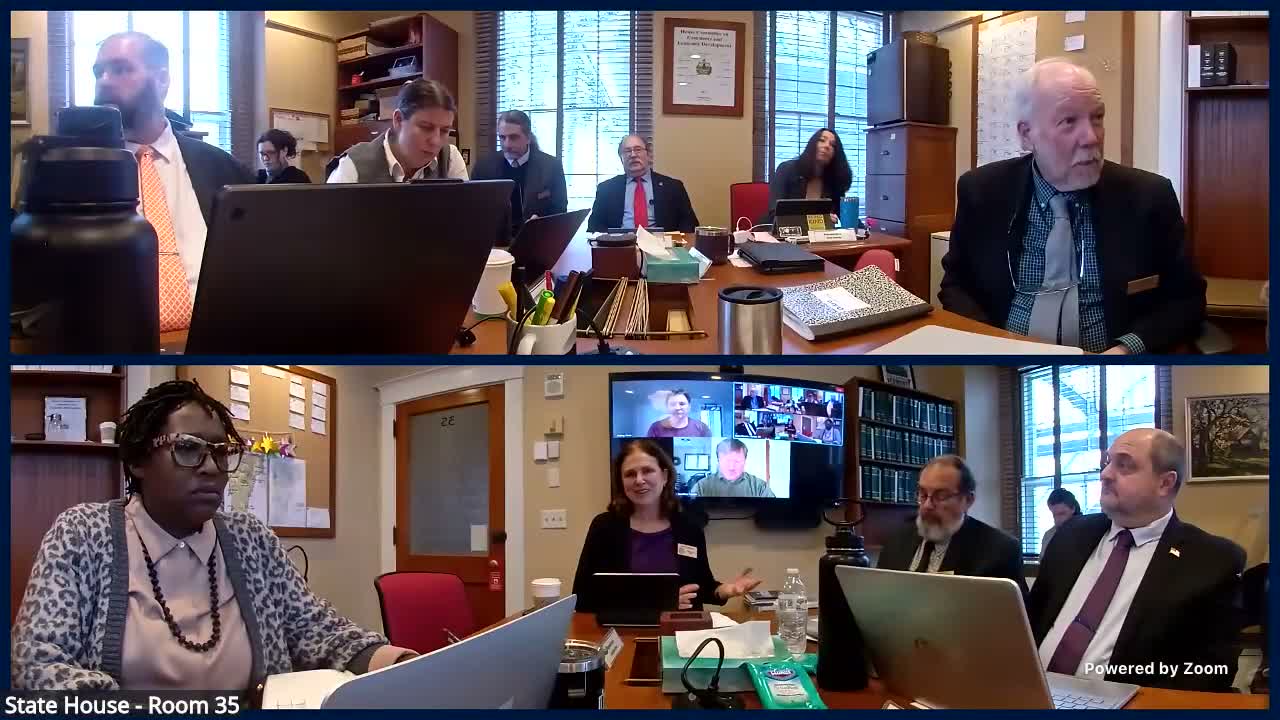
Summary
VEDA asked the House Commerce & Economic Development Committee to change statute so it may participate as a subordinate lender on multifamily (5+ unit) projects. VHFA said liquidity exists but cheaper financing, subsidy and nonfinancial fixes (workforce, permitting) are needed to make projects affordable.
Joan Goldstein, CEO of the Vermont Economic Development Authority, told the House Commerce & Economic Development Committee on Jan. 7 that VEDA seeks statutory authority to participate in financing multi-unit housing in partnership with banks and credit unions. Goldstein said VEDA would act only when private lenders ask for a subordinate participant and would not solicit or supplant existing lenders.
Goldstein said VEDA has provided financing since 1974 and currently has about $285 million in loans and roughly $230 million in outstanding debt. "So our ask is that in order to play a role to help assuage some of the issue, why not add VEDA, give VEDA that capability to do to expand the commercial real estate capabilities with the banks and credit unions only when they need us," she said.
Maura Collins, executive director of the Vermont Housing Finance Agency, said VHFA welcomes collaboration but urged the committee to weigh tradeoffs. Collins told members that the central market problem she hears from developers and lenders is not availability of loans but the cost of debt and total development costs. "The problem is paying for that loan," she said. "The debt service to pay for that loan will drive up rents."
Collins highlighted state and federal financing tools that make lower interest rates possible, including tax-exempt private activity bonds and the state—s 10% for Vermont program (LIAC). She said Vermont lost more than $300 million in volume-cap allocation between 2013 and 2022 because it went unused and argued the state should prioritize using that allocation when feasible. She also noted VHFA can and does act as a subordinate lender on multifamily projects.
VHFA cautioned that adding more lenders or funding sources can increase total development costs through extra legal, underwriting and review steps. Collins cited data showing projects with many funding sources often have higher per-unit costs and said subsidy rather than incremental loan participation is frequently required to make affordable projects pencil. She also emphasized nonfinancial barriersworkforce shortages, permitting delays and certain energy requirementsthat raise construction costs.
Both agency leaders described projects where coordinated financing has been used successfully, and Collins said VHFA and VEDA have complementary roles dating to the agencies— 50-year histories. No formal action or vote was taken; the committee will consider statutory language and follow up with agency staff as the session advances.