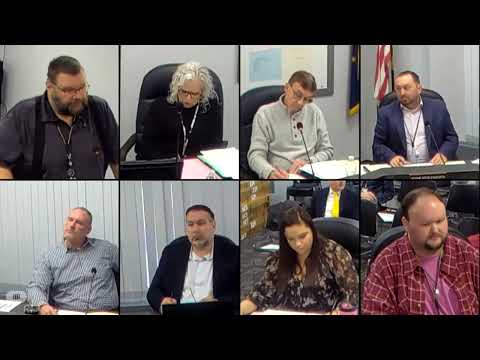
Grant County adopts meeting rules, approves incarceration-fee ordinance and jail-capacity resolution
Loading...
Summary
The Grant County commissioners adopted Ordinance 2026-1 (rules of procedure), Ordinance 2026-2 (authorizing the sheriff to collect inmate incarceration fees in a restricted fund), and Resolution 2026-1 addressing jail population and transport/housing funding. Each measure passed by voice vote on Jan. 5, 2026.
The Grant County Board of Commissioners adopted three formal measures during its Jan. 5, 2026 meeting: a rules-of-procedure ordinance, an ordinance authorizing the sheriff to collect inmate incarceration fees, and a resolution on jail population and related funding.
County Attorney Marty Harker introduced Ordinance 2026-1, described in the meeting as an ordinance of the Grant County Indiana Board of Commissioners establishing rules of procedure for conduct of official meetings. After brief discussion the board approved Ordinance 2026-1 by voice vote.
At the sheriff’s request, Harker presented Ordinance 2026-2, which — according to the attorney’s summary — authorizes the sheriff to charge and collect the maximum per diem incarceration fee allowed under Indiana law and requires creation of a County Prisoner Reimbursement Fund. Harker said the ordinance contains indigency exceptions and that funds deposited to the reimbursement fund are restricted by statute for operation, construction, repair, remodeling, equipping of the county jail or juvenile detention center, or for the cost, care, maintenance and housing of prisoners, including housing prisoners in other counties. The transcript does not specify the dollar amount of the per-diem maximum; the ordinance was approved on a voice vote after a short public-comment period.
Harker also introduced Resolution 2026-1, intended to minimize the county’s legal risk from jail overcrowding. The resolution asks the sheriff to maintain the jail at or below the county’s maximum operating capacity and requests that the County Council appropriate funds necessary to transport and house inmates when overcrowding occurs. The board adopted the resolution by voice vote.
Votes at a glance • Ordinance 2026-1 (Rules of Procedure) — adopted (voice vote). • Ordinance 2026-2 (Incarceration fee / County Prisoner Reimbursement Fund) — adopted (voice vote). The transcript records the ordinance’s intent and restrictions but does not record a numeric per-diem amount. • Resolution 2026-1 (Jail population / funding request) — adopted (voice vote).
The board opened a public-comment period for Ordinance 2026-2; one member of the public, Bill Creech of Marion, spoke in general support of the commissioners’ 2025 work and did not address the ordinance’s details. No opposing public testimony appears in the transcript.