Get Full Government Meeting Transcripts, Videos, & Alerts Forever!
Get email alerts on the Infrastructure Planning topic
No spam. Unsubscribe anytime.
Missoula County outlines 50-year Wye infrastructure plan to enable housing and industrial growth
Summary
Missoula County staff and private developers presented a 50-year infrastructure plan for the Wye area, stressing that water, sewer and roads must come first to unlock housing (potentially thousands of homes) and industrial development; the plan recommends phased infrastructure, funding strategies and further studies on aquifer, schools and intersections.
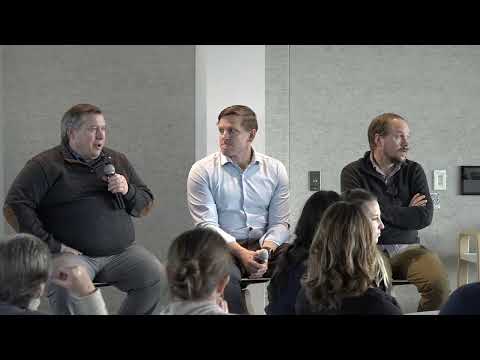
Missoula County officials and private developers laid out a long-range plan at a City Club Missoula forum to guide development in the Wye area, stressing that central water, sewer and road infrastructure are prerequisites to building housing and industrial capacity at scale.
Andrew Hagemeyer, director of community and economic development for Missoula County, said the county faces two central problems driving the Wye plan: a local housing shortage and a shrinking industrial land base that affects jobs and the tax base. "The three most critical, the must-haves, are water, sewer, and roads," Hagemeyer said, framing infrastructure as the lever that will allow denser, more diverse housing and modern industrial uses.
Jeff Smith, chief executive officer of WGM Group, summarized the Wye infrastructure study and phasing. He said the study area is about 3,400 acres after removing interstate and rail rights-of-way, and that a parcel-by-parcel inventory covered more than 700 parcels. The plan uses a Phase 0–4 sequencing approach; Phase 0 identifies precedent or catalyst infrastructure needed before development can proceed. Smith said full build-out scenarios informed transportation, water, sewer (including membrane bioreactor, or MBR, treatment facilities for parts of the area), stormwater controls and public-service needs for schools, fire and parks.
Smith said the plan’s 50-year horizon produced large-scale estimates: about 800 acres of developable industrially zoned land with potential for roughly 7,000,000 square feet of industrial buildings, and about 1,300 acres in planned-neighborhood zones that could yield up to 10,000 homes at an 8-units-per-acre threshold. He also said a full-build transportation scenario could generate on the order of 100,000 trips per day across phases.
Developer Matt Malott of Sterling Commercial Real Estate Advisors argued the county can avoid low-density sprawl by building town-center development around job centers already present in the Wye, citing existing employers such as Amazon and Montana Knife Company. "Nobody likes sprawl," Malott said, and he used taxable-value examples to show how infrastructure supporting taller, denser development raises tax revenue per acre compared with low-density lots.
Presenters repeatedly emphasized that infrastructure is expensive and must be funded through a mix of private investment and public funding. Smith said the plan includes a stepwise funding strategy that layers private, local, state and federal sources and called for an aquifer study to guide future water-supply decisions. On sewer, Smith recommended MBR systems for outlying planned neighborhoods and noted that parts of the Wye already sit inside the City of Missoula’s utility service area while much of the planned neighborhood land lies outside that boundary.
During table-top discussions and the question-and-answer period, residents and stakeholders asked about specific impacts and implementation details. Susan Holloway asked how smaller nearby school districts such as Hellgate and DeSmet would be funded; Hagemeyer replied that school districts control their own funding and that the county can assist by funding studies and helping with school siting and analysis. Questions about parks, active-transportation connections across the interstate and transit, and clean-energy opportunities prompted staff to point to planning-level recommendations in the plan and to note that more design and engineering work is required.
Audience questions also covered whether the county would consider purchasing private water systems on the south side of I‑90; presenters said the plan recommends studying that option and ultimately folding local systems into a coordinated network of supply and distribution administered at the county level. Several private-sector participants said sequential land assembly and development will be led by the private sector with county assistance for infrastructure and permitting.
The presenters closed by noting next steps: further technical studies (aquifer, intersection capacity and corridor studies such as West Broadway to Russell Street), refinement of phasing and funding strategies for Phase 0 work, and coordination with affected school districts and fire districts. Brandon Noss, City Club chair, thanked the speakers and opened the room for table talk and questions to continue in future forums.