Montgomery County officials highlight rapid newcomer enrollment but warn staffing and crisis caseloads are straining services
Loading...
Summary
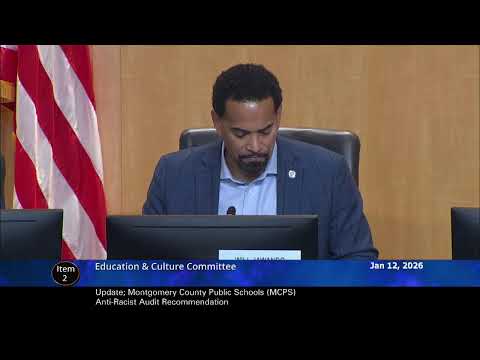
MCPS officials told the Education and Culture Committee that process improvements have sped newcomer enrollment—75% of students are enrolled within two days and 95% within a week—but staff cuts to trauma‑responsive counselors (ETCs) and rising crisis referrals tied to recent federal immigration enforcement are stretching capacity.
MCPS officials updated the Montgomery County Council’s Education and Culture Committee on the work of the International Admissions and Enrollment (IAE) office, reporting quicker intake times alongside rising case complexity that strains a reduced counseling team.
Margarita Borges, IAE director, said the office now functions as a centralized trauma‑informed welcome center that does more than enroll students: staff conduct mental‑health intakes, perform credit evaluations, provide immediate needs (food, clothing) and coordinate referrals to community partners. "Seventy‑five percent of our students are enrolled within just two days of arriving at our office," Borges said, adding that "95% of the families enroll within a week." Borges said those turnaround times mark a major operational improvement since the pandemic.
The presentation noted several technical and process upgrades — ParentVUE assistance at the welcome center, a new call‑center queue with callback options, and electronic intake via the Synergy system — that have shortened wait times and improved credit‑transfer accuracy for secondary students. Borges also said the IAE now operates under the Division of Multilingual Education and that a proprietary global coursework database has helped place secondary newcomers in appropriate classes.
At the same time, council members pressed staff about capacity. Oscar Albaringa, newcomer coordinator, said the dedicated team of EML therapeutic counselors (ETCs) has fallen to about 20 active counselors from a high of 37 in 2023. "Our ETCs are assigned to two to three schools each, and then they provide countywide referral support," Albaringa said. He added that reductions have forced IAE to reassign or drop weekly on‑site coverage at roughly five schools and to triage countywide referrals.
Councilmembers linked the staffing strain to a shift in the nature of cases: several speakers described an increase in crisis incidents — students whose parents have been detained, deported or otherwise removed from a household — and in nonresident and McKinney‑Vento cases that require longer residency verification and wraparound supports. "The conversations have changed to crisis mode," Albaringa said, noting the rapid need to stabilize students when families face enforcement actions.
Borges said that a residency specialist routes complex cases and that the office enrolls certain crisis students tuition‑free when they meet McKinney‑Vento or other emergency criteria. Committee members were told MCPS currently identifies about 1,467 McKinney‑Vento students and that the number is growing.
Members asked for follow‑up information: disaggregated country and language data for newcomers, a list of schools that will lose weekly ETC coverage, and more detail on professional development and staffing classification. Borges confirmed IAE has several staff who can notarize documents on the spot and described efforts to expedite transcript certification for families leaving the country.
The committee did not take formal action on the briefing. Staff said they will provide requested follow‑up data and appear at upcoming budget forums where staffing and funding options can be discussed.