
Downingtown advisers recommend $30 million bond refinancing to address deferred maintenance
Get AI-powered insights, summaries, and transcripts
Subscribe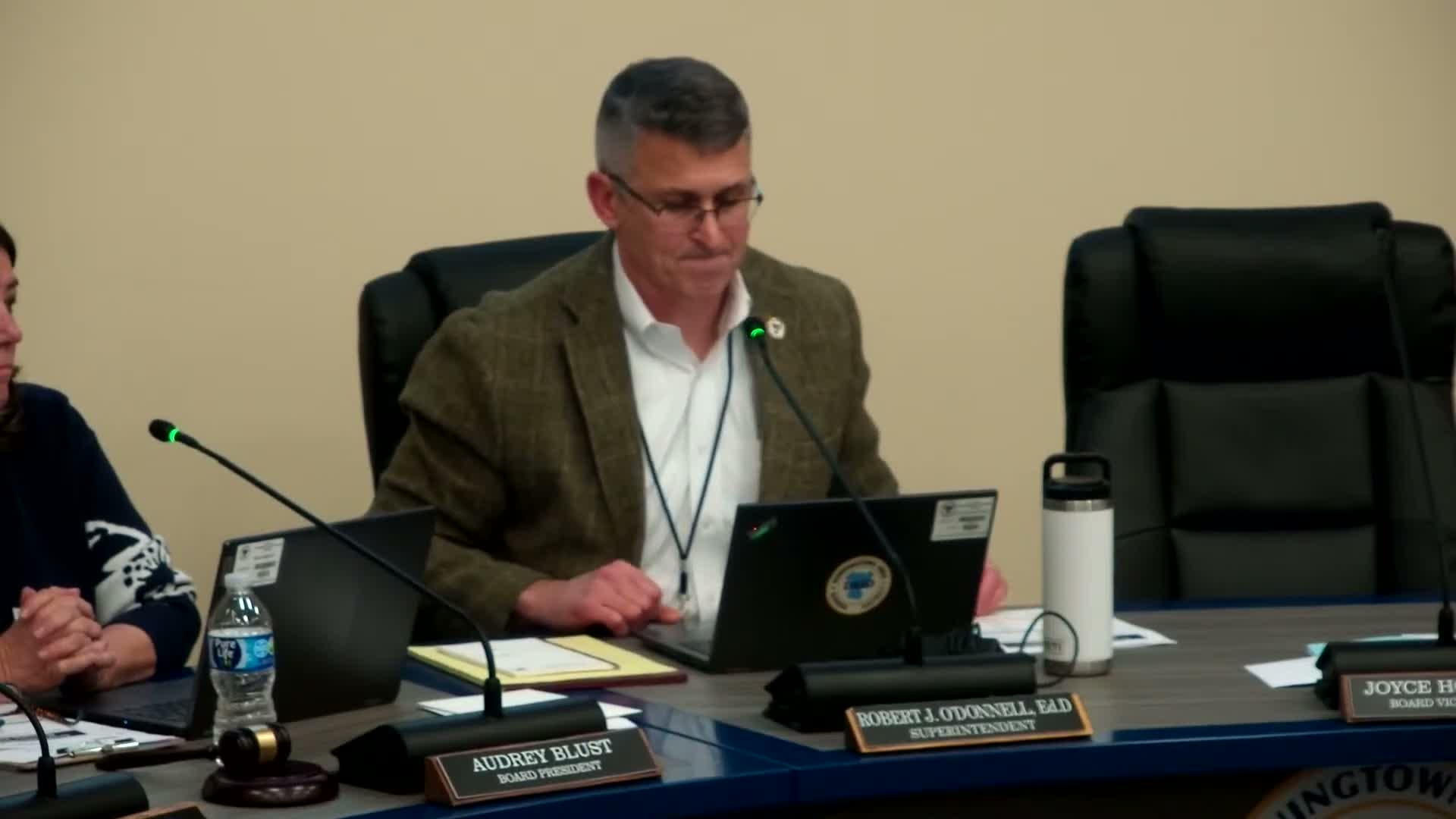
Summary
School district advisers told the board that falling municipal rates make reallocating debt and issuing $30 million in new bonds attractive to pay for deferred HVAC, roofs and other capital work while stabilizing annual debt service.
Downingtown Area School District officials and their financial advisers recommended pursuing a refunding that would refinance three existing bond issues and issue $30 million in new money to address deferred maintenance and restore capital reserves.
At an informational Committee of the Whole meeting, Raymond James underwriting partner Lou Verdeli said municipal borrowing rates have moved lower in recent months and that the district’s strong credit profile would likely yield interest rates in the low-to-mid 3% range. John Fry of PFM reviewed the district’s outstanding debt and call schedule, noting about $8 million in annual debt service and roughly $47 million principal outstanding on active issues.
The advisers presented several scenarios: refund existing eligible issues and borrow either $20 million or $30 million, while either maintaining the district’s current $8 million annual run rate or structuring payments to lower that run rate by $1 million or $2 million. Verdeli said lowering the annual budget burden requires modestly extending maturities in some scenarios but stressed that, because market rates are lower, the extension would not be prohibitively costly.
Dr. Christopher O'Donnell, the superintendent, told the board the administration favors the $30 million option to replenish capital reserves and reimburse prior projects such as Beaver Creek and West Bradford. "This gives us an opportunity to address deferred maintenance that we otherwise might not be able to fund," he said.
Advisers framed the procedural timeline: bonds could be priced and interest rates locked in early April, with the earliest settlement after May 1 (the 90-day window before an 08/01/2026 call date). They recommended the board consider approving a maximum-parameters bond resolution at the regular Feb. 11 board meeting so the financing team can advertise the issue and proceed with pricing if the board directs.
Board members asked detailed questions about which prior projects were financed by the 2017 and 2018 issues, the total gross/net debt-service cost under each scenario and whether the restructuring would affect the district’s credit rating. Fry and Verdeli said rating agencies typically weigh overall financial performance and demographic factors more heavily than a modest restructuring or small term extension; they did not expect a credit downgrade if maturities remain relatively short.
Several directors and staff stressed that any new proceeds should be prioritized for mechanical systems and safety‑critical projects. Administration and advisers said the district can repay borrowed principal early if a future cash inflow occurs (property sales or other windfalls), but they cautioned that such pay-downs cannot be guaranteed.
No formal board vote on a bond authorization was taken at the Committee of the Whole meeting; the advisers presented the options for the board’s consideration and asked for direction to return with materials and a draft parameters resolution for the Feb. 11 regular meeting.
The district will return to the board with final recommendation and resolution language; if the board approves the parameters resolution in February, advisers plan to price in early April and settle in May.