
North Kingstown details PFAS detections and outlines $12.6 million treatment plan
Get AI-powered insights, summaries, and transcripts
Subscribe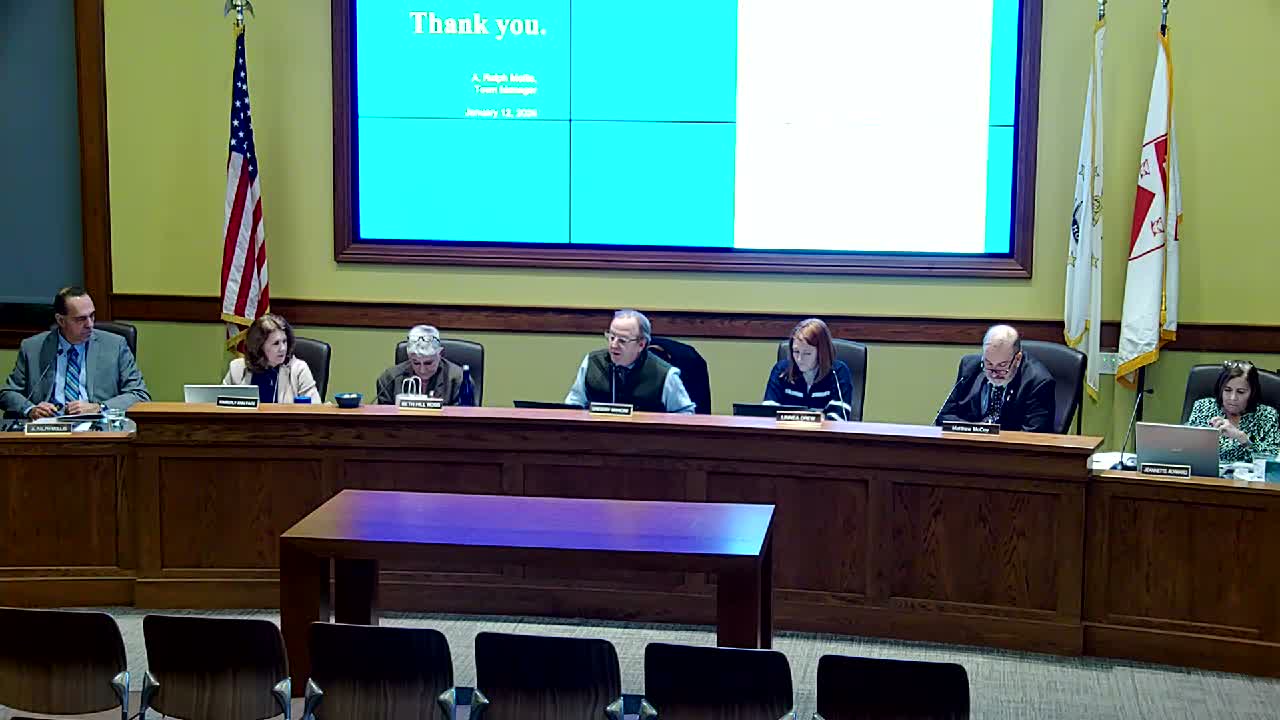
Summary
Town Manager Ralph Malas and water staff told the council that four of six active wells show PFAS detections (2.73–12.8 ppt), all below Rhode Island's 20 ppt standard; the town described options including a locally built treatment plant (estimated $12.6 million) or wholesale purchase from Kent County Water and funding from state infrastructure grants and class-action settlement proceeds.
Town Manager Ralph Malas delivered a comprehensive update to the North Kingstown Town Council on Jan. 12 about PFAS — the class of so‑called "forever chemicals" — in the town's drinking-water wells and the town's planned response.
Malas said Rhode Island has a drinking-water standard of no greater than 20 parts per trillion (ppt) for PFAS. "All of our well sources are well below the 20 parts per trillion standard," he told the council, but he also warned that the U.S. Environmental Protection Agency has signaled it may focus on certain PFAS constituents at levels near 4 ppt.
Malas reported that testing detected PFAS in four of the town's six active wells at levels ranging from 2.73 ppt to 12.8 ppt. "We have detected PFAS in sampling in 4 of our 6 active well sources at levels ranging from 2.73 parts per trillion to 12.8 parts per trillion," he said, and added that Well 10 had been taken offline in 2014 out of precaution.
Town staff described two principal response options under active consideration: building a local treatment facility designed to remove PFAS from Well 9 (and potentially Well 10) or purchasing pretreated wholesale water from Kent County Water. Malas said the town has engaged CEI Engineering on design work for a treatment plant and is coordinating with the Rhode Island Infrastructure Bank for grant and low‑interest loan support. He said the town has also joined a national class-action lawsuit that has yielded more than $2,000,000 to date and expects additional recoveries.
On estimated costs, Malas said the most reliable figure the town has received to date is about $12,600,000 for plant construction, with ongoing treatment and operation costs projected at roughly $200,000 per year. He acknowledged estimates vary and that the town is exploring grant and loan combinations to limit the local fiscal burden.
Alan (Water Department) answered council questions about testing for private-well owners and treatment technology. He said the state's private-well program is developing testing capacity and confirmed the granulated activated carbon (GAC) technology under discussion can address multiple emerging contaminants, though disposal of spent media would remain a future consideration.
Malas reviewed operational capacity across wells and contingency planning: Well 9 supplies 1,800 gallons per minute and is a significant source, Wells 7 and 8 are maintained as emergency backups (combined about 1,000 gpm) but are offline, and a new Well 3 is under construction to replace several older wells. He emphasized the town is "in a very favorable position" to pursue treatment given available capital funds, RI Infrastructure Bank programs and the class-action settlement funds, but that any major decision would come back to the council for approval.
Council discussion focused on homeowners with private wells (testing access and outreach), whether a treatment plant could be designed to handle future contaminants, and the trade-offs of buying wholesale pretreated water (cost and operational control). Malas said no immediate water‑rate increase is planned but noted that long-term financing, design and construction choices could affect rates later.
The council did not take a formal vote on a building decision at the Jan. 12 meeting; members asked staff to continue design work, pursue funding opportunities, keep the council apprised and explore private-well outreach and testing information for residents.