Panama City approves budget amendment to start internal paving crew over objections from two commissioners
Loading...
Summary
Commission approved a budget amendment and interlocal agreement to establish an internal paving crew and equipment purchases totaling $1,558,708.00; vote passed 3–2 after debate over cost, staffing and use of HUD and CRA funds.
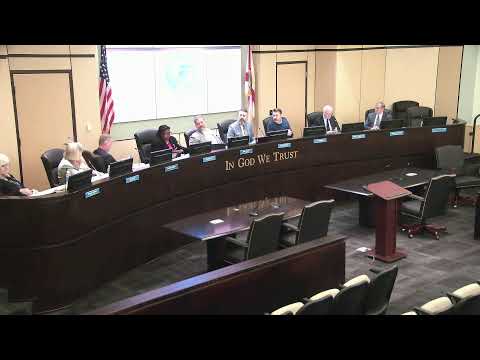
The Panama City Commission voted 3–2 on Jan. 13 to approve a budget amendment and interlocal agreement to establish an internal residential paving crew aimed at accelerating repairs of neighborhood streets.
Staff presented resolution 20260113.2 and an interlocal agreement with the Panama City Community Redevelopment Agency that would fund roadway repairs over five years: $450,000 per year for the Millville District, $250,000 per year for Downtown North, and a proposed St. Andrews allocation to begin in a later fiscal year. The proposal also relied on one-time Housing and Urban Development (HUD) funds in FY26—$273,000 for a leased asphalt paver and $350,000 for materials and rentals—with a lease-to-purchase plan that, per the staff memo, would permit the city to buy the paver at the lease end for an estimated $1,700.00 (document text).
The budget amendment totaled $1,558,708.00 to cover the lease, equipment purchases (including a 15-ton spreader quoted at $235,708.00), and related items. Deputy City Engineer Matt DeVito and public-works staff said the chosen equipment is smaller than contractor-grade pavers but suits the program’s objective of addressing short, fragmented neighborhood segments where mobilization costs make contractor bids expensive.
Supporters said an in-house crew would reduce mobilization fees, speed response to potholes and small segments, and fill a service gap that contractors won’t economically address. "We're building a tool that allows us to save money on the smallest, tiniest pieces of asphalt in the city," a commissioner said in favor.
Opponents argued the city lacked experience, that initial buy-in would tie up funds needed for other priorities, and that the $5 million five-year figure cited in debate underestimates long-term costs. "I don't believe that we ought to be in the road business," one commissioner said, voting No.
The motion to approve the interlocal agreement and budget amendment passed 3–2; roll call votes were recorded on the record. Staff said CRA, housing, and environmental-services funds would cover the program over the five-year initial plan and that staff will return for implementation details and reporting.
Next steps: staff to coordinate procurement, finalize lease-purchase terms and report program metrics to the commission during implementation reviews.