
Santa Monica council directs planning review and repeals interim zoning after FPPC guidance on councilmember conflict
Get AI-powered insights, summaries, and transcripts
Subscribe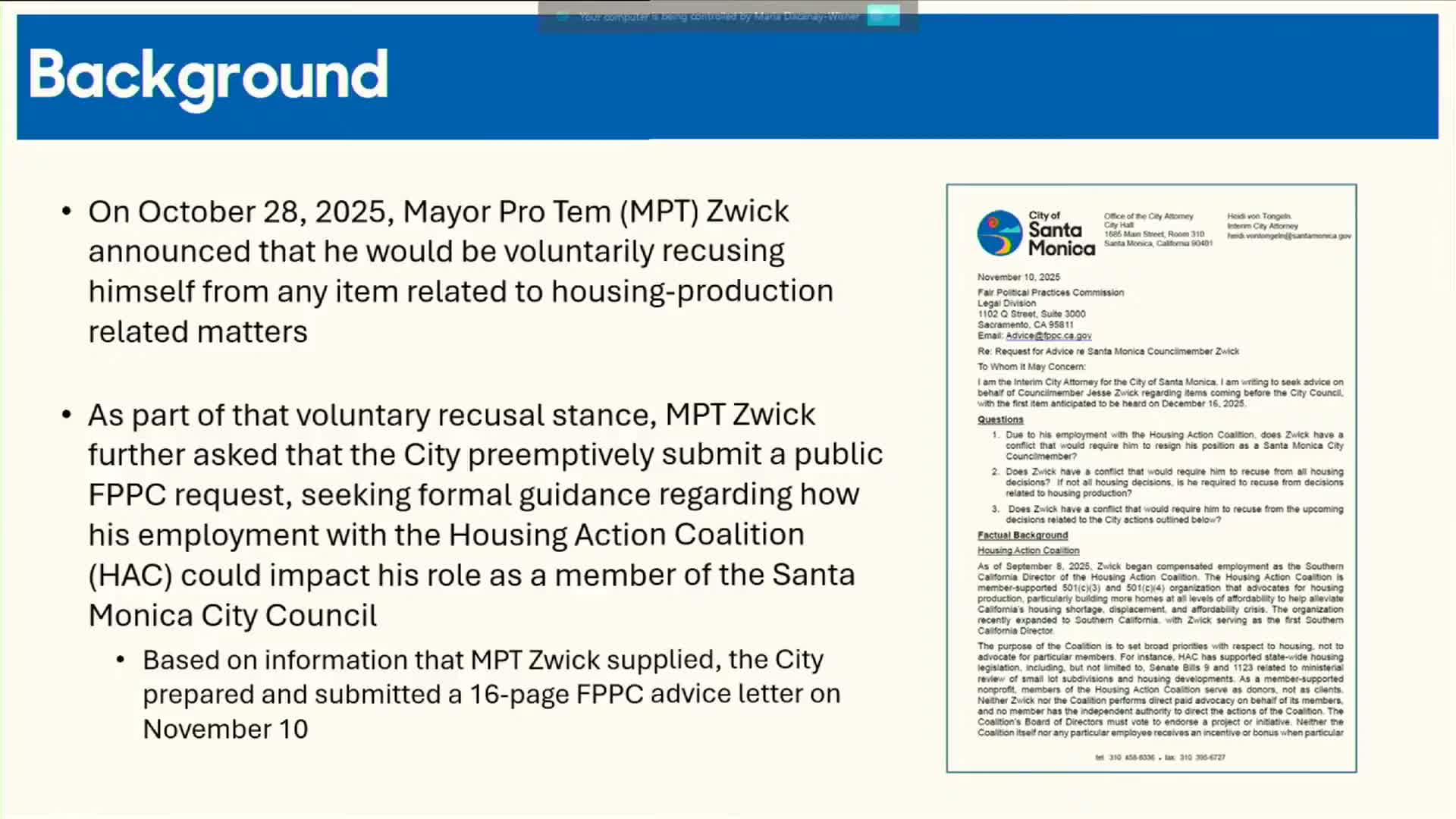
Summary
After receiving FPPC advice about prospective recusal for housing-production items, the Santa Monica City Council voted to repeal an emergency interim zoning ordinance and sent a planning-process ROI to staff and the planning commission to evaluate how to implement state housing laws locally, while ratifying the city’s building code to avoid permitting disruptions.
Mayor Caroline Turosas opened Tuesday’s meeting by telling residents the council had read thousands of emails and that staff, led by the city attorney, had reviewed items that could fall within newly issued guidance from the Fair Political Practices Commission (FPPC).
The FPPC had advised that Mayor Pro Tem Jesse Zwick should prospectively recuse from “housing production”-related matters after the city submitted a factual outline of his contacts with the Housing Action Coalition and his subsequent employment there, staff said. The FPPC did not find past violations or require resignation, but determined Zwick should recuse going forward from certain housing-production decisions, the interim city attorney told the council.
City staff presented a list of five prior policy approvals that fell inside the FPPC’s time window (Aug. 12–Oct. 28) and could affect housing production: an ROI (resolution of intention) addressing SB 9, SB 450 and SB 11/23; adoption of an administrative single-stair procedure; adoption and submittal of the local building standards to the state; amendment/extension of the Affordable Housing Production Program (AHPP); and an emergency interim zoning ordinance (EIZO) implementing SB 11/23 locally.
Staff recommended the council reratify the building code adoption (to avoid disrupting permit processing after the state-effective date) but to revote, rescind, or give fresh direction on the other items.
After extended discussion and multiple substitute motions, the council voted to repeal the city’s SB 11/23 emergency interim zoning ordinance and to direct staff and the planning commission to begin a public ROI process that examines how the city will implement SB 9, SB 450 and SB 11/23 locally. That ROI will include analysis of options and tradeoffs, including ways to encourage family-sized units, examine affordability contributions or exemptions by project size, and consider whether certain local standards should be aligned with or remain more expansive than state law.
Mayor Turosas and several councilmembers emphasized that the intent was not to undo state law; rather the ROI is meant to clarify how the city will implement state requirements and to determine whether any local regulations should be adjusted to secure affordable housing outcomes.
The council asked staff to report back on any additional items discovered in the attorney’s ongoing review, and staff said it would do so if further items warranted reconsideration.
What happens next: staff will prepare an ROI and materials for the planning commission’s public review; the planning commission will hold public hearings and make recommendations back to the council, which will make any final code changes or policy decisions.