Get Full Government Meeting Transcripts, Videos, & Alerts Forever!
Get email alerts on the Water Policy topic
No spam. Unsubscribe anytime.
Cottonwood Heights planning commission tables water‑use chapter, asks for edits and utility coordination
Summary
The Planning Commission reviewed a draft 'Water Use and Preservation' chapter, debated land‑use levers versus education, and voted to table formal adoption to the Jan. 7, 2026 meeting for further edits and proper noticing.
Cottonwood Heights Planning Commission members reviewed a draft "Water Use and Preservation" element of the city's general plan and voted to table formal adoption until the Jan. 7, 2026 planning commission meeting to allow staff to revise language and fix a noticing issue.
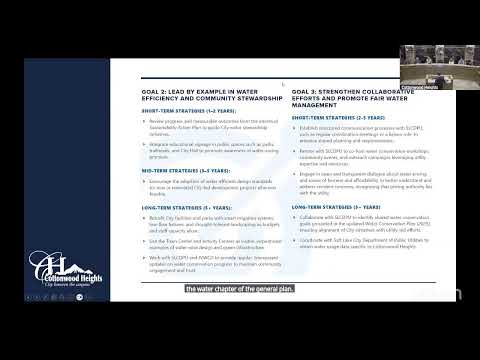
The draft, presented by a planning consultant, outlines state expectations for municipal general plans and four local goals: community education and outreach; leading by example on efficiency; strengthening collaborative water management; and integrating conservation into land development. The presenter said the draft "was shared with the state, and they did return back their approval of this draft that had met their requirements." Commissioners were asked to focus on whether they agreed with the goals and the short‑, mid‑ and long‑term strategies tied to them.
The discussion centered on two recurring tensions: how much the city can or should influence water outcomes through land‑use rules and how much should rely on education and incentives. Commissioner Shelton disputed the plan's emphasis on population growth, saying, "Our population is smaller than it was 10 years ago," and cautioned against over‑relying on growth assumptions when crafting conservation measures. He asked commissioners to be careful that language on integrating conservation into land development not be read as introducing broad, enforceable mandates on private property.
Planning staff and other commissioners described an approach focused on targeted changes for new development and redevelopment rather than retrofitting existing houses. As an example of the kind of technical change staff would examine, planning staff noted that in some commercial zones "if you're adjacent to any type of residential use, we require a 15 foot landscape buffer around the property," and suggested that a wall could be considered as an alternative buffer that would reduce irrigation demand for new projects.
Commissioners also raised technical and equity questions. One commissioner asked how local hydrology affects whether outdoor watering is truly "wasted water," noting that in some neighborhoods water seeps back into creeks while in others excess irrigation is lost to deeper groundwater. Staff said the chapter's education and outreach elements would include user‑friendly tools to help residents understand local conditions and proper water‑saving practices.
Several commissioners pressed staff to improve interagency coordination. Commissioners and staff agreed the city has had limited engagement with Salt Lake City Public Utilities; staff reported that their interviews with the utility found the utility "open to having conversation," and commissioners suggested assigning a city liaison or pursuing representation so Cottonwood Heights has "a seat at the table" on regional decisions that affect the city.
On process, staff said the suggested edits appear to be primarily textual and strategic and could be refined and returned to the commission with a public hearing and a recommendation to the city council. Planning staff also said they would inform the Department of Natural Resources about a noticing deficiency; staff said the draft is effectively complete but "formally can't be adopted until January" because of the noticing timeline.
Chair moved to table the water chapter to the Jan. 7, 2026 planning commission meeting; the motion carried by voice vote. The commission then approved the consent agenda (planning commission minutes from Nov. 5, 2025) and adjourned.
Next steps: staff will revise the chapter to reflect commissioner edits, prepare a public‑hearing notice, pursue outreach/liaison options with Salt Lake City Public Utilities, and return a revised draft to the commission on Jan. 7, 2026.