Get Full Government Meeting Transcripts, Videos, & Alerts Forever!
Get email alerts on the General Plan Water topic
No spam. Unsubscribe anytime.
Commissioners press for more data as Cottonwood Heights reviews general plan water chapter
Summary
Planning consultants presented the water chapter; commissioners raised that Salt Lake Public Utilities aggregates data, leaving the city unable to measure local per-capita water use precisely and pushed for education-based strategies and a possible goal to seek representation in regional water governance.
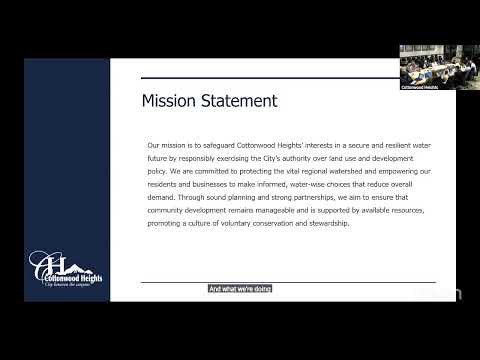
Sam of Landmark Design (lead consultant) walked the commission through the draft water element of the general plan and the mission statement language about protecting the watershed. Commissioners sought clarity on whether "protecting the watershed" was meant as riparian protection, stormwater management or regional resource stewardship; Sam said the intent combined pollution prevention, stormwater practices and development standards aimed at preserving long-term availability.
A recurring concern was data. Commissioners noted the city does not control the water system and that Salt Lake Public Utilities aggregates customer data across its service area. Sam said the draft used numbers from the utility’s draft master plan but acknowledged staff lacked granular, city-specific usage breakdowns. Speaker 3 summarized the problem: "we don't have the data... We've asked for it, but we just don't have that access to that data." Commissioners voiced skepticism about meeting system-wide per-capita targets without better metrics.
Staff referenced a trajectory graphic showing 179 gallons per capita per day (GPCD) with a target of 146 GPCD drawn from the utility's goals. Commissioners discussed whether the city’s role should be to mandate reductions or to educate and facilitate conservation; several favored education and municipal example-setting (tracking city-owned property water use) rather than imposing mandates absent enforcement authority and granular data.
Commissioners also discussed governance and representation: several argued Cottonwood Heights lacks a meaningful seat in regional utility decision-making and could consider legislative or intergovernmental strategies to pursue representation or oversight. The commission directed staff to refine the water element text to clarify watershed language, continue seeking utility data, emphasize education and municipal tracking, and consider whether a strategy to pursue representation should be included in the general plan.
Ending: Commissioners approved a motion directing staff to proceed with drafting and follow-up; staff will produce a revised water element that clarifies language, documents data requests, and outlines suggested next steps for municipal tracking and intergovernmental outreach.