Get Full Government Meeting Transcripts, Videos, & Alerts Forever!
Get email alerts on the Tree Preservation Code topic
No spam. Unsubscribe anytime.
Bend staff propose narrow edits to tree preservation code after one year of implementation
Summary
City planning staff presented a narrow package of amendments to Bend’s tree preservation code after a year of implementation, citing preliminary data from 766 applications (55 subject to standards), options developers used, mitigation outcomes and the use of fee-in-lieu funds to support an urban canopy plan.
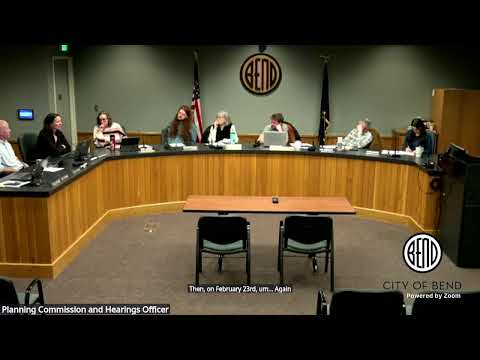
City planning staff presented a one-year review of Bend’s tree preservation code at a Jan. 12 Planning Commission work session and proposed narrow amendments intended to clarify implementation and add limited flexibility.
Pauline, a city planning staffer, told commissioners the tree code adopted Aug. 16, 2024, distinguishes “regulated trees” (measured at 4½ feet and 6 inches or greater) and larger “priority trees” (20 inches DBH). The code gives developers three compliance options: preserve at least 20% of priority trees (Option 1); preserve 25% of the total DBH of regulated trees (Option 2); or preserve as little as 5% of DBH and mitigate the shortfall (Option 3). Where preservation is infeasible, mitigation can be on-site tree replacement or a payment in lieu set at $600 per required replacement tree.
Using data from Aug. 16, 2024–Sept. 30, 2025, staff reported 766 applications touched by the code during that window; 711 were exempt (mostly single‑dwelling or small middle‑housing projects), while 55 required tree‑preservation review. Of those 55, staff said 3 proposed preserving priority trees only; 6 proposed the 25% regulated‑DBH path; 17 preserved both priority and DBH thresholds; 9 preserved at least 5% and mitigated; 2 used discretionary tracks; and 1 proposed mitigation only. Staff said those projects will result in about 1,160 new trees planted on 13 project sites and roughly $111,000 in fees assessed to date.
Pauline gave a concrete example of a dense multiunit development on about 17 acres with total regulated DBH of 2,729 inches. To meet the 25% DBH standard the site would have needed to preserve 683 inches; the applicant preserved roughly 5.5% (152 inches), leaving 531 inches to mitigate, which staff calculated as about 104 required replacement trees or $62,400 if paid in lieu.
“Because this is such a short time frame of data being collected, it’s still too early to make significant changes to the code,” Pauline said, and staff recommended a narrow set of clarifications and limited new exemptions so data collection can continue.
Key proposed changes include three additional exemptions tied to small parcels and certain land‑division configurations; allowing deferred planting of replacement trees for up to eight months when weather or species availability requires delay; and adding a discretionary track for root protection zone adjustments. Under the proposed discretionary path, the city’s urban forester would be able to review site‑specific requests to alter the root protection zone when the strict, clear‑and‑objective metric would otherwise prevent preservation of a large tree. Staff said recommended encroachments would not exceed 25% without added mitigation measures and on‑site ISA‑certified arborist supervision.
Commissioners asked whether developers were using code incentives (reduced setbacks, increased lot coverage) to preserve trees; Pauline said staff would do a better job advertising available incentives. Commissioners also asked how payment‑in‑lieu funds would be used; staff and Ian Gray, the city’s urban forester (introduced later in the meeting), said the fees are intended to fund urban canopy planning, maintenance and planting citywide and that Ian will prepare an urban canopy plan to direct those funds.
Commissioners pressed on monitoring and effectiveness: because many mitigation plantings and fencing requirements are only now entering construction, staff said it will take multiple years to assess survival and fencing efficacy. Fire‑safety and defensible‑space questions were raised; staff said the tree preservation code and defensible‑space requirements are not mutually exclusive and that, where conflict exists, mitigation tracks are available and the fire marshal has been consulted.
Public hearings are scheduled: the Planning Commission public hearing is set for Jan. 26, and the City Council public hearing and first reading is scheduled for March 4; staff will accept emailed comments and written submissions for the record. The commission did not take a vote on the amendments at the work session.
Next steps: staff will publish clearer information about incentives on the city website, the urban forester will develop an urban canopy plan to guide fee spending, and staff will return with the public‑hearing record and the council’s March review.