Water advisory group reviews five-year data and modeling for conservation measures
Loading...
Summary
Utility staff presented 2021–25 implementation results and updated modeling for Bend’s water-conservation programs, highlighted right-of-way landscape code changes adopted Nov. 1, 2024, and outlined next steps to refine program design before submitting the WMCP to the state.
Dan, a water utility staff member, opened the conservation update by describing new monitoring and how staff are using it to refine program assumptions and targeting.
The presentation said the utility added five ET/weather stations and joined the AgriVet network to improve weather and irrigation data collection. Dan reviewed the history of the conservation measures: staff narrowed a longer list into a set of modeled measures (program C) that were finalized in 2020 and rolled out in 2021. He told the advisory group the utility had implemented 10 of the modeled measures and prioritized two others for later rollout.
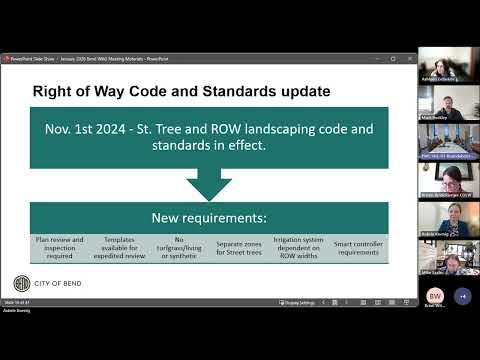
The presentation walked through a suite of implementation changes tied to the city’s right-of-way landscape code, which staff said went live on November 1, 2024. Under the new code, right-of-way plans must be submitted and reviewed; cool-season grasses and synthetic turf are not permitted in the right-of-way; separate irrigation zones are required for street trees; and smart controllers that link to weather data are explicitly encouraged. Dan said the utility created pre-approved templates and expedited review processes to ease developer compliance.
Staff summarized near-term metrics and field observations. Since Nov. 1 the utility recorded 399 plan-review and inspection actions, Dan said, with initial failures largely tied to missing information and misunderstandings about the code. He described enforcement work in one neighborhood where retroactive turf removal and irrigation conversion were required. Cost inputs from contractors varied, he said, and the utility is still refining what the typical additional cost for a lot will be.
On modeling, Dan said the team is rerunning projections using actual participation and production data, clarifying savings-per-participant and normalizing savings by unit type. The updated model uses shorter “measure lives” for many items (Dan noted staff are modeling a 12-year measure life in some cases rather than assuming permanent savings) and will test additional measures — including potential graywater options — in a Program D scenario. He emphasized the difficulty of attributing savings to specific measures because growth patterns, building types (a shift from single-family to multifamily), weather and customer behavior all affect outcomes.
Dan pointed to one headline takeaway: the utility’s actual production to date is lower than the 2020 projection, with staff noting roughly 863,000,000 fewer gallons produced this year than originally projected. He also recapped the long-range reduction goal that framed the original plan: 7,900,000,000 gallons over 20 years, which he said is a planning target rather than a regulatory mandate.
Advisory members asked whether the model accounts for rate impacts (it does not — staff said rate modeling is being done separately) and whether production data are calibrated to consumption (staff said the presentation used production data and that consumption graphs are available elsewhere). Dan said follow-up inspections and audits are important because initial checks show only about 40% of rebated smart controllers were programmed correctly.
Next steps the utility described include pausing to refine model inputs using the new monitoring and participation information, evaluating admin costs and enforcement tradeoffs, and returning to the advisory group with refined scenarios before finalizing the Water Management Conservation Plan (WMCP) and presenting it to City Council prior to the state submission deadline staff cited as October. The group did not take any formal votes during the update.