
Land Access and Opportunity Board urges cautious rollout of Act 181, requests $3 million to launch programs
Get AI-powered insights, summaries, and transcripts
Subscribe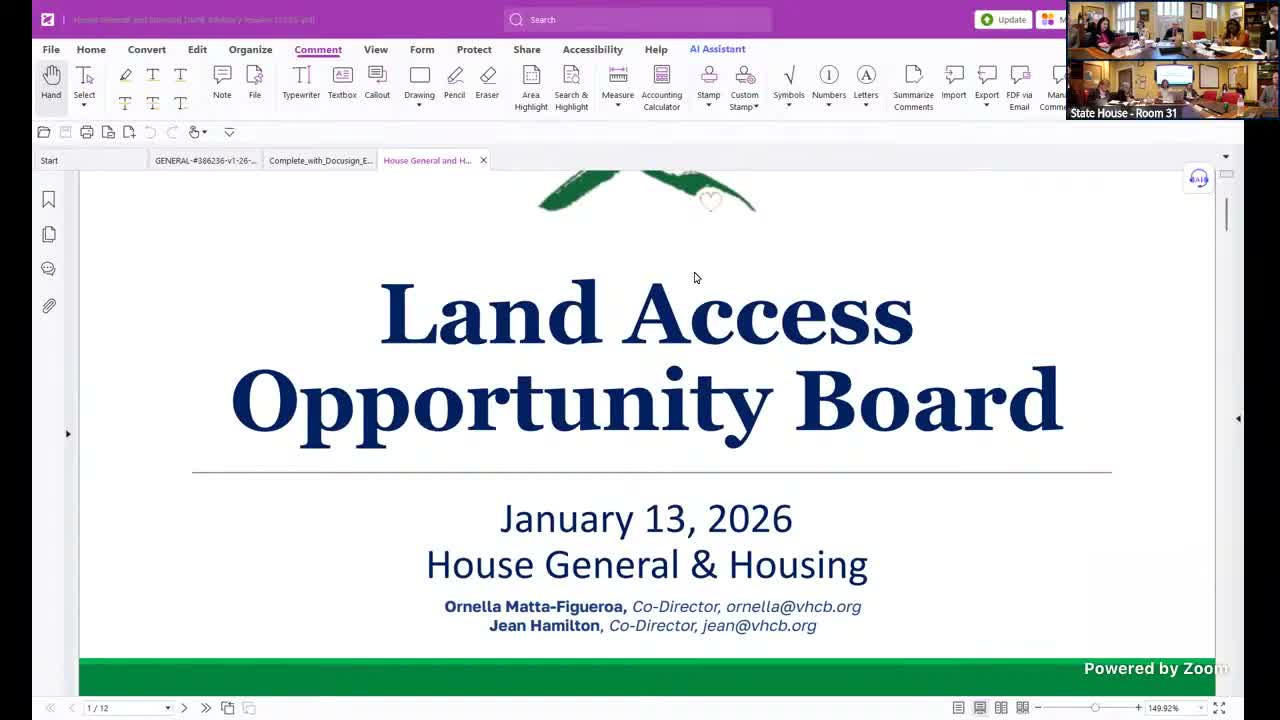
Summary
At a House Committee on General and Housing hearing, the Land Access and Opportunity Board outlined its advisory and grantmaking role, asked for $3 million to expand programs, and urged lawmakers to slow implementation of Act 181 to study rural and food‑land impacts.
The Land Access and Opportunity Board told the House Committee on General and Housing that it is asking lawmakers for $3,000,000 to expand programs that address disparities in land and homeownership and urged a slower rollout of Act 181 to protect rural communities and access to food lands.
For the record, Anna Matatiroa, co‑director of the Land Access and Opportunity Board, said the board combines advisory powers and grantmaking authority to identify system bottlenecks and recommend changes rather than build a parallel housing system. Matatiroa described LAOB as "a strategic effective investment in Vermont systems" and said the board seeks funding to translate those recommendations into programs that serve marginalized communities.
Jean Hamilton, the board's other co‑director, told the committee the board's priorities include low‑income Vermonters, people with disabilities, LGBTQIA Vermonters, immigrants, people of color, and "psychiatric survivors," a term the board defined as people who have received psychiatric care or who live with mental illness. Hamilton said LAOB's statute names 12 appointing organizations and that the board comprises roughly 24 members.
Hamilton described LAOB's recent budget history: the board received a base appropriation of $1.63 million, carried forward about $1.35 million from prior appropriations, and operated this year with roughly $2.0 million after a $1.0 million reversion that the administration later included in its recommendation; the board is requesting $3.0 million for the coming year. "FY 26 was our program launch year," Hamilton said, explaining the mix of base, carryforward, and requested funding to scale programs.
On policy, Hamilton urged the committee to "slow down the rollout of 181" so state and local leaders can assess rural economic effects and municipal capacity. She expressed concern that a tiered implementation could, in practice, create permitting requirements similar to Act 250 for single‑family homes in some areas: "We need to understand what's happening to the rural economy with these changes," she said.
Hamilton also raised a separate but related concern about food‑land access following a recent Vermont Supreme Court ruling that she said "has now allowed for zoning to zone out agriculture," enabling municipalities to regulate where agriculture occurs. She argued that if zoning pushes agriculture out of growth and downtown areas, residents who lack cars or transit access could lose the ability to grow food near where they live. Hamilton recommended a state‑led mapping exercise to quantify community food‑land needs and incorporate those layers into growth‑area planning.
Matatiroa described how LAOB exercises its advisory powers: working groups, one‑on‑one consultations with agencies and regional planning commissions, contracted facilitation, community case studies, and formal memos to inform system upgrades. She said some convenings are held as open board meetings subject to open meeting laws when board members are paid stipends to attend, while other community gatherings have been held outside formal posting.
A committee member asked for clarification on the term "psychiatric survivor," and Hamilton defined it in testimony as people who have participated in psychiatric care or who live with mental illness. In response to a public comment, a participant named Debbie pointed to local zoning work in Concord, Vermont, as a model where housing integrates on‑site gardens.
The committee did not take any formal votes during this hearing. The chair closed the session, noted upcoming bill review work and deadlines, and said the committee will hear from the Vermont Natural Resources Council at the next meeting.
Next steps: committee members will review bills and deadlines in the coming week and may invite LAOB back for deeper discussion on Act 181 implementation and the board's program plans.