Get Full Government Meeting Transcripts, Videos, & Alerts Forever!
Get email alerts on the Sunshine Complaints topic
No spam. Unsubscribe anytime.
Commission split over Sunshine Law appeals, minutes and meeting conduct; OIP guidance sought
Summary
A series of Sunshine Law appeals and public-record requests prompted split votes and heated debate over meeting minutes, the chair's discretion to mute or remove speakers, and whether the deputy attorney general's draft responses should be authorized — several draft responses failed to gain the commission's approval.
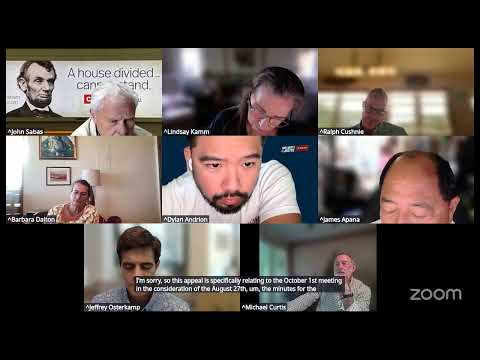
The commission considered multiple appeals under Hawaii's Sunshine Law and public-record statutes alleging violations that included denial of public testimony on agenda items, selective distribution of documents to commissioners, and ejection or muting of a commissioner during deliberations. The deputy attorney general submitted draft responses to several appeals; commissioners repeatedly split on whether to authorize those drafts.
Key dispute areas included: whether the chair properly removed or muted a commissioner during a meeting when that commissioner sought to appeal a chair ruling; whether proposed additions to meeting minutes should have been recorded (the statute requires minutes to include the substance of matters discussed and any information a commissioner requests to be included); and whether sharing documents with a single commissioner instead of the full body constituted an improper narrowing of public access.
The deputy attorney general advised that the Sunshine Law does not prescribe the content of a board packet and that, where a board packet is prepared, it must simply be made available to the public. He summarized draft responses that found no Sunshine Law violation in a number of the appealed actions, while acknowledging at least one instance where public testimony was not taken in the meeting where a matter was first discussed and recommending the harm was mitigated when testimony and deliberation occurred at a subsequent meeting.
Commissioners and numerous public testifiers pushed for greater transparency and for formal acknowledgement of procedural mistakes. Multiple votes on whether to authorize the DAG's drafted responses failed; commissioners discussed referring matters to OIP (the Office of Information Practices) and the State Auditor, and several members recommended formal Sunshine Law training for commissioners and staff.