
County work session reviews driveway policy, debates who pays for culverts
Get AI-powered insights, summaries, and transcripts
Subscribe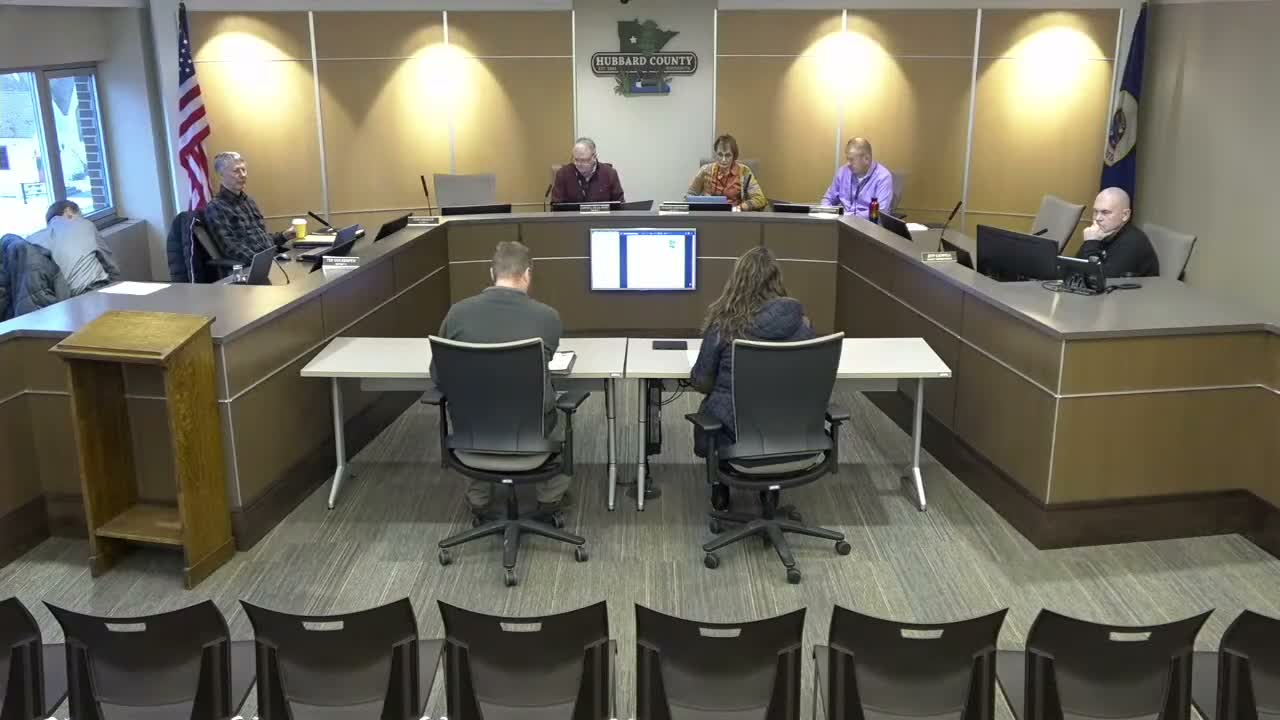
Summary
At a Hubbard County work session, staff presented a draft driveway and entrance policy; board members pressed for clearer ordinance language, cost figures for culverts and permit fees, and a redlined draft for a February follow-up.
Speaker 3 presented a draft driveway and entrance policy at a Hubbard County work session, telling the board the draft and related ordinance materials were intended to reduce unnecessary access points and improve safety on county roads. "My goal is to minimize accesses into properties as much as I can because every access you add creates a turning movement, which creates a conflict point," Speaker 3 said.
The discussion centered on three practical questions: clarity and consistency with existing ordinance language, who furnishes and ultimately owns culverts used in driveway approaches, and whether the current $300 entrance application fee fairly reflects the county’s costs. Speaker 3 noted a discrepancy between a 48-hour notice in the draft and a 72-hour requirement in the ordinance and proposed changing the draft to match the ordinance.
Board members and staff described the current local practice as follows: the county charges a $300 nonrefundable entrance application fee and has been supplying culverts to applicants. Speaker 3 summarized the ordinance language (02/2002) they reviewed: the fee covers inspection and a culvert "if necessary," and the ordinance states culverts would be furnished by the county and remain county property. "Right now, we charge a $300 fee for our entrance applications, and then we provide the culvert to the land owner," Speaker 3 said.
Several members questioned whether the flat $300 fee is fair to applicants who do not require a culvert. "I'd rather see a lower permit fee with no culvert, and then if you have to buy a culvert, you have to buy an approved culvert," Speaker 4 said. Speaker 3 said $300 primarily covers staff time for site visits and permit processing and does not cover pipe material: "$300 does not cover the pipe at all. It covers more our time in terms of going out and doing the pipe, looking at the actual location." The board discussed alternatives used elsewhere, such as a base permit plus additional culvert charge or a retainer refundable after inspection.
Members also debated whether the county should furnish culverts to guarantee correct size and aprons. Speaker 5 argued county-supplied culverts avoid substandard private installations: "I think it would be important that we're furnished the covers are furnished by the county because then you can put in the right size with the right apron." Speaker 3 replied that private installs sometimes use plastic pipes she considers inadequate: "There's people are putting in plastic...I don't think they have the structural integrity that we would want in our ditches."
Technical details discussed included common culvert dimensions and installation: Speaker 3 estimated a typical installation is "a 30 foot 18 inch pipe with 2 aprons" and noted deeper ditches can require much longer pipe. Board members observed that diameter and material (for example, upsizing from 18-inch to 21-inch) can increase costs more than linear length, leading Speaker 3 to recommend pricing options be based on pipe size and material rather than solely on length.
The board also discussed ownership and maintenance responsibilities after installation. Speaker 3 reported current practice effectively leaves ongoing maintenance to property owners unless the county receives a complaint and inspects: "Once we deliver it and once they put it in, then we don't do anything necessarily with it unless we get a complaint." Speaker 7 recommended revising ordinance language (noting section 2.2) to clarify that if a larger-than-standard culvert is required, the applicant pays the additional cost only when that size is "required" rather than simply "requested," and suggested reviewing the entire ordinance through the public hearing process if substantive changes are needed.
ATV traffic and related damage to approaches and shoulders drew significant attention. Speaker 3 and others said ATVs and side-by-sides have increased wear: "They're running up. They're kicking the gravel off...we don't repair them because they're not our driveways." The board discussed mapping high-ATV corridors and considering grant-supported trail routing or allowing ATVs on certain shoulders at reduced speeds to concentrate traffic away from damaged approaches.
Practical next steps were agreed: Speaker 7 asked staff to produce a redlined ordinance and a redlined proposed policy, plus permit and culvert cost numbers, and return the item for further review at a February work session. Speaker 3 agreed to provide the requested numbers and revisions within about three weeks.
The session closed with routine announcements (township association meeting Jan. 26 and a proposed Board of Appeal and Equalization date in June) and a motion to adjourn, which passed.