
Police chief updates council on BCAT: team compressed by staffing shortfalls, handled thousands of crisis responses
Get AI-powered insights, summaries, and transcripts
Subscribe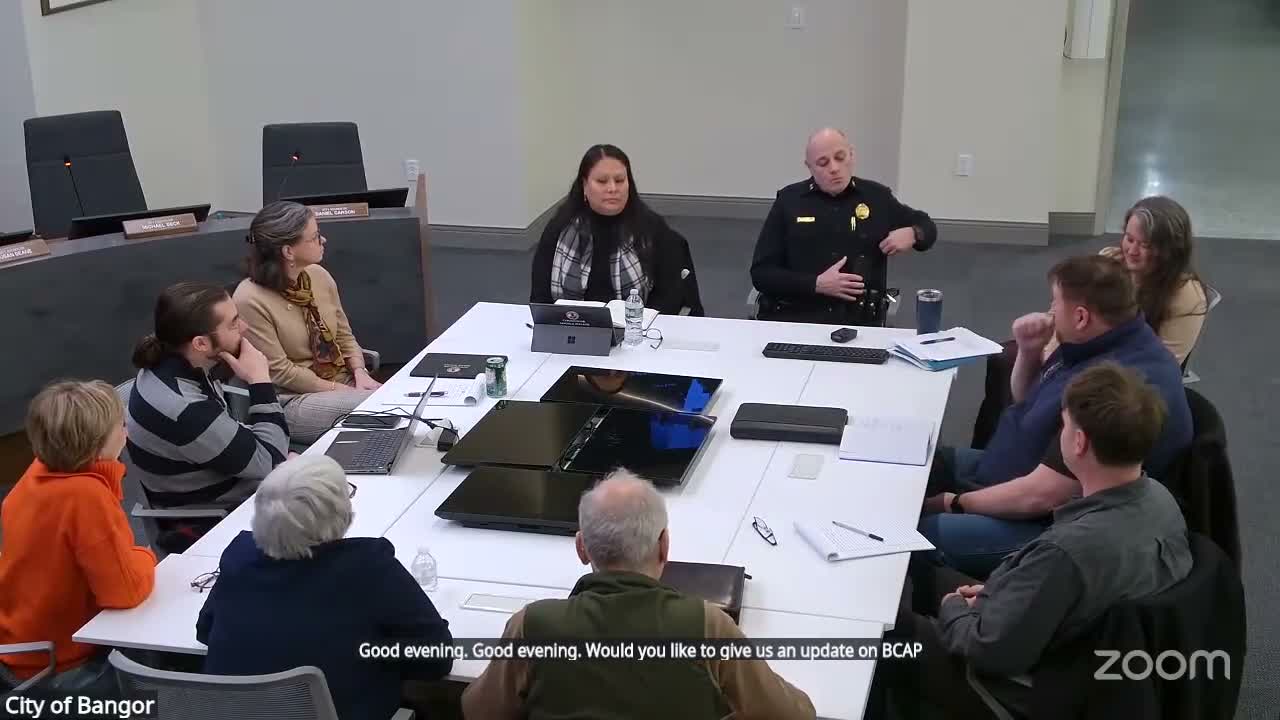
Summary
The police chief told the council BCAT (Bangor Community Action Team) was created in 2023 as a non-police crisis response; the team is under-staffed (two of an intended four), handled about 1,800 BCAT responses in 2025 and the department estimates 20–33% of daily calls relate to the unsheltered population.
The Bangor police chief briefed the council on the Bangor Community Action Team (BCAT) during the Jan. 13 workshop, describing BCAT as an alternate-response model intended to pair specialized responders with people in crisis rather than a uniform police response.
BCAT’s purpose and origins: Formed in 2023 and modeled on West Coast programs, BCAT was designed for welfare checks, behavioral-health crises and other situations where a non-police or de-escalatory approach is appropriate. “BCAT stands for Bangor Community Action Team,” the chief said, and the program works closely with public-health staff, EMS, hospitals, shelter managers and outreach partners.
Workload and staffing: The chief said BCAT has never operated with a full four-person core; staffing has been a recurring challenge and turnover high. He reported BCAT responded to just over 1,800 calls in 2025 and that, across the whole department, dispatch handled roughly 36,000 calls last year. The chief estimated that about 20% of daily calls relate directly to the unsheltered population, and that including mental-health and substance-use calls could raise that share to about one-third.
Training and model: The chief contrasted BCAT training with police academy timelines: a police academy plus field training is about a year, while BCAT-specific training modules could prepare a BCAT responder in months (the chief estimated a full BCAT responder could be trained in roughly six months). The intended BCAT response model is two-person teams with radio support from patrol when necessary.
Integration with HMIS and outreach: Council members asked whether BCAT officers could serve as HMIS entry points. Gunderman said the city’s outreach person currently performs HMIS entry and that BCAT could be trained to enter or hand off clients to the Hub 7 coordinator for assessment and placement.
Budget and next steps: The chief said background checks were under way for two potential hires and expressed optimism about returning to fuller staffing; council members discussed BCAT staffing levels during budget planning. No formal staffing changes or budget approvals were made at the workshop.
The chief’s presentation underscored how caseloads tied to unsheltered-population needs have stretched BCAT and other community-facing units and framed staffing and training as priorities for upcoming budget discussions.