
Eugene Planning Commission recommends staffs version 4 of public health standards code amendment after split vote
Get AI-powered insights, summaries, and transcripts
Subscribe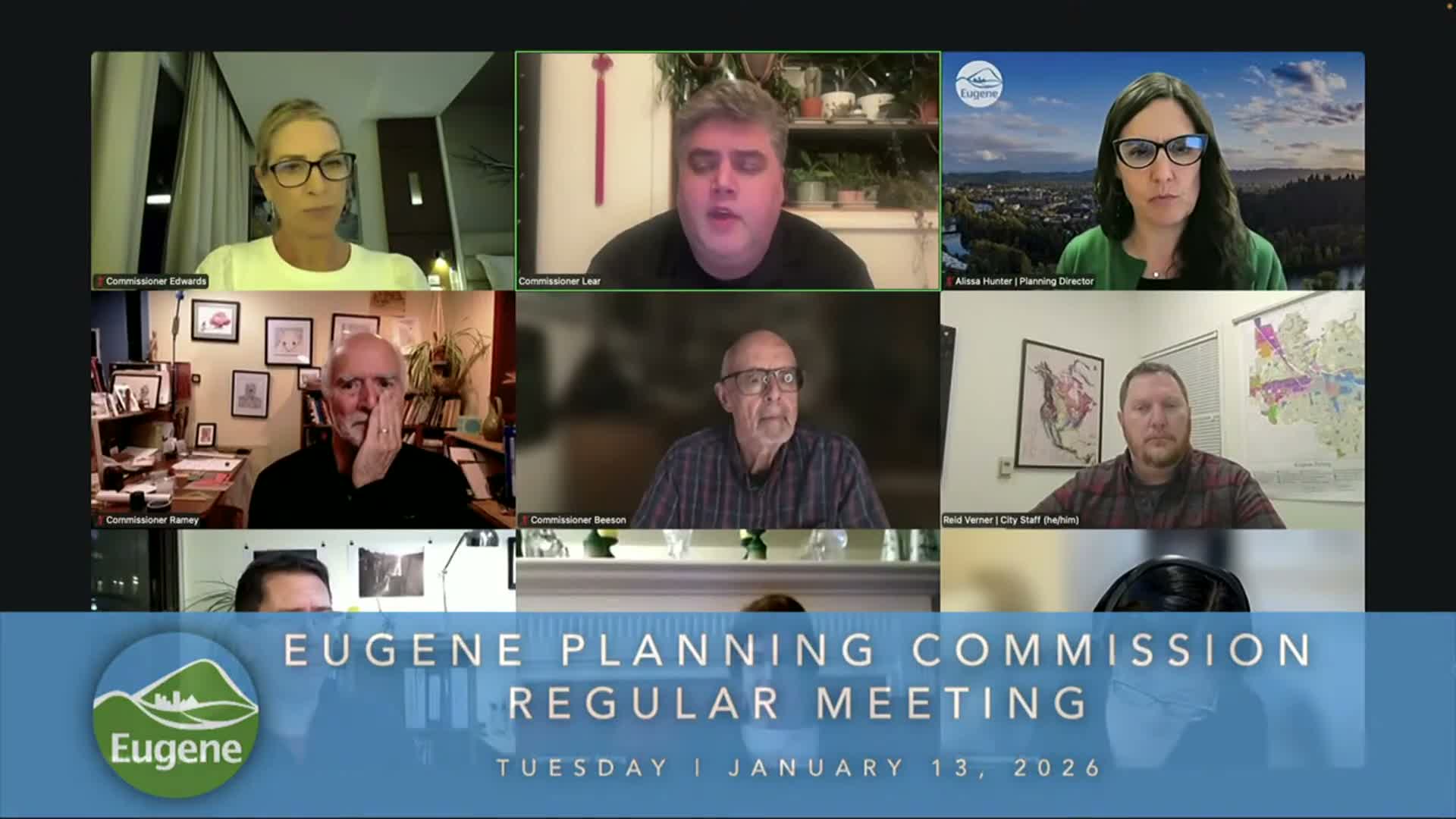
Summary
After extended deliberations on applicant responsibilities and regulatory coordination, the Eugene Planning Commission voted 4-3 to recommend version 4 of the public health standards land use code amendment (City file CA 2503) to the City Council and asked staff to draft a letter capturing majority and minority positions for the council packet.
The Eugene Planning Commission voted 4-3 on Jan. 13, 2026, to recommend that the Eugene City Council consider version 4 of the proposed public health standards land use code amendments (City file CA 2503), following more than an hour of deliberations about whether applicants or the city should shoulder the burden of coordinating with state and federal environmental regulators.
Reid Verner, the citys land use supervisor with Building and Permits Services, told the commission that version 4 "removes any requirements for applicants submitting development permits to identify and attest to needed regulatory permits" and instead directs the city to send notice of certain development permit applications to the Environmental Protection Agency, the Oregon Department of Environmental Quality and the Lane Regional Air Protection Agency. Verner said staff was also offering version 3 as an alternative; staff recommended version 3 in writing but provided draft motion language for recommending version 4 per the planning commissions December direction.
Commissioners framed their debate around two central questions: how closely the planning commission should try to implement explicit City Council direction from June 2025, and how to balance protections for residents near industrial zones with the administrative burden on applicants, particularly small businesses. Commissioner Beeson urged the commission to support version 3, citing the council motion and a review of permit activity, saying "there are less than 10 building permits of the type we are talking about issued in a given year in the city of Eugene." Beeson argued version 3 better implements council direction and helps put relevant permitting information on the public record sooner.
Opponents of requiring applicant attestations, including Commissioner Edwards and others, said the council's original wording was not workable in practice because some environmental permits depend on details (such as specific equipment) that are determined after land-use approvals. They and other supporters of version 4 argued that having the city notify regulatory agencies about applications would inform regulators without imposing an upfront, potentially infeasible requirement on applicants.
A procedural amendment offered by Commissioner Beeson to substitute version 3 for version 4 was seconded and put to a vote; the amendment failed 3-4. The main motion to recommend version 4 then passed 4-3. The commission recorded the outcomes verbally during the meeting; the chair announced both the substitute vote (3-4) and the final recommendation (4-3).
Following the recommendation vote, commissioners asked staff to prepare a short letter for the City Council packet that would capture both the majoritys rationale and the minoritys concerns. Commissioner Ramey moved that the chair and vice chair work with staff to prepare the letter; the commission approved proceeding with staff drafting and delegated review to the chair and vice chair so the material could be ready for the council hearing schedule.
The commission also clarified next steps: staff will forward the recommendation and the draft materials to the City Council for a public hearing tentatively scheduled for Feb. 17, 2026. Staff reminded commissioners of upcoming urban growth strategy meetings and recruitment for boards and commissions. The meeting adjourned after staff and commissioners finalized the delegation for the council letter.
The commissions deliberations highlighted tradeoffs between stricter applicant requirements that some argued would better enforce the councils intent and a more permissive city-notice approach designed to avoid practical permitting sequence problems. Commissioners repeatedly emphasized concerns about impacts on small businesses and the need to center affected residents voices in future implementation steps.