
NDOT unveils traffic‑calming concept for Morewood Drive; neighbors to decide by mailed/online ballot
Get AI-powered insights, summaries, and transcripts
Subscribe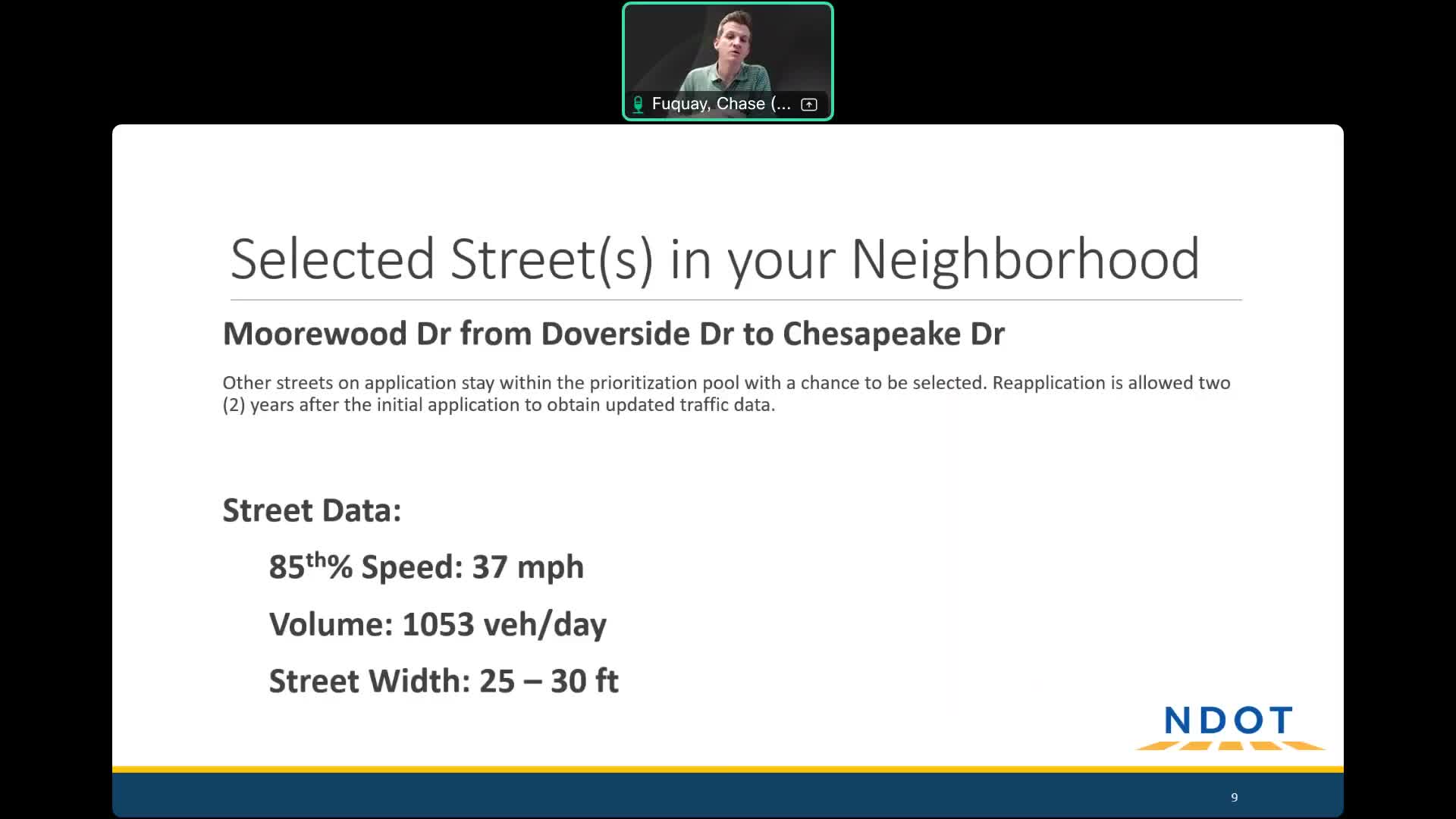
Summary
Nashville Department of Transportation staff presented a proposal for speed cushions, a bulb‑out and lane‑narrowing on Morewood Drive, citing an 85th‑percentile speed of about 37 mph and daily volumes just over 1,000 vehicles. The design will go to a mailed/online ballot for adjacent property owners; approval requires two‑thirds yes votes.
Nashville Department of Transportation engineer Chase Peekway presented a preliminary traffic‑calming plan for Morewood Drive during a recorded neighborhood meeting, saying the proposal aims to reduce vehicle speeds and improve safety on the residential corridor. "We're really in the engineering section of the 3 e's here," Peekway said, referring to education, enforcement and engineering.
Peekway said field data collected for the corridor show an 85th‑percentile speed of roughly 37 miles per hour and daily traffic volumes just over 1,000 vehicles. Those measures, together with roadway width (about 25–30 feet) and nearby pedestrian destinations, informed the concept design staff shared with the neighborhood.
Under the concept, staff proposed evenly spaced speed cushions along the corridor, a bulb‑out with pedestrian curb cuts at Rainwood Drive, one cushion near the Masonwood intersection and two cushions approaching the project terminal at Riverside to align spacing with existing cushions south of Bartlett Parkway. The plan also includes corridor‑wide lane narrowing and consideration of sidewalks where they already exist. Peekway described speed cushions as "the most common tool used in the [traffic calming] program" because they have a demonstrated effect on average and 85th‑percentile speeds.
NDOT staff reviewed alternative measures that may be used where cushions are infeasible, including radar speed feedback signs, visual lane narrowing through edge striping, mold‑outs at intersections, and, in limited cases, chicanes or traffic circles. Peekway noted tradeoffs such as potential loss of on‑street parking and greater pavement requirements for some treatments.
Morewood Drive was selected as one of 25 streets in the fall 2025 cycle out of more than 700 applications citywide, Peekway said. The project follows a phased process: field verification of locations for physical measures, a second neighborhood meeting to gather in‑person feedback, and a mailed/online ballot for properties that abut the project corridor. Ballots will be mailed with a unique identifier and the online voting window is six weeks; if two‑thirds of returned ballots are "yes," the project will move to construction.
Peekway explained voter eligibility rules: each residential property owner, church and school directly abutting the ballot zone receives one vote; property owners with multiple parcels get one vote; vacant parcels, homeowner‑association parcels and city‑owned properties are not eligible; businesses are ineligible. Staff said they will validate the voter list before ballots are distributed and asked residents who believe they should receive a ballot but have not to contact NDOT.
The department encouraged further input through its traffic calming engagement page. "Please visit engage.nashville.gov/trafficcalming," Peekway said, and provided his contact information for validation or questions. If the neighborhood approves the project by ballot, NDOT said it will finalize plans and advance to construction in a later phase.
The presentation closed with staff saying a second neighborhood meeting will be scheduled to provide additional opportunity for local feedback and field verification.