Eugene requires EPDs for city concrete mixes as officials track recycled‑content gains
Loading...
Summary
City of Eugene staff told a committee the project team has adopted Environmental Product Declarations (EPDs) for concrete on capital projects, alongside requirements for 35% recycled asphalt content and a 30% minimum for SCMs in concrete; staff said EPD reporting became required in 2025 and suppliers are complying.
City of Eugene project staff said the city now requires Environmental Product Declarations for concrete mixes used on its capital projects and described concurrent requirements aimed at lowering embodied carbon.
Rachel Vicunas, one of three principal civil engineers in the City of Eugene Public Works Engineering capital project team, told the committee the team has moved multiple material‑policy changes into standard specifications. "We're getting these EPDs are now a requirement for all of our concrete mixes on our capital projects," Vicunas said, describing EPDs as third‑party, lifecycle‑based documents that report greenhouse‑gas impacts from raw materials through disposal.
Vicunas and Katie Marwitz, another principal civil engineer who oversees transportation projects, said the city previously adopted warm‑mix asphalt — which staff estimate reduced project CO2 emissions by about 20–35% — and requires reclaimed asphalt materials in city projects. "The City of Eugene currently requires 35% of recycled materials to be used in base and wearing courses of asphalt concrete pavement," Vicunas said, identifying reclaimed asphalt pavement and reclaimed asphalt shingles as the primary inputs.
On concrete, the presenters said the city requires a minimum of 30% supplementary cementitious materials (SCMs) — such as fly ash and blast‑furnace slag — to reduce the share of cement, which staff called the most carbon‑intensive component of concrete. Vicunas showed a supplier EPD example in which a 3,000‑psi mix reported a global‑warming‑potential value cited at about 170 (units shown on the supplier's EPD) against the city's specification threshold of 200 for that unit.
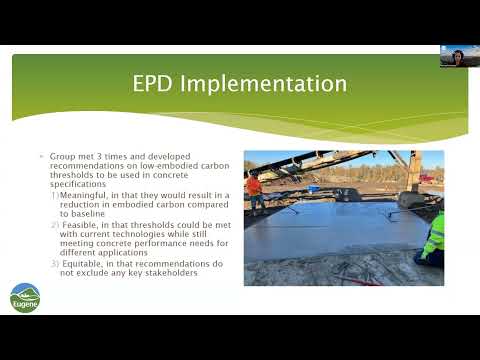
Staff described how a 2023 greenhouse‑gas threshold committee — including city divisions, Lane County materials lab staff, local suppliers Riverbend and Knife River, and Carbon Leadership Forum participants — developed regionally aligned thresholds using NRMCA Pacific Northwest benchmarks. Vicunas said the committee chose thresholds intended to be meaningful (to reduce embodied carbon), feasible (suppliers could meet them) and equitable (to avoid excluding local or small suppliers).
Commissioners asked whether these practices are accessible to smaller, homeowner‑scale projects. Katie Marwitz said small one‑off deliveries remain harder to source with EPD‑documented mixes, but as suppliers normalize reporting and some small suppliers source mixes from larger producers, the practice could become more widely available.
On performance, staff said acceptance testing focuses on strength and that higher SCM content can extend cure time, though tested mixes have met strength criteria; staff noted limited long‑term performance data and said they will continue to monitor results and pilot higher SCM mixes.
The presenters said suppliers have been submitting EPDs to the city's approved materials list on a recurring schedule and that the EPD requirement was formally implemented after a one‑year notice period: the committee recommended thresholds in 2023 and staff began requiring EPDs in 2025. Staff said they have not seen measurable material cost increases tied to EPD reporting and that early burdens were primarily administrative as the practice became routine.
The project team said next steps include continuing pilot pours with higher SCM content, continued engagement with local suppliers Riverbend and Knife River, and exploring further increases to recycled content in asphalt where feasible. The committee said staff will bring further scope and next‑step discussion to upcoming meetings and that presentation slides and the recorded meeting will be posted for public review.