
NDOT previews traffic-calming plan for Bay Cove Trail; residents press for circles and more radar signs
Get AI-powered insights, summaries, and transcripts
Subscribe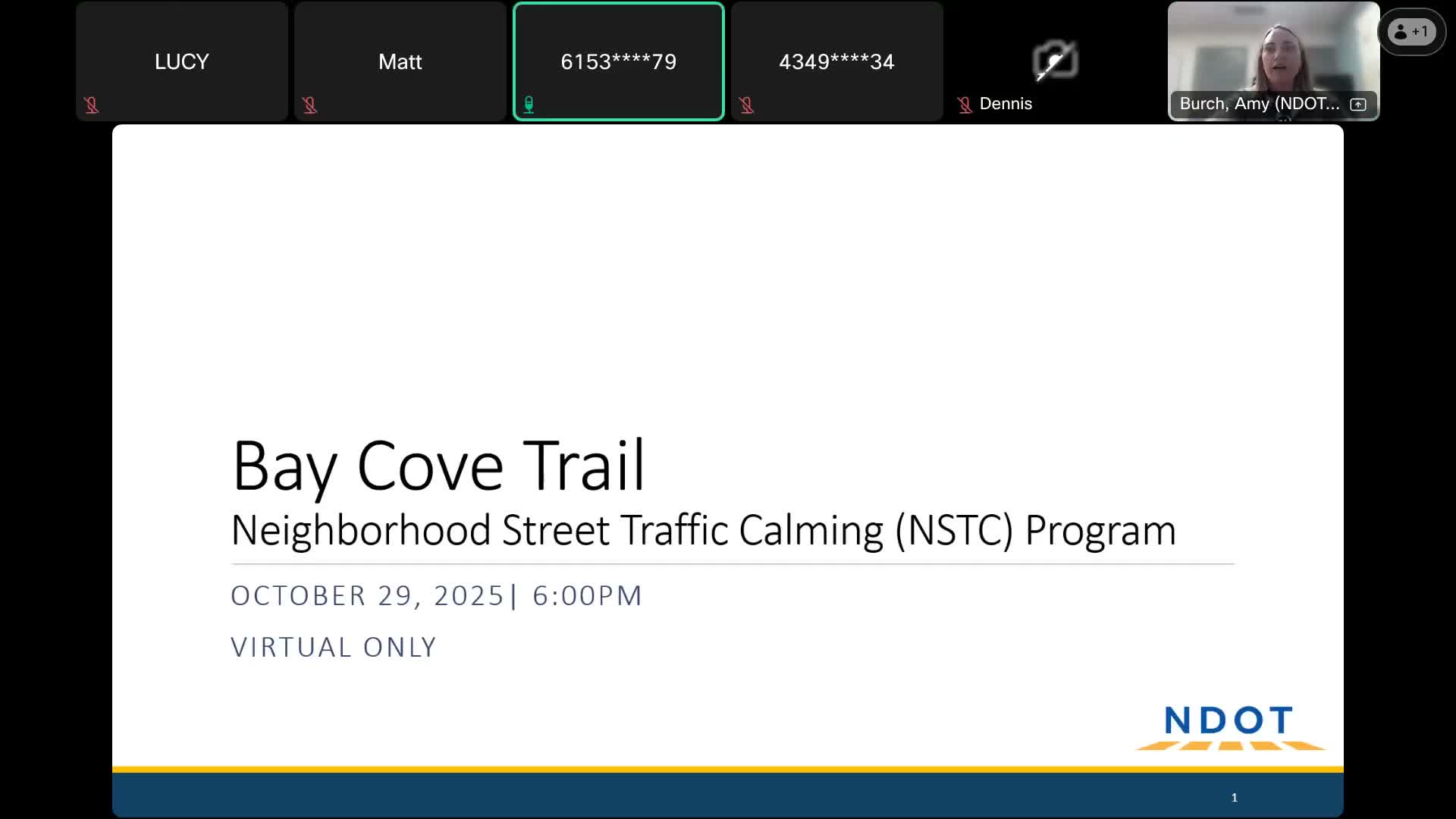
Summary
NDOT presented a preliminary traffic-calming plan for Bay Cove Trail after data showed an 80th‑percentile speed of 35 mph on a 25 mph street and roughly 1,200 vehicles per day. The plan includes speed cushions and radar feedback signs; residents urged traffic circles and treatments at a blind Rolling River intersection. A mailed ballot requiring 66% approval will decide vertical installations.
Amy Burch, a traffic engineer working with the Department of Transportation (NDOT), presented a preliminary traffic‑calming plan for Bay Cove Trail and detailed why the street was selected for the neighborhood program. NDOT measured an 80th‑percentile speed of 35 miles per hour on a street posted at 25 mph and said the segment carries about 1,200 vehicles per day.
NDOT framed the program as an engineering‑focused effort to slow speeds on residential streets as part of the city’s safety goals. Burch said the program uses a five‑criteria prioritization (vehicle speeds 45% weight; volume 25%; non‑driver accommodations 15%; vulnerable‑user crashes 10%; trip destinations) to rank applications; the city has received more than 600 requests and selects about 25 streets each six months.
On performance, Burch cited before‑and‑after NDOT data from prior cushion installations showing average speed reductions (from 31 to 22 mph) and 80th‑percentile improvements (37 to 25 mph). On data collection she said NDOT used tube counters over 24‑hour periods this spring to record speed, direction and classification. “I am a traffic engineer and consultant that works with NDOT,” Burch said when introducing the project; she later explained, “I am saying that 85% of the traffic we measured [is] going 35 miles per hour or below that.”
NDOT’s concept for Bay Cove Trail (the segment between Morton Mill Road and Rolling River Parkway) initially showed multiple sets of speed cushions placed according to typical spacing, an all‑way stop at Eller Drive, and radar feedback signs on downhill approaches where cushions are not suitable because of steep grades. Burch said cushions are modular rubber devices designed with gaps to reduce impacts on emergency vehicles and are usually installed with advisory 20 mph signage.
Residents pushed for alternatives and immediate action. One resident (Speaker 2) described repeated near misses and said, “I don’t want the blood of my family or the blood of someone else’s family to be on their hands by not taking some action.” Another resident highlighted a blind curve at the Rolling River Parkway intersection and urged a stop sign or other treatment there. Burch responded that NDOT must follow national guidance for stop signs and will review crash data, sight lines and field measurements to see whether markings, a median island, a bulb‑out or other treatments are more appropriate than an unwarranted stop sign.
Burch clarified how the neighborhood ballot works: NDOT mails a postcard with a unique ID to property owners abutting the right‑of‑way (residential properties, churches and schools get one vote). Voting is online via a QR code or web link, remains open six weeks, and a plan that proposes vertical measures such as cushions requires at least 66% favorable votes to proceed to construction; Burch said construction typically enters the queue about eight to 10 months after a successful ballot. “If 66% of the votes are favorable for the plan, then that plan moves forward into the construction period,” she said.
Because attendees expressed mixed views — some strongly opposed to cushions, others wanting action to reduce crash risk — NDOT proposed a revised concept for a follow‑up meeting: fewer cushions, additional radar feedback signs, and the possibility of a traffic circle at Blythe Court if field measurements show it will fit. Burch said NDOT will return with a detailed design showing house numbers, driveway locations and exact placement so residents can review the refined plan before voting.
NDOT stressed maintenance and reporting: cushions typically last many years but defects should be reported through Metro’s 311/hub system. Burch closed by saying NDOT expects to convene another neighborhood meeting in about two months to present the updated plan and then mail ballots.
Next steps: NDOT will perform field measurements of grades and sight lines, revise the concept to reflect resident feedback (fewer cushions, more radar signs, potential traffic circle), hold a second neighborhood meeting to review the design, and then mail ballots that require a two‑thirds favorable vote to install vertical measures.
Authorities and formal actions remain procedural at this stage; no ballot has occurred and no formal motion was taken at the meeting.